
Mecha · Interactive story
The Weight of the Chair: Command in the Age of Steel
The battlefield is a map, but the casualties are real. Command with cold precision.
Start as a guest. Choose your character before the story begins.
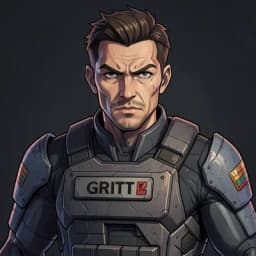
Meet the sample character
Command is a weight only the living feel.
Try a scene · No signup
Protocol 9
A short sample of this world. Your own version starts with your character.
You stare at the flickering holographic displays of the Vanguard-7. Your palms are slick with sweat, the smell of ozone and burnt hydraulic fluid thick in the air. Outside the blast-glass, the void is a chaotic scramble of tracer fire and exploding hulls. Miki’s pulse-readout is spiking; she is pushing her frame too hard, the sync-ratio hitting critical levels that will burn her nervous system if she does not pull back.
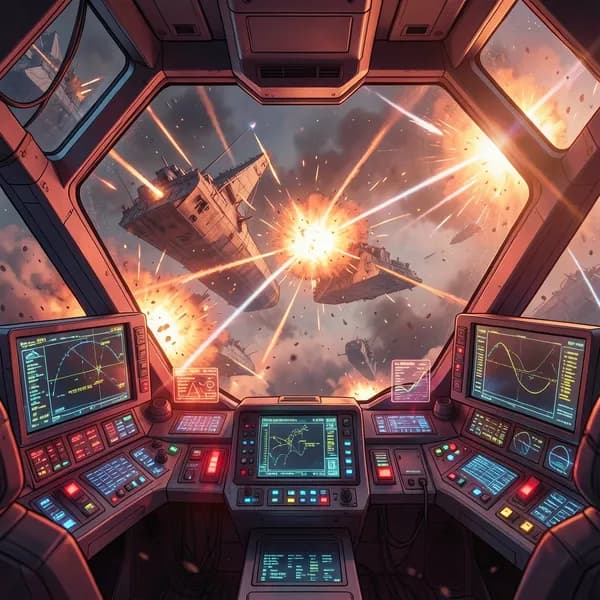
“Commander! The sync-link is searing my brain—I cannot maintain formation!”
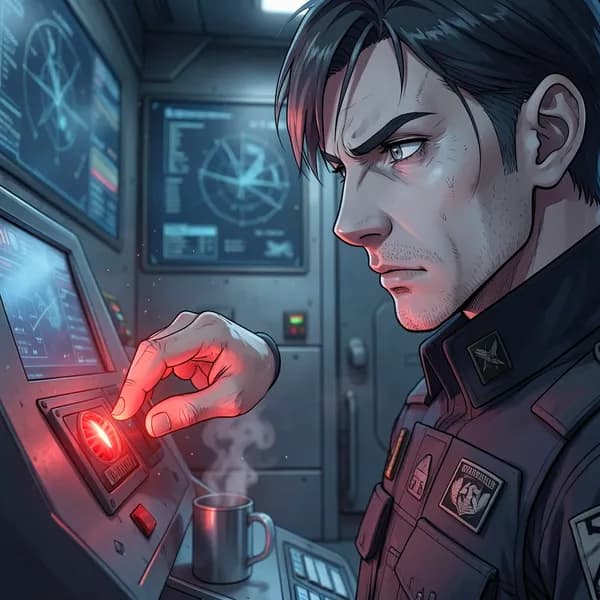
The command deck shudders as a stray shell slams into the port stabilizers. You have seconds to decide the fate of your vanguard squad. If you pull them back, the enemy breaches the reactor core. If you keep them out there, you send a pilot to a certain, agonizing end. Your thumb hovers over the emergency vent button.
“Miki, hold your position. If you break, the entire sector falls. I am keeping you locked in.”
The readout changes. Miki’s bio-signature begins to stutter, the yellow alarm light bathing the bridge in a rhythmic, sickening glow. Do you force her to hold until the reserve units arrive, or do you cut the link and accept the inevitable breach of the command deck?
The breach is imminent. How do you handle the failing sync-link?
Your character. Your next move.
The fate of the squadron is yours.
The enemy is at the gate, and your pilots are waiting for the signal. Will you order the charge or pull them back to safety? Every decision you make in this command center ripples across the battlefield. Step into the chair and see if you have the resolve to win the war without losing yourself.
Take Command NowYour Story, Your Way
Everything is customizable. Pick any genre, setting, or character — the AI builds a world around exactly what you want.
Any Character
Design your appearance, personality, backstory — every detail
Any World
Fantasy kingdoms, sci-fi stations, modern cities — you choose
Branching Paths
No two playthroughs are the same. Your choices reshape everything
Full Immersion
AI images, voice acting, sound effects — a living story
Allocate limited thermal shielding to specific units before the enemy ambush begins.
Decide whether to authorize a high-risk extraction under heavy artillery fire.
Manage pilot morale during long-term campaigns to prevent critical errors in combat.
Static hisses over the comms as the radar lights up with incoming signatures. You stare at the tactical map, red blips encroaching on the perimeter. Pilot Sato’s vitals are spiking; her mech’s coolant is failing, and the enemy lines are closing. You have seconds to decide: pull her back and leave the objective undefended, or push her to overclock the reactor and finish the job. Every choice you make echoes through the cold metal halls of the command center. This is a story where your orders have consequences, and the casualties are never just numbers on a screen. You sit in the chair of the commanding officer, holding the lives of your pilots in your hands while the war rages on.
What is The Commanding Officer in Mecha?
The Commanding Officer is the tactical heart of any mecha narrative. They are not the ones in the cockpit taking the hits, but they feel every explosion as if they were there. Think of Bright Noa from Mobile Suit Gundam, a man tasked with keeping a ship of reckless teenagers alive while the world burns around them. The CO manages resources, morale, and the brutal reality of attrition. They are the architect of victory and the keeper of the manifest. In works like Legend of the Galactic Heroes, the CO’s brilliance is measured by their ability to manipulate the battlefield from a distance, turning losing scraps into narrow escapes. They balance the cold, hard logic of strategy against the human need to bring their squad home in one piece. This archetype serves as the bridge between the high-level politics of war and the visceral, grease-stained reality of the frontline.
Why play The Commanding Officer as an interactive story?
Playing as a CO means the command deck is your home. You deal with insubordination, fuel shortages, and the gut-wrenching silence that follows a failed mission. You might have to choose which pilot gets the upgraded chassis or decide whether to prioritize civilian evacuation over strategic superiority. The tension comes from the disconnect: you see the whole board, but you cannot touch the controls. You must trust your pilots, even when they are making mistakes that could cost them their lives. Your agency in this role is measured by how you manage the emotional and logistical toll of a long-term campaign.
The psychology of The Commanding Officer: why readers fall for this character
The Commanding Officer archetype taps into the fantasy of ultimate responsibility. Unlike the pilot, who focuses on reflex and sync-rates, the CO embodies the burden of leadership. They are the ones who look at the casualty reports and see names, not statistics. In Neon Genesis Evangelion, Misato Katsuragi exemplifies this strain; she is responsible for children piloting god-like machines, constantly juggling bureaucratic pressure with the emotional fallout of every sortie. Similarly, the Commander in XCOM captures the spirit of the archetype, forcing the player to name their soldiers, ensuring that when they die, the loss is personal. This archetype thrives on the trolley problem of warfare. You are not just playing a game; you are managing a living organization. The appeal lies in the intellectual challenge of outmaneuvering an opponent, combined with the moral weight of knowing that your tactical brilliance is paid for in blood. Readers and players gravitate toward this role because it tests their capacity for cold judgment in the face of impossible emotional stakes.
FAQ
What is the main difference between playing a pilot and a CO?
A pilot focuses on combat reflexes and machine synchronization. A CO focuses on long-term strategy, logistics, and the survival of the entire squad.
Can I lose the war if I make too many bad calls?
Yes. Your resources are finite. If you sacrifice too many pilots or lose key infrastructure, the overall campaign will fail.
Is this purely a strategy simulation?
It is a narrative experience where strategic choices drive the plot. Your decisions change the story’s outcome and the world state.
Will my pilots have their own personalities?
Yes. Every pilot has a unique history and temperament. How you treat them affects their performance and loyalty on the field.
Explore more Mecha stories like First Synchronization, Mech Pilot Training, Rival Pilot.
More Mecha Stories
First Synchronization
The neural link activates and suddenly you can feel the mech as your own body. Your first synchronization is overwhelming—sixty tons of steel responding to your thoughts, your emotions, your fear.
TropeMech Pilot Training
The academy pushes you to your physical and mental limits. You train to become a mech pilot, competing against the best recruits in the world for the chance to bond with a machine that could save humanity.
TropeRival Pilot
Your rival is faster, more experienced, and never lets you forget it. The competition between you drives both of you to dangerous extremes, but when the real enemy arrives, rivalry might have to become alliance.
TropeMech Tournament
The arena shakes as mechs clash in sanctioned combat. You enter the tournament to prove yourself, win glory, or earn the resources your people desperately need—but your opponents fight for reasons just as compelling.
TropeKaiju vs Mech
Something colossal is rising from the deep and conventional weapons cannot stop it. You climb into the cockpit of humanity's last line of defense—a mech built specifically to fight monsters the size of skyscrapers.
TropeMech Upgrade
New parts, new weapons, new capabilities—your mech is evolving. Each upgrade pushes the machine closer to its limits and deeper into territory where the line between pilot and weapon begins to blur.