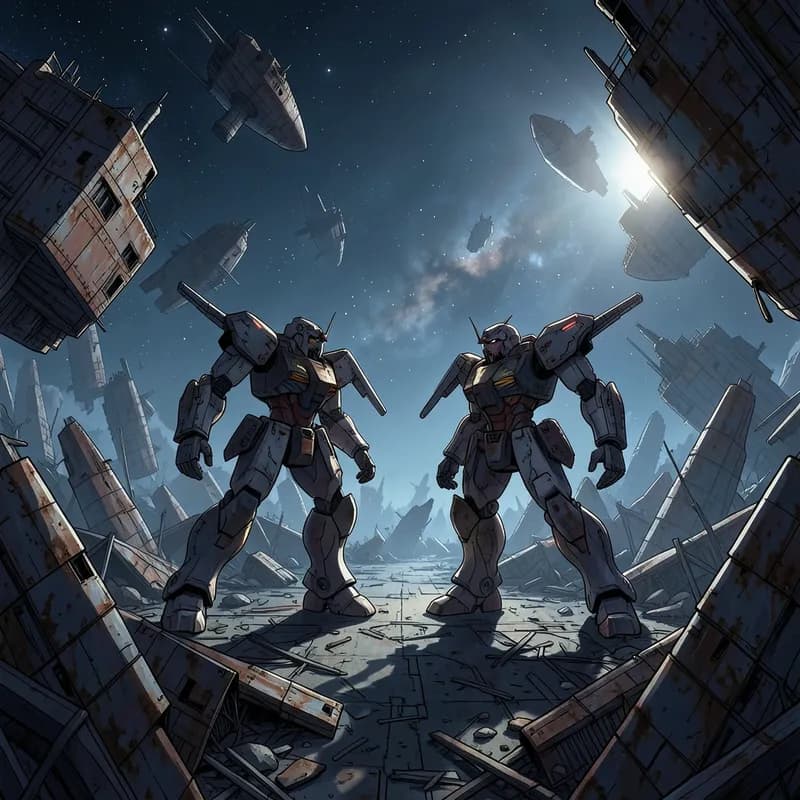
Mecha · Interactive story
Steel, Ego, and the Edge of Destruction
Your cockpit is a cage, and your rival is the only one with the key.
Start as a guest. Choose your character before the story begins.
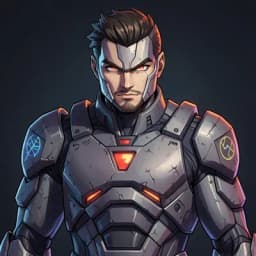
Meet the sample character
The reactor is redlining, and your rival is already ahead.
Try a scene · No signup
Kinetic Feedback
A short sample of this world. Your own version starts with your character.
Your neural link bites into your temples, a sharp, electric sting that tells you the mech is finally synced. Inside the cockpit of the Iron-Ox, the heat is rising, sweat slicking your palms as you grip the controls. The frame groans under the stress of the gravitational pull, metal protesting against the vacuum outside. You aren't just piloting; you are the machine’s nervous system.

“Still dragging your feet, Jiro? My Viper-Strike has already cleared the debris field while you're busy checking your coolant levels.”

Hideo’s voice crackles over the comms, mocking and crisp. You watch his sleek, silver machine dart through the wreckage with infuriating grace. Your own reactor output spikes, the warning light blinking a frantic, rhythmic amber. The gap between you is widening, and the training simulation goal is slipping through your fingers.
“Keep talking, Hideo. I’m just waiting for the right moment to turn that silver paint into scrap metal.”
You feel the machine shudder as you hit the throttle, but the neural interface flares with a sharp, blinding static. The Iron-Ox is pushing back, the internal dampeners screaming under the load. You have seconds to compensate before the sync breaks entirely, leaving you a sitting duck in the middle of a live-fire zone.
The feedback loop is breaking. Do you push through the pain or pull back?
Your character. Your next move.
Step into the cockpit. Claim your victory.
The enemy is closing in, and your rival is already making their move. Do you trust your training or your instincts? Every decision from the cockpit interface shapes the war and the future of your unit. The machine is waiting for your command.
Sync and EngageYour Story, Your Way
Everything is customizable. Pick any genre, setting, or character — the AI builds a world around exactly what you want.
Any Character
Design your appearance, personality, backstory — every detail
Any World
Fantasy kingdoms, sci-fi stations, modern cities — you choose
Branching Paths
No two playthroughs are the same. Your choices reshape everything
Full Immersion
AI images, voice acting, sound effects — a living story
Calibrate your neural interface to match your rival’s unpredictable combat signature during high-speed dogfights.
Choose whether to protect your squad or pursue a personal grudge against your cockpit nemesis.
Modify your mech’s weapon systems to counter the specific combat style of your primary antagonist.
Decide if you will offer an alliance when your rival’s unit suffers a critical failure.
The warning light blinks crimson across your HUD. Outside the cockpit, the sky over Neo-Kyoto is choked with debris, but your attention is locked on the silver frame of the enemy unit dancing just ahead. Kaito. He’s been breathing down your neck since the academy, mocking your synch-rate and stealing every mission objective. Now, the main reactor is critical, and the command center is screaming for a retreat, but your hands tighten on the controls. Do you pull back to save the squad, or do you push your machine to the redline to finally prove you are the superior pilot? Your choice determines whether you return as a hero or wreckage. This is an interactive story where every tactical decision, from fuel management to weapon deployment, carries weight. You are the pilot, and the rivalry is the fire that defines your legacy.
What is Rival Pilot in Mecha?
The Rival Pilot trope is the friction that sparks the engine of any great mecha story. It is not just about two people who dislike each other; it is about two pilots whose skill sets are mirrors, forcing them to constantly adapt, evolve, and push their machines beyond safety parameters. In Mobile Suit Gundam, the tension between Amuro Ray and Char Aznable defines the entire conflict, transforming a war into a personal duel of ideologies and combat prowess. The rival acts as a benchmark. They are the person who knows exactly how to exploit your mechanical blind spots because they have spent hours analyzing your flight patterns. Whether it is a bitter academy grudge or a fundamental disagreement on the ethics of war, the rival forces the protagonist to define their own identity. Without that constant pressure, the protagonist might never reach their peak performance. It is a relationship forged in the heat of heavy ordinance, where the mutual respect for the other’s skill often outweighs the surface-level animosity. It provides a human focal point amidst the chaos of giant robot warfare.
Why play Rival Pilot as an interactive story?
Playing through a mecha rivalry allows you to inhabit the cockpit during the most volatile moments of a pilot's career. You decide if your rivalry remains a cold, professional competition or if it spirals into a dangerous vendetta that threatens your entire squadron. You will face dilemmas where your mechanical limits are tested: do you prioritize the mission objective, or do you sabotage your own tactical position just to get a clean shot at your rival? The stakes are visceral. Every choice regarding your loadout, your flight style, and your communication with the command center changes how the rival reacts to you. If you are aggressive, they become more cautious; if you are tactical, they grow reckless. You are not just observing a rivalry; you are actively shaping the power dynamic between two pilots whose fates are inextricably linked by the machines they fly.
Famous examples of Rival Pilot in books, film, and games
The Rival Pilot trope thrives on the transition from opposition to uneasy cooperation. In Neon Genesis Evangelion, the psychological distance between Shinji and Asuka creates a unique pressure, where their clashing personalities directly affect their synchronization with their Evas. Their inability to reconcile their differences leads to tactical failures, highlighting how personal ego can dismantle a military unit. Conversely, in the Armored Core series, the rivalry is often transactional and cold. You are constantly pitted against pilots who view you as an obstacle to their paycheck. The shift from seeing them as a target to needing them as a wingman when a massive, world-ending weapon appears creates a profound narrative arc. Another example is the rivalry found in Pacific Rim, where the bond between pilots is a literal requirement for operation. When two pilots who don't trust each other are forced to share a neural drift, the friction creates a dangerous instability that the player must overcome. This trope endures because it mirrors the complexities of human competition. We all have that counterpart—the person who forces us to be better, even if we despise them for it. In fiction, this is amplified by the weight of tons of steel and nuclear-powered reactors. The rivalry serves as a constant reminder that no matter how good you are, someone is always training harder.
FAQ
What is the primary difference between a villain and a rival pilot?
A villain seeks to destroy the world or your mission, while a rival seeks to prove they are better than you. Often, a rival is an ally who happens to have a different philosophy or a chip on their shoulder.
Can I choose to befriend my rival?
Yes. Your choices allow you to de-escalate the tension. You might find that your rival’s motives are actually aligned with your own, leading to a powerful combat partnership.
How does the AI impact the rivalry?
The AI simulates the rival’s personality. If you play aggressively, the AI learns your patterns and will adapt, making them a much harder opponent to predict in the next encounter.
Is the rivalry always limited to combat?
Not at all. Many stories feature the rivalry in the hangar, the briefing room, and the politics of the military command. Your reputation is built on more than just your kill count.
Explore more Mecha stories like First Synchronization, Mech Pilot Training, Mech Tournament.
More Mecha Stories
First Synchronization
The neural link activates and suddenly you can feel the mech as your own body. Your first synchronization is overwhelming—sixty tons of steel responding to your thoughts, your emotions, your fear.
TropeMech Pilot Training
The academy pushes you to your physical and mental limits. You train to become a mech pilot, competing against the best recruits in the world for the chance to bond with a machine that could save humanity.
TropeMech Tournament
The arena shakes as mechs clash in sanctioned combat. You enter the tournament to prove yourself, win glory, or earn the resources your people desperately need—but your opponents fight for reasons just as compelling.
TropeKaiju vs Mech
Something colossal is rising from the deep and conventional weapons cannot stop it. You climb into the cockpit of humanity's last line of defense—a mech built specifically to fight monsters the size of skyscrapers.
TropeMech Upgrade
New parts, new weapons, new capabilities—your mech is evolving. Each upgrade pushes the machine closer to its limits and deeper into territory where the line between pilot and weapon begins to blur.
TropeNeural Link Bond
The bond between you and your mech is growing deeper than engineering intended. You share memories, emotions, and something that feels disturbingly like a soul. Disconnecting may no longer be an option.