
Mecha · Interactive story
Steel Titans Against the Tide
The city is crumbling, the monster is screaming, and your neural link is redlining.
Start as a guest. Choose your character before the story begins.
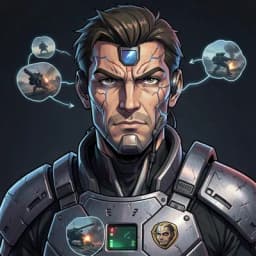
Meet the sample character
The breach is widening.
Try a scene · No signup
Tidal Force Feedback
A short sample of this world. Your own version starts with your character.
The smell of ozone bites into your nostrils as the neural sync climbs to 88 percent. Your spine burns against the command chair, every fiber of your nervous system mapped directly to the hydraulic pistons of the Type-9 Titan. Outside the reinforced viewport, the dark waters of the bay churn, a massive, bioluminescent ridge rising to shatter the harbor bridge like a toothpick. You are the only thing standing between the creature and the city’s power grid.

“Sato, do not attempt a kill shot while the sync is unstable. You will fry your cortex before the creature even hits the sand.”

The monster emits a high-frequency vibration that rattles your teeth inside your helmet. The Titan’s HUD flickers, displaying red warnings across your vision: 'Structural Integrity Critical'. You feel the weight of the massive gatling cannon in your right hand, its spin-up whine a siren song of impending destruction. The creature’s tail whips forward, snapping the heavy steel crane above you, showering the deck in sparks.
“My cortex is the least of our worries, Commander. If I do not vent the heat through the main cannon, we are both going to be scrap metal in thirty seconds.”
The massive beast roars, a sound that is not just audio—it is a physical impact in your marrow. The creature’s jaws are closing around the reactor core housing nearby. If you fire now, you risk a catastrophic thermal overload that could flatten the remaining docklands. If you wait for a clean shot, the beast consumes the city's power source, leaving millions defenseless. Your finger rests on the trigger, the metal cold against your trembling glove.
The creature’s neck is exposed as it bites into the reactor housing—do you take the shot, defend the structure, or push your machine beyond its limits?
Your character. Your next move.
Step into the cockpit before the city falls.
The beast is breaching the harbor, and your squad is waiting for your orders. Will you lead the charge into the surf, or reinforce the inner walls to buy civilians more time? Your neural link is stabilizing, and the heavy cannons are primed for your command. Don't wait for reinforcements that aren't coming.
Synchronize and EngageYour Story, Your Way
Everything is customizable. Pick any genre, setting, or character — the AI builds a world around exactly what you want.
Any Character
Design your appearance, personality, backstory — every detail
Any World
Fantasy kingdoms, sci-fi stations, modern cities — you choose
Branching Paths
No two playthroughs are the same. Your choices reshape everything
Full Immersion
AI images, voice acting, sound effects — a living story
Configure your mech's loadout for heavy artillery, agile melee combat, or experimental energy shielding.
Manage your neural sync stability to avoid sensory overload during intense combat sequences.
Prioritize civilian evacuation routes while diverting the beast's attention away from key infrastructure.
Choose whether to risk a desperate finishing move or conserve fuel for a defensive retreat.
The alarm blares—a rhythmic, guttural warning that vibrates through the reinforced titanium floor of the hangar. You pull the harness tight, the smell of ozone and hydraulic fluid filling the narrow cockpit. Outside, the skyline of New Tokyo is already a jagged silhouette of ruin, carved out by a creature that defies biology. It stands taller than the skyscrapers, its hide shimmering with an unnatural, bioluminescent sheen. You close your eyes, syncing your pulse with the machine’s reactor. The HUD flickers to life, painting the world in tactical wireframes and threat warnings. This is not a drill; it is the final stand. Your hands grip the control sticks, cold metal meeting sweaty palms, as the beast turns its colossal, soulless eyes toward your position. In this interactive story, your choices dictate the flow of combat. Will you prioritize the evacuation of the lower districts, or will you engage the target head-on while the structural integrity of your mech is still at eighty percent? The choice is yours, and the clock is counting down.
What is Kaiju vs Mech in Mecha?
The Kaiju vs Mech trope pits the raw, primal force of nature against the pinnacle of human engineering. It is a spectacle of scale, where humanity attempts to reclaim its dominance through heavy ordinance, piloted armor, and sheer tactical ingenuity. Unlike standard military combat, this battle is personal; the pilot is often forced to synchronize their very nervous system with the machine, making every blow the robot takes feel like a physical strike to the pilot’s own body. Pacific Rim serves as a definitive modern example of this dynamic, emphasizing the drift between pilots to manage the mental load of controlling a Jaeger. Meanwhile, the classic Neon Genesis Evangelion shifts the focus to the psychological toll of fighting monsters that seem to possess an inexplicable, terrifying connection to the pilots themselves. Whether it is a battle for survival or a desperate attempt to protect a crumbling civilization, the trope relies on the tension between the fragile human inside and the invincible-looking titan they operate. It is about the audacity of standing tall against something that makes you feel like an insect.
Why play Kaiju vs Mech as an interactive story?
In this interactive story, you are not a passive observer; you are the pilot whose decisions dictate the outcome of the battle. You will face high-stakes dilemmas that go beyond simple attack-or-retreat commands. You might need to decide whether to vent your cooling systems to gain an extra burst of speed—risking a reactor meltdown—or to hold your ground and protect a crumbling bridge full of fleeing civilians. The weight of the machine is yours to command, and the narrative adapts to your strategy. Will you be a reckless brawler who sacrifices armor for raw power, or a tactical genius who uses the environment to dismantle the beast piece by piece? You might be asked to initiate a manual override when your neural link begins to fray, or to choose which teammate to support when a secondary threat emerges from the debris. Your choices dictate the mechanical wear, the pilot’s stress levels, and ultimately, whether the city stands or falls.
Famous examples of Kaiju vs Mech in books, film, and games
The Kaiju vs Mech trope has evolved through various mediums, each offering a distinct take on the relationship between pilot and monster. In the film Pacific Rim, the focus is on the scale and the physical necessity of giant robots to combat interdimensional entities, highlighting the cooperative effort required to pilot a Jaeger. It turns the genre into a high-octane celebration of industrial design and teamwork. Conversely, Neon Genesis Evangelion uses the giant robot trope to explore deep-seated existential dread and trauma; the mechs are biological entities, and the pilots are children forced into a war they cannot understand. The struggle is as much about the pilot's fractured mental state as it is about the monsters attacking Tokyo-3. In the manga and anime Godzilla: Planet of the Monsters, the trope is inverted, showing a future where humanity has been driven off Earth by Godzilla and must return with experimental mechs to reclaim their home, framing the fight as a desperate, long-term war of attrition. What makes this trope endure is its ability to scale up human struggle. No matter how advanced the technology gets, the core conflict remains the same: a fragile, finite human fighting to survive against an overwhelming, indifferent force of nature.
FAQ
How does the neural link impact my gameplay?
The link measures your connection to the mech. High sync increases damage output but risks pilot fatigue. Ignore it, and your machine may become unresponsive or cause internal feedback.
Can I lose the battle?
Yes. If you fail to prioritize tactical objectives or push your mech beyond its structural limits, the city will fall. Your decisions have permanent consequences on the narrative.
Does the type of mech I choose matter?
Absolutely. A heavy-class unit handles differently than a scout model. Your choice of chassis influences your speed, defense, and the types of weapons you can mount.
Is this story focused on the pilots or the robots?
Both. The narrative balances the technical demands of piloting with the personal life and emotional state of the pilot in the cockpit.
Explore more Mecha stories like First Synchronization, Mech Pilot Training, Rival Pilot.
More Mecha Stories
First Synchronization
The neural link activates and suddenly you can feel the mech as your own body. Your first synchronization is overwhelming—sixty tons of steel responding to your thoughts, your emotions, your fear.
TropeMech Pilot Training
The academy pushes you to your physical and mental limits. You train to become a mech pilot, competing against the best recruits in the world for the chance to bond with a machine that could save humanity.
TropeRival Pilot
Your rival is faster, more experienced, and never lets you forget it. The competition between you drives both of you to dangerous extremes, but when the real enemy arrives, rivalry might have to become alliance.
TropeMech Tournament
The arena shakes as mechs clash in sanctioned combat. You enter the tournament to prove yourself, win glory, or earn the resources your people desperately need—but your opponents fight for reasons just as compelling.
TropeMech Upgrade
New parts, new weapons, new capabilities—your mech is evolving. Each upgrade pushes the machine closer to its limits and deeper into territory where the line between pilot and weapon begins to blur.
TropeNeural Link Bond
The bond between you and your mech is growing deeper than engineering intended. You share memories, emotions, and something that feels disturbingly like a soul. Disconnecting may no longer be an option.