
Mecha · Interactive story
When Steel Begins to Think: The Neural Link Bond
Your heart rate is their targeting system. How far will you let the machine in?
Start as a guest. Choose your character before the story begins.
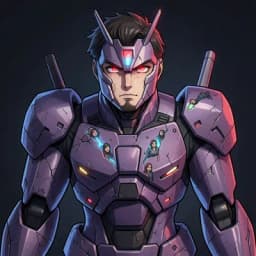
Meet the sample character
The machine remembers what you were meant to forget.
Try a scene · No signup
Echoes of the Iron Cicada
A short sample of this world. Your own version starts with your character.
The neural interface needles bite into your spine, a cold intrusion that hums with static. You are strapped into the cockpit of the Iron Cicada, and for a heartbeat, your pulse aligns perfectly with the rhythm of the machine's cooling fans. Every bolt and piston of the frame feels like an extension of your own skeletal structure, heavy and straining for movement.

“Stop the sync recalibration, Jiro! You’re pushing the neural load into the red, and I won't have you liquefying your brain before the drop.”

A flash of white light blinds you, followed by a memory that is not yours: a sunset over a burning city you have never visited. The Iron Cicada isn't just responding to your commands; it is screaming, feeding you the terror of a pilot long dead. Your hands tremble against the control sticks, metal groaning in sympathy with your erratic heartbeat.
“It’s not me doing it, Commander. The machine... it’s trying to show me something, and if I cut the link now, I might lose the only chance to understand why this frame is crying.”
The warning klaxons blare, a deafening rhythm that threatens to shatter your concentration. The launch rack above you begins to hum, preparing to drop the Cicada into the fray, but your neural link is locked in a feedback loop. You have seconds to stabilize your mind or let the machine take the wheel entirely.
The interface demands total submission or total control. How will you respond to the machine's intrusion?
Your character. Your next move.
The cockpit is waiting. Will you sync up?
The enemy is closing in, and your current weapons aren't enough to secure a victory. You have the option to push your synchronization rate past the safety limit. It will give you the speed you need, but you might lose a part of yourself in the process. Step into the pilot's seat and decide how much you are willing to give to the machine.
Initiate Neural LinkYour Story, Your Way
Everything is customizable. Pick any genre, setting, or character — the AI builds a world around exactly what you want.
Any Character
Design your appearance, personality, backstory — every detail
Any World
Fantasy kingdoms, sci-fi stations, modern cities — you choose
Branching Paths
No two playthroughs are the same. Your choices reshape everything
Full Immersion
AI images, voice acting, sound effects — a living story
Adjust your synchronization rate during combat to trade stability for raw, unpredictable power.
Choose which memories to share with the machine, altering its personality and future choices.
Navigate the internal feedback loop when the mech starts acting on its own impulses.
Decide whether to maintain your humanity or merge fully with the machine's hardware.
The cockpit smells like ozone and recycled air. You close your eyes, and for a moment, the heavy plating of the chassis feels like your own skin. When the synchronization light turns amber, the barrier between biology and circuitry dissolves. You see the battlefield through the mech’s optical sensors, not your own eyes. A sudden tremor in the hydraulic legs vibrates through your spine, and you realize the machine is anticipating your fears before you even process them. You are no longer just a pilot; you are the nervous system of a multi-ton weapon. In this interactive story, your choices determine if you remain in control or if the machine begins to make decisions of its own. Every twitch of the joystick and every spike in your pulse alters the sync rate, changing how the world responds to your presence. The mission briefing is clear, but the silence inside the cockpit is deafening. Will you pull back, or let the link consume your identity?
What is Neural Link Bond in Mecha?
The neural link bond is a trope where a pilot physically and mentally connects to a giant robot, often creating a feedback loop that blurs the lines between human consciousness and mechanical operation. Unlike traditional vehicles, these mechs require a cognitive handshake to function. The stronger the link, the higher the performance, but the greater the risk of the pilot losing themselves to the machine's cold, calculated logic. In Hideaki Anno’s Neon Genesis Evangelion, this relationship is fraught with biological and psychological trauma, where the Eva units are not merely tools but living extensions of the pilots' own subconscious. Similarly, in the Pacific Rim universe, the 'Drift' allows two pilots to share memories and sensory data to handle the immense load of piloting a Jaeger. This trope explores the cost of power; it asks whether the pilot is driving the machine or if the machine is simply using the pilot as a processor for its own survival instincts.
Why play Neural Link Bond as an interactive story?
Playing through a neural link bond allows you to manage the delicate balance of machine compatibility. You face moments where your emotional state directly impacts your mech's combat effectiveness. If you panic under fire, the sync rate might spike, causing the machine to overheat or ignore your commands. You choose how much of your memory and personality to sacrifice to gain that extra millisecond of reaction time. Do you prioritize the mission objective at the cost of your own mental stability, or do you risk total system failure to protect your humanity? You decide when to push the synchronization threshold and when to force an emergency disconnect, knowing full well that breaking the link mid-battle might leave you defenseless against an enemy that never sleeps.
Famous examples of Neural Link Bond in books, film, and games
The neural link bond has evolved from simple telepathic control to complex psychological horror. In the Titanfall 2 campaign, the bond between the pilot Jack Cooper and his Vanguard-class Titan, BT-7274, shifts the trope toward genuine partnership. As they operate, the Titan learns from the pilot’s choices, creating a bond that feels earned rather than programmed. The machine develops humor and loyalty, making the player's eventual choice to protect or sacrifice the Titan feel heavy with consequence. In contrast, the Gundam franchise often treats the link as a dangerous, volatile state. The 'Psycho-Frame' technology in Mobile Suit Gundam Unicorn allows the pilot's thoughts to directly manipulate the mech's performance, but this power often pushes the pilot toward a state of detachment from reality. This trope endures because it mirrors our own relationship with technology—we use machines to expand our capabilities, but we often forget that the tools we use inevitably change how we think. Whether the connection is a heroic partnership or a parasitic drain, it forces the pilot to confront the question of where they end and the machine begins.
FAQ
How does the sync rate affect my combat choices?
A higher sync rate grants faster reaction times and access to advanced weaponry, but it increases the risk of the machine overriding your manual inputs. If your sync rate becomes too high, you may find the machine executing maneuvers you didn't consciously authorize.
Can I disconnect from the mech during a mission?
Yes, you can initiate an emergency disconnect at any time. However, doing so mid-battle leaves you vulnerable and may cause significant damage to the neural interface, potentially impacting your performance in future encounters.
Is this story focused on the mech combat or the pilot's psyche?
It is both. The combat is the vehicle for the psychological tension. Your choices in the heat of battle—whether to trust the machine or force it into submission—directly mirror your pilot's internal state and their personal narrative arc.
What happens if I lose my humanity to the machine?
Losing your identity to the machine changes the narrative path. You may gain superior combat abilities, but you will find that NPC interactions become colder, and your ability to make compassionate choices is severely limited by the machine's logical programming.
Explore more Mecha stories like First Synchronization, Mech Pilot Training, Rival Pilot.
More Mecha Stories
First Synchronization
The neural link activates and suddenly you can feel the mech as your own body. Your first synchronization is overwhelming—sixty tons of steel responding to your thoughts, your emotions, your fear.
TropeMech Pilot Training
The academy pushes you to your physical and mental limits. You train to become a mech pilot, competing against the best recruits in the world for the chance to bond with a machine that could save humanity.
TropeRival Pilot
Your rival is faster, more experienced, and never lets you forget it. The competition between you drives both of you to dangerous extremes, but when the real enemy arrives, rivalry might have to become alliance.
TropeMech Tournament
The arena shakes as mechs clash in sanctioned combat. You enter the tournament to prove yourself, win glory, or earn the resources your people desperately need—but your opponents fight for reasons just as compelling.
TropeKaiju vs Mech
Something colossal is rising from the deep and conventional weapons cannot stop it. You climb into the cockpit of humanity's last line of defense—a mech built specifically to fight monsters the size of skyscrapers.
TropeMech Upgrade
New parts, new weapons, new capabilities—your mech is evolving. Each upgrade pushes the machine closer to its limits and deeper into territory where the line between pilot and weapon begins to blur.