
Mecha · Interactive story
Steel and Smoke: Command Your Mech on the Front Lines
The sensors are screaming, the city is burning, and you are the last line.
Start as a guest. Choose your character before the story begins.
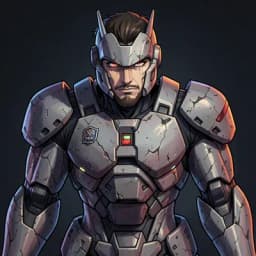
Meet the sample character
The Frontline Awaits Your Command
Try a scene · No signup
Iron Heart, Fractured Sky
A short sample of this world. Your own version starts with your character.
You feel the G-force spike as your neural link pulses with the Vanguard’s hydraulic heartbeat. The cockpit is a claustrophobic box of strobing red alerts and the sharp, burning scent of ozone. Outside, the skyline of Sector 4 is nothing but jagged steel skeletons silhouetted against a sulfurous, orange haze. A heavy mortar shell hits the pavement nearby, shaking your massive chassis with a bone-rattling thud.

“Jiro, forget your fuel gauges. Push that reactor to peak output and hold the bridge, or don't bother coming back.”

The data stream from your sensors is a jagged mess of incoming fire and flickering targeting reticles. The machine hums beneath your skin, a heavy, cold weight that screams for movement. You realize your heat sink is already redlining, and the enemy vanguard is closing the gap with terrifying speed. Your hands tremble against the control sticks, the connection blurring the line between your nervous system and the alloy frame.
“Understood, Commander. If I overheat now, I am just a sitting target. I am going to risk the overclock.”
You reach for the safety limiter, your fingers slick with sweat. The bridge is buckling under the weight of three enemy walkers, their autocannons chewing through the ferro-concrete. To your left, your wingman’s signal has gone dark, leaving you isolated. You have one second to decide how to break this formation before the next volley turns you into molten scrap.
The enemy line is tightening. How do you force a breakthrough?
Your character. Your next move.
Command the machine. Define the battlefield.
Your squad is pinned down, and the enemy artillery is closing in. Do you hold the line until reinforcements arrive, or do you take the risk and push forward into the smoke? Your hands are on the controls, and the next command is yours. Step into the cockpit and witness the consequences of your tactical decisions.
Start your first missionYour Story, Your Way
Everything is customizable. Pick any genre, setting, or character — the AI builds a world around exactly what you want.
Any Character
Design your appearance, personality, backstory — every detail
Any World
Fantasy kingdoms, sci-fi stations, modern cities — you choose
Branching Paths
No two playthroughs are the same. Your choices reshape everything
Full Immersion
AI images, voice acting, sound effects — a living story
Reroute auxiliary power to your thrusters to perform a high-risk aerial combat maneuver.
Choose between defensive shielding or offensive weaponry during a high-intensity urban ambush.
Decide whether to abandon your damaged mech to salvage critical data from the wreckage.
Coordinate with AI squad members to execute a pincer movement in the ruins.
Static hiss fills your headset as the HUD flickers to life, highlighting heat signatures through the thick, acrid smoke of the ruins. Ahead, the rhythmic thud of enemy heavy artillery vibrates through your floorboards, turning the concrete beneath your mech’s stabilizers into powdered dust. Your neuro-link pulses against your spine, a cold reminder that you are no longer just a pilot; you are the nervous system for fifty tons of reinforced alloy. Shells crater the street to your left, shrapnel pinging against your armor plating like hail on a tin roof. You have ten seconds to decide: vent your coolant to push your thrusters for a flanking maneuver, or lock your targeting sensors and hold the line. Every twitch of the joystick and every heartbeat counts. In this theater of war, your commands dictate the outcome of a campaign that has already claimed too many lives.
What is Battlefield in Mecha?
The battlefield is the quintessential stage for mecha fiction, defined by the claustrophobic intersection of massive engineering and total environmental collapse. It is a space where the geography is as much an enemy as the opposing pilot. Unlike space combat, where distances are vast and cold, the battlefield forces intimate, visceral violence. Buildings become cover, bridges become choke points, and the very ground you stand on is subject to the destructive power of heavy weaponry. Think of the intense urban warfare in Armored Core VI: Fires of Rubicon, where verticality and debris dictate how you engage; or the desperate, mud-caked reality of Mobile Suit Gundam: The 08th MS Team, where a mech is not a god-like machine but a fragile tool struggling against terrain and attrition. This setting demands more than just aiming a cannon. It requires spatial awareness, resource management, and the ability to adapt as the map shifts beneath your feet.
Why play Battlefield as an interactive story?
Playing through a battlefield scenario shifts the focus from grand strategy to the brutal reality of the cockpit. You are not a commander looking at a map; you are the eyes and ears of a machine that is constantly taking damage. You will face choices that test your discipline: do you sacrifice your shield generator to rescue a downed wingman, or do you prioritize the mission objective while your support crumbles? The tension arises from the physical limits of your machine. When your heat levels redline, or your ammunition count drops to single digits, the weight of your choices becomes tangible. You aren't just selecting an option; you are deciding whether to push your machine past its breaking point or play it safe and risk losing the ground you've fought so hard to gain. Every decision ripples through the mission, changing the structural integrity of the field around you.
What makes Battlefield work: the worldbuilding
The battlefield setting thrives on entropy. Good mecha stories use the environment to strip away the artifice of war. In Neon Genesis Evangelion, the city of Tokyo-3 is a weaponized landscape that literally retracts and reconfigures, turning the battlefield into a shifting puzzle. Patlabor focuses on the mundane, technical failures of operating heavy machinery in tight, civilian-populated areas, where a single misstep causes more damage than the enemy. To make this setting work, you must prioritize sensory details: the smell of ozone, the grinding of servos, the flickering of a dying HUD, and the deafening roar of enemy fire. Conflict arises when the machine’s limits clash with the pilot’s desperation. The best stories in this genre treat the mech as an extension of the pilot’s own body—when the armor plating is shredded, the pilot feels the phantom pain. Characters aren't heroes; they are operators who have learned to speak the language of steel and hydraulic fluid. Whether it’s the rain-slicked trenches of a gritty war drama or the neon-drenched streets of a cyberpunk insurrection, the battlefield is where the pilot’s humanity is tested against the cold, unfeeling requirements of the machine.
FAQ
Can I customize my mech's loadout for the battlefield?
Absolutely. Your choice of chassis, armor plating, and weapon systems directly influences how you handle different terrain types and enemy configurations.
Do environmental hazards affect my performance?
Yes. Crumbling buildings, fire, and unstable ground can cripple your mobility or damage your sensors, forcing you to adapt your tactics on the fly.
Is this setting purely about combat?
While war is the backdrop, the narrative focuses on the pilot's survival, moral dilemmas, and the bonds formed with squadmates under extreme stress.
How does the AI influence the flow of the battle?
The AI reacts to your choices, dynamically changing enemy behavior and environmental conditions to ensure that no two combat engagements feel identical.
Explore more Mecha stories like First Synchronization, Mech Pilot Training, Rival Pilot.
More Mecha Stories
First Synchronization
The neural link activates and suddenly you can feel the mech as your own body. Your first synchronization is overwhelming—sixty tons of steel responding to your thoughts, your emotions, your fear.
TropeMech Pilot Training
The academy pushes you to your physical and mental limits. You train to become a mech pilot, competing against the best recruits in the world for the chance to bond with a machine that could save humanity.
TropeRival Pilot
Your rival is faster, more experienced, and never lets you forget it. The competition between you drives both of you to dangerous extremes, but when the real enemy arrives, rivalry might have to become alliance.
TropeMech Tournament
The arena shakes as mechs clash in sanctioned combat. You enter the tournament to prove yourself, win glory, or earn the resources your people desperately need—but your opponents fight for reasons just as compelling.
TropeKaiju vs Mech
Something colossal is rising from the deep and conventional weapons cannot stop it. You climb into the cockpit of humanity's last line of defense—a mech built specifically to fight monsters the size of skyscrapers.
TropeMech Upgrade
New parts, new weapons, new capabilities—your mech is evolving. Each upgrade pushes the machine closer to its limits and deeper into territory where the line between pilot and weapon begins to blur.