
Mecha · Interactive story
The Final Sortie: One Last Sync to Save the World
The reactor hums, the neural link burns, and the enemy is at the gate.
Start as a guest. Choose your character before the story begins.
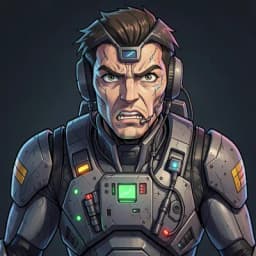
Meet the sample character
The final light of the Icarus-7 orbital station
Try a scene · No signup
Redshift Horizon
A short sample of this world. Your own version starts with your character.
The hangar deck groans under the weight of incoming fire as the Icarus-7 station rotates into the path of the enemy fleet. Your mech, the Iron Lung, sits on the launch cradle. The neural interface needles prick at the back of your neck, cold and sharp. You feel the machine’s heartbeat—a rhythmic, sluggish thrum of dying reactor coolant.

“Sato, if you don't clear the launch tube in thirty seconds, the blast door is going to weld shut with you inside.”

The sync-link spikes. Your vision blurs, projecting a tactical map of the swarm closing in on the station's hull. You feel the heat of your own machine’s core climbing past the safety threshold. The internal monitors scream warnings in a language of bright, flashing amber, demanding a decision before the blast door seals your fate forever.
“I’m not leaving the station undefended, Halloway. I’m forcing the core to dump its remaining energy into the forward thrusters.”
The override command flashes on your console: 'Total System Lockout Expected.' Outside, the enemy dreadnought is charging its main cannon, aimed directly at the station's primary oxygen tank. You have to launch now, or you’ll be vaporized while still clamped to the deck. The choice is between burning out your engine or risking a direct hit.
The blast door is closing rapidly; how do you force your way into the vacuum of space?
Your character. Your next move.
The enemy is closing. Do you sync?
The reactor is critical and your ammunition is low. The final sortie begins now. Will you hold the line until the very end, or will your machine become a monument to your last stand? Every choice you make in the cockpit determines if you return a hero or leave a legacy in the rubble.
Begin your final sortieYour Story, Your Way
Everything is customizable. Pick any genre, setting, or character — the AI builds a world around exactly what you want.
Any Character
Design your appearance, personality, backstory — every detail
Any World
Fantasy kingdoms, sci-fi stations, modern cities — you choose
Branching Paths
No two playthroughs are the same. Your choices reshape everything
Full Immersion
AI images, voice acting, sound effects — a living story
Manage reactor heat levels while choosing between high-damage output or defensive shielding.
Decide whether to sacrifice your machine's structural integrity to save a trapped civilian.
Execute high-speed maneuvers that test your pilot's neural sync stability and reaction time.
Determine the ultimate fate of your squad through your tactical calls during the assault.
The smell of ozone clings to the cockpit, a sharp, metallic tang that masks the fear rising in your throat. Through the cockpit glass, the horizon burns with the light of a thousand incoming missiles. Your rig, a thirty-foot behemoth of steel and hydraulic actuators, groans as you tighten the neural sync. This is the last sortie. The command center has gone silent, leaving only the static of a dying frequency and the weight of the mission ahead. You are the final line of defense between the encroaching shadow and whatever remains of the colony. In this interactive story, your hands grip the flight sticks, and every decision you make—from the energy allocation to your final maneuver—shapes the outcome of this desperate stand. You have trained for years to pilot this machine, but no simulation prepared you for the reality of a mission with no guaranteed return. The enemy is closing, and the reactor core is redlining. It is time to sync.
What is Final Sortie in Mecha?
The Final Sortie is a narrative trope representing the climax of a mecha conflict. It signifies the point of no return, where the protagonist and their machine are pushed beyond their mechanical and psychological limits. This trope relies on the inherent tension of the genre: the pilot is physically tethered to the machine, meaning their mortality is inextricably linked to the hardware. When the mission is declared a 'final sortie,' the stakes shift from tactical victory to legacy and survival. In classic works like 'Mobile Suit Gundam,' the final sortie often forces the pilot to confront the moral cost of their weapon. Unlike standard battles, this event typically involves a sacrifice or a high-stakes gamble that forces the protagonist to choose between their survival and the fulfillment of their objective. It is the moment where the 'mecha' stops being just a vehicle and becomes an extension of the pilot's will, often leading to a total sync that threatens to consume the pilot entirely. Whether it is a desperate defense against an overwhelming invasion or a final assault on a fortified stronghold, the trope ensures that the pilot's last act carries the weight of the entire narrative arc.
Why play Final Sortie as an interactive story?
Playing a final sortie as an interactive experience puts the burden of command directly on your shoulders. Unlike watching a show or reading a book, you feel the mechanical stress of your machine as you decide whether to divert power to your particle cannons or your shielding. You will face impossible choices: do you abandon your wingman to secure the objective, or do you risk total system failure to pull them from the fire? The agency provided by this format turns the trope into a high-pressure simulation. You are not just observing a hero; you are managing the heat levels, the ammunition counts, and the mounting fatigue of the pilot. Every choice you make influences the integrity of your armor and the morale of the ground forces waiting for your signal. The tension is palpable because you know that a single wrong input—a missed parry or a late thruster burn—could be the difference between a triumphant return and drifting into the void.
Famous examples of Final Sortie in books, film, and games
The Final Sortie is a cornerstone of the mecha genre, appearing in various forms across media. In the film 'Pacific Rim,' the final assault on the Breach uses this trope to establish the ultimate sacrifice required to close the portal, showing how the connection between two pilots must be absolute to survive the pressure. Similarly, in the series '86,' the final missions are defined by a sense of impending doom where the pilots know they are considered disposable, turning their final sorties into acts of defiance against an uncaring command structure. In video games like 'Armored Core,' the final missions often force the player to confront their own past decisions, pitting them against rivals they once called friends. These stories all share a common thread: the machine is an extension of the pilot's soul. Whether it is the desperate, high-octane combat of 'Gundam' or the gritty, realistic survival of '86,' the trope endures because it forces the audience to ask what they would be willing to give up when the mission is all that matters. It strips away the pretense of war and leaves only the pilot, the machine, and the final, decisive strike.
FAQ
What is a final sortie in a mecha game?
It is the concluding mission of a story, where the protagonist enters a battle from which they may not return. It focuses on high stakes, mechanical failure, and the pilot's personal growth.
How does the neural sync mechanic impact my choices?
The neural sync reflects the physical toll of piloting. High-stress choices can increase sync strain, potentially leading to system failure or pilot blackouts if you push your machine too hard.
Can I survive the final mission?
Your survival depends on your tactical decisions, resource management, and how you choose to prioritize your objectives. Not every outcome results in a heroic return.
Is this game suitable for fans of classic mecha anime?
Yes. The narrative respects the tropes of the genre, focusing on the pilot-to-machine bond, heavy machinery, and high-pressure combat scenarios common in the genre.
Explore more Mecha stories like First Synchronization, Mech Pilot Training, Rival Pilot.
More Mecha Stories
First Synchronization
The neural link activates and suddenly you can feel the mech as your own body. Your first synchronization is overwhelming—sixty tons of steel responding to your thoughts, your emotions, your fear.
TropeMech Pilot Training
The academy pushes you to your physical and mental limits. You train to become a mech pilot, competing against the best recruits in the world for the chance to bond with a machine that could save humanity.
TropeRival Pilot
Your rival is faster, more experienced, and never lets you forget it. The competition between you drives both of you to dangerous extremes, but when the real enemy arrives, rivalry might have to become alliance.
TropeMech Tournament
The arena shakes as mechs clash in sanctioned combat. You enter the tournament to prove yourself, win glory, or earn the resources your people desperately need—but your opponents fight for reasons just as compelling.
TropeKaiju vs Mech
Something colossal is rising from the deep and conventional weapons cannot stop it. You climb into the cockpit of humanity's last line of defense—a mech built specifically to fight monsters the size of skyscrapers.
TropeMech Upgrade
New parts, new weapons, new capabilities—your mech is evolving. Each upgrade pushes the machine closer to its limits and deeper into territory where the line between pilot and weapon begins to blur.