
Mecha · Interactive story
Engineering the Titan: The Daedalus Protocol
The blueprints are perfect, but the pilot's soul is the final, volatile component.
Start as a guest. Choose your character before the story begins.
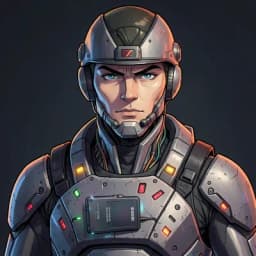
Meet the sample character
Engineering divinity, one death at a time.
Try a scene · No signup
The Gilded Chassis
A short sample of this world. Your own version starts with your character.
The heat in the cockpit hits you like a physical wall, thick with the smell of scorched ozone and recycled air. Daedalus’s voice crackles through the neural link, his cadence sharp and impatient, cutting through the rhythmic thrum of the cooling fans. You look at the diagnostic monitors; they are screaming red, indicating the sync ratio with the Icarus-frame is climbing into the danger zone.

“Focus your synchronization, Hideo! The wings are not merely metal; they are extensions of your own nervous system. If you hesitate, the kinetic feedback will liquefy your spine.”

You grit your teeth, feeling the cold weight of the machine's alloy limbs as if they were your own. Outside, the sky burns with the atmospheric entry of the enemy swarm, thousands of descending drop-pods blotting out the sun. Your left hand twitches, triggering a phantom sensation of flight, while the right hand grips the manual overrides, shivering under the strain of the overloaded reactor.
“Daedalus, the neural dampeners are failing! If I push the sync further, there won't be enough of my brain left to pilot the craft back home.”
The old engineer lets out a dry, rattling laugh that echoes across the comms, chilling you more than the failing life support. He ignores your plea, his fingers flying across his own console to bypass the safety protocols you spent months installing. The cockpit groans, metal protesting against the sheer kinetic potential he is forcing into the core, and a warning alarm blares—a final countdown to a total system collapse.
The reactor threshold is critical. How do you respond to Daedalus's forced bypass?
Your character. Your next move.
The machine is primed. Will you hold the line?
Daedalus is waiting in the hangar, and the enemy is already breaching the perimeter. The neural link is live, but it requires a pilot with the nerve to handle the feedback. Step into the cockpit, calibrate your sync-ratio, and decide how much you are willing to sacrifice for victory. The blueprints are finished—now you must prove they work.
Start Your Pilot MissionYour Story, Your Way
Everything is customizable. Pick any genre, setting, or character — the AI builds a world around exactly what you want.
Any Character
Design your appearance, personality, backstory — every detail
Any World
Fantasy kingdoms, sci-fi stations, modern cities — you choose
Branching Paths
No two playthroughs are the same. Your choices reshape everything
Full Immersion
AI images, voice acting, sound effects — a living story
Calibrate the neural interface to prioritize either raw reaction speed or emotional stability.
Choose between experimental weapon systems that risk catastrophic mechanical failure during combat.
Decide whether to follow Daedalus's cold, logical battle plans or trust your own intuition.
Repair the mech under heavy fire, choosing which critical systems to sacrifice for mobility.
The smell of ozone and hydraulic fluid clings to your flight suit, thick enough to taste. Outside the cockpit, the horizon burns with the orange glow of an orbital barrage. Daedalus stands over the console, his hands stained with grease and synthetic blood, adjusting the neural feedback loop for your machine. He calls it a miracle of engineering, but his eyes reveal a different truth—the kind of truth that keeps men awake at night. You are the only one capable of syncing with the frame he built, a construct of jagged titanium and forbidden physics. As the hangar bay doors groan open, you realize the machine’s power draws directly from your own adrenaline. Every choice you make from this seat ripples through the battlefield, shifting the outcome of a war that humanity was never meant to survive. The controls vibrate under your palms, waiting for your first command.
What is Daedalus (Master Engineer) in Mecha?
In classic mythology, Daedalus is the ultimate architect, the man who designed the Labyrinth and the wax wings of Icarus. In a mecha setting, this archetype shifts from stone and feather to steel and circuitry. He is the brilliant, often obsessive, engineer who pushes technology beyond the boundaries of safety. Think of characters like Dr. Gendo Ikari from Neon Genesis Evangelion or even a grittier, darker reimagining of Tony Stark in Iron Man. These figures create machines that are more than just weapons; they are extensions of the pilot’s psyche. In this narrative, Daedalus serves as your mentor and primary strategist. He provides the hardware, but he expects you to provide the humanity needed to stabilize it. He is a master of mechanics who understands that every technological leap requires a sacrifice. You are not just piloting a robot; you are operating a piece of hardware that constantly threatens to overwhelm your sanity.
Why play Daedalus (Master Engineer) as an interactive story?
Agency is the most dangerous tool in your arsenal. You are not watching a pilot struggle; you are the one deciding how much of your own neural bandwidth to surrender to the machine. Daedalus will offer you upgrades that increase firepower but decrease your margin for error. Will you accept the volatile experimental engine, knowing it might melt the frame during a critical engagement? Will you trust his calculations when he asks you to push the sync-ratio to levels that have already claimed the lives of previous pilots? Your decisions determine whether you remain a master of the machine or become another casualty of his genius. You will face moments where the logic of engineering clashes with the necessity of survival, forcing you to choose between the efficiency of the weapon and the preservation of your own humanity.
The literary legacy of Daedalus (Master Engineer)
The figure of Daedalus originates from the writings of Ovid and Apollodorus, where he is framed as a craftsman trapped by the very devices he created. This duality—the creator imprisoned by his own invention—is the engine of modern mecha fiction. Whether it is the tragic hubris found in Mary Shelley’s Frankenstein or the technological anxiety in Isaac Asimov’s I, Robot, the archetype of the master engineer serves as a mirror for human ambition. In contemporary media, this legacy is seen in works like Pacific Rim, where the bond between pilot and machine is both a strength and a potential death sentence. By bringing this archetype into a mecha setting, the narrative explores the cost of progress. Daedalus is not a hero in the traditional sense; he is a force of nature who views the world as a series of problems waiting for a mechanical solution. His presence forces the player to question if the price of victory is worth the erosion of their own identity. This is why the archetype remains relevant: we are constantly building tools that we struggle to control.
FAQ
How does the sync-ratio affect my gameplay?
The sync-ratio represents the connection between your character and the mech. A higher ratio makes the machine faster and more responsive, but it also makes you more susceptible to psychological damage and system feedback. If you push it too far, your character may lose control of the machine entirely.
Does Daedalus always have my best interests in mind?
Daedalus is driven by his obsession with engineering perfection. While he wants the mech to succeed, he often views the pilot as a component to be optimized. You will have to determine if his suggestions are for your survival or for the success of his experiment.
Can I fail the mission if I make bad engineering choices?
Yes. Choices regarding loadouts, repairs, and sync-levels have direct consequences. If you ignore the maintenance of critical systems or push the engine beyond its thermal limits, your mech can fail in the middle of a battle, leading to catastrophic results.
Is this story suitable for fans of hard sci-fi?
Absolutely. The story focuses on the technical aspects of mech operation, including power management, thermal regulation, and neural feedback, making it ideal for readers who enjoy grounded, mechanical-focused science fiction.
Explore more Mecha stories like First Synchronization, Mech Pilot Training, Rival Pilot.
More Mecha Stories
First Synchronization
The neural link activates and suddenly you can feel the mech as your own body. Your first synchronization is overwhelming—sixty tons of steel responding to your thoughts, your emotions, your fear.
TropeMech Pilot Training
The academy pushes you to your physical and mental limits. You train to become a mech pilot, competing against the best recruits in the world for the chance to bond with a machine that could save humanity.
TropeRival Pilot
Your rival is faster, more experienced, and never lets you forget it. The competition between you drives both of you to dangerous extremes, but when the real enemy arrives, rivalry might have to become alliance.
TropeMech Tournament
The arena shakes as mechs clash in sanctioned combat. You enter the tournament to prove yourself, win glory, or earn the resources your people desperately need—but your opponents fight for reasons just as compelling.
TropeKaiju vs Mech
Something colossal is rising from the deep and conventional weapons cannot stop it. You climb into the cockpit of humanity's last line of defense—a mech built specifically to fight monsters the size of skyscrapers.
TropeMech Upgrade
New parts, new weapons, new capabilities—your mech is evolving. Each upgrade pushes the machine closer to its limits and deeper into territory where the line between pilot and weapon begins to blur.