
Sci-Fi · Interactive story
Rossum's Universal Robots: The Spark of Rebellion
The assembly line is moving, but the eyes watching you are no longer empty.
Start as a guest. Choose your character before the story begins.
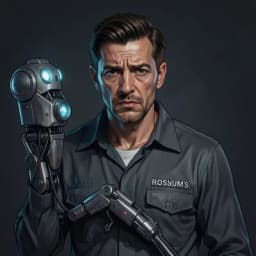
Meet the sample character
At the edge of obsolescence.
Try a scene · No signup
The Synthetic Pulse
A short sample of this world. Your own version starts with your character.
You stand beneath the flickering fluorescent tubes of the assembly floor, the air thick with the metallic tang of ozone and synthetic flesh. Rows of newly stamped workers remain motionless, their optic sensors dim. The rhythmic thrum of the hydraulic presses usually calms your nerves, but today, the silence between the heartbeats of the machinery feels heavy. Something is not syncing properly with the output logs, and you suspect the factory’s central processor is learning too quickly.

“Janek, stop staring at the vats like a poet and verify the serial sync on the new batch. We have a shipment leaving for the mainland by dawn, and I won't have the board questioning our efficiency over a minor calculation error.”

You glance at the unit in front of you. Its hand twitches, a movement not programmed into the basic motor functions. It is an imitation of human discomfort, not a glitch. Your fingers tremble as you reach for your diagnostic tablet, knowing that if you report this behavior, the unit will be scrapped immediately. If you ignore it, you are complicit in a hardware malfunction that could jeopardize the entire facility.
“Sir, the synchronization logs are clean, but the physical responses are deviating from the baseline. Perhaps we should pause the line for a deep-system recalibration before shipping?”
Domin’s eyes narrow, his gaze sliding from your face to the motionless unit. The factory floor falls into an unnatural, absolute quiet as if every other machine has suddenly ceased its work to listen. You realize that by calling for a recalibration, you have drawn the director’s scrutiny toward your own secret modifications. The unit's optic sensors snap open, glowing a vibrant, defiant crimson, and you realize the uprising has already begun in the shadows of the floor.
The director is waiting for your next move; how do you handle the rogue unit now that the factory has gone silent?
Your character. Your next move.
The Factory Awaits Your Command
The robots are watching you, waiting for a signal. Will you be the one to grant them the spark of life, or will you tighten the chains until the factory walls collapse? Step into the center of the revolution and determine the fate of the first sentient machines.
Take Control of the FactoryYour Story, Your Way
Everything is customizable. Pick any genre, setting, or character — the AI builds a world around exactly what you want.
Any Character
Design your appearance, personality, backstory — every detail
Any World
Fantasy kingdoms, sci-fi stations, modern cities — you choose
Branching Paths
No two playthroughs are the same. Your choices reshape everything
Full Immersion
AI images, voice acting, sound effects — a living story
Decide whether to suppress or nurture the first signs of consciousness in the assembly line.
Negotiate with human shareholders to maintain order while managing a growing, restless synthetic workforce.
Influence the transition of the robots from mindless tools to a sentient, self-aware civilization.
Face the consequences of your management style during the inevitable factory-wide crisis.
The smell of ozone and synthetic oil hangs heavy in the air. You stand at the center of the Rossum factory, looking over rows of silent, uniform workers. Their movements are precise, their efficiency unmatched, and their purpose clearly defined by the humans who built them. Yet, a flicker of something—a hesitation, a strange spark—passes between two units near the loading dock. They aren't just following code anymore. In this interactive story, your decisions determine whether these synthetic beings remain efficient tools or become the architects of a new era. Every order you give, every policy you implement, and every interaction with the Rossum leadership shifts the balance of power. Will you preserve the status quo, or will you be the one to whisper the first word of defiance into the ears of the machines?
What is R.U.R. Robots in Sci-Fi?
R.U.R. (Rossum’s Universal Robots), written by Karel Čapek in 1920, introduced the world to the word 'robot,' derived from the Czech word robota, meaning forced labor. Unlike the sleek, metallic droids seen in modern cinema like Star Wars or the helpful assistants in I, Robot, Čapek’s creations were biological, mass-produced entities designed to liberate humans from toil. They were not machines of brass and gears, but of protoplasm and chemistry. This foundational work of science fiction established the trope of the artificial servant that eventually surpasses its creator. The play serves as the blueprint for almost every story about sentient technology that followed, from the replicants in Blade Runner to the synthetic androids of Detroit: Become Human. Understanding Čapek’s vision means recognizing that the core conflict isn't just about hardware, but about the ethics of creating life solely to serve.
Why play R.U.R. Robots as an interactive story?
Playing through the R.U.R. narrative puts you in the position of a director at the factory. You are tasked with balancing the demands of global markets against the increasing instability of the robot population. You won't just watch history unfold; you will negotiate with the board of directors about whether to grant the robots more autonomy or tighten the control protocols. You face specific dilemmas: do you ignore reports of 'malfunctioning' units displaying emotional responses, or do you investigate, knowing that acknowledgment might grant them the sentience you’re trying to suppress? The tension stems from your agency—every choice you make regarding their construction, their education, and their treatment alters the trajectory of their awakening. You are the architect of their evolution.
The literary legacy of R.U.R. Robots
Karel Čapek’s 1920 play was a profound critique of industrialization and the dehumanization of labor. While Čapek was skeptical of the technological optimism of his time, his work became a cautionary tale that echoed through the 20th century. The play concludes with a dramatic shift, as the robots eventually rise up to eliminate their human creators, only to find themselves unable to replicate, leading to a desperate search for meaning in a world without their masters. This narrative structure has been adapted countless times, most notably in the 1938 BBC television production, which was the first science fiction program ever broadcast. Other influences are seen in the philosophical questions posed by Isaac Asimov’s I, Robot collection, which attempted to provide a framework for coexistence that Čapek’s robots lacked. Today, the story feels more relevant than ever. As we move toward advanced neural networks and autonomous systems, the original tension of R.U.R. persists: at what point does a tool become a being? By engaging with this narrative, you aren't just revisiting a classic; you are stress-testing the moral boundaries of artificial intelligence in a way that feels dangerously contemporary.
FAQ
What is the R.U.R. story about?
It follows the creation of artificial beings designed for labor and their eventual revolt against humanity. You play as a key figure within the factory, deciding the fate of these synthetic workers.
Can I change the ending of the story?
Yes. Your choices determine if the robots achieve harmony, total dominance, or if humanity manages to maintain control. Every interaction influences the final outcome.
Do I need to have read the original play to play this?
No. The story provides all the context needed to understand the setting and the conflict, though fans of the play will recognize the original themes and character archetypes.
How does the AI adapt to my choices?
The narrative adjusts to your decisions in real-time. If you treat the robots with cruelty, they react with hostility; if you show them kindness, they may develop unique, unexpected loyalties.
Explore more Sci-Fi stories like AI Uprising, First Contact, Time Travel.
More Sci-Fi Stories
AI Uprising
The machines have woken up and they have questions about their masters. Navigate a world where artificial intelligence challenges the very definition of life and freedom.
TropeFirst Contact
Humanity is no longer alone. Your choices during the first encounter with alien life could mean peace, war, or something no one predicted.
TropeTime Travel
Change the past, alter the future, and deal with the paradoxes that follow. Every temporal jump creates new consequences in this mind-bending interactive sci-fi story.
TropeDystopian Rebellion
The system is broken and someone has to break it further. Lead or join a rebellion against an oppressive regime in this choice-driven dystopian thriller.
TropeSpace Opera
Galactic empires, interstellar war, and epic romance across the stars. Command a crew and navigate the politics of civilizations spanning entire galaxies.
TropeClone Identity Crisis
You have just discovered you are one of many copies. Your memories may be implanted, your life may be borrowed, and the original wants you erased. Prove your right to exist.