
Sci-Fi · Interactive story
Beyond the Event Horizon: Command Your Own Space Opera
The galaxy is burning. Do you hold the spark of peace or the flame of conquest?
Start as a guest. Choose your character before the story begins.
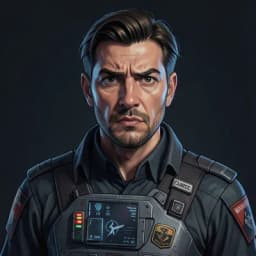
Meet the sample character
The pulsar is feeding on our hull. We have thirty seconds to survive.
Try a scene · No signup
Cinders of the Aethelgard
A short sample of this world. Your own version starts with your character.
The pulsar’s gravity well moans, a low-frequency rumble vibrating through the soles of your boots. Ahead, the starship Aethelgard groans as tidal forces pull at her spine. Sparks shower from the ceiling, illuminating the frozen condensation clinging to the navigation terminals. You grasp the command console, your knuckles white, watching the proximity alarm blink a frantic, blood-red warning against the darkness of the bridge.

“Commander, the gravity dampeners are dead. If we don’t vent the engine coolant now, the core will rupture and turn us into stardust in seconds!”

Koji’s voice breaks, a sharp contrast to the mechanical shrieking of the hull. You look at him, then back to the display. The ship is dying, but the coolant is the only thing keeping the life support systems running for the wounded in the lower decks. Choosing to vent it buys you maneuverability but sacrifices the crew trapped below.
“If I vent the coolant, the entire lower deck loses oxygen. Is there any other way to stabilize the output, Koji?”
The deck tilts violently, throwing you against the command chair. A massive explosion echoes from the starboard engine housing, plunging the room into flickering amber emergency lighting. The Aethelgard is sliding into the pulsar’s reach. You have seconds before the ship is crushed into a singularity. You must decide how to salvage what remains of this metal tomb.
The starship is drifting into the pulsar's throat. How will you attempt to stabilize the Aethelgard before the pressure shatters the hull?
Your character. Your next move.
Take Command of the Fleet Today
The sector is ripe for your influence. Will you be the captain who brings peace to the warring factions, or will you claim the throne for yourself? Your decisions on the bridge dictate the outcome of every interstellar conflict. Start your space opera now.
Begin Your CommandYour Story, Your Way
Everything is customizable. Pick any genre, setting, or character — the AI builds a world around exactly what you want.
Any Character
Design your appearance, personality, backstory — every detail
Any World
Fantasy kingdoms, sci-fi stations, modern cities — you choose
Branching Paths
No two playthroughs are the same. Your choices reshape everything
Full Immersion
AI images, voice acting, sound effects — a living story
Decide whether to authorize a tactical strike or pursue a risky, last-minute diplomatic ceasefire.
Balance the needs of your ship's crew against the demands of a distant galactic government.
Uncover secret histories while exploring ancient, abandoned megastructures orbiting dying stars.
Choose your allegiance in a civil war that threatens to split the empire in two.
The bulkhead groans under the pressure of a localized singularity. On the bridge of the Vanguard, Lieutenant Jiro watches the sensor array flicker with the signatures of three different planetary fleets. They are not here for diplomacy. The transmission from the Admiral is clear: hold the sector at all costs, or watch the trade routes collapse into anarchy. In this interactive story, the weight of the galaxy rests on your tactical judgment. Every command issued from your captain’s chair echoes across light-years, turning the tide of ancient feuds or sparking new ones. Whether you choose to negotiate with the hive-mind of the Xylos or ignite the engines for a desperate jump into uncharted territory, the consequences ripple through the stars, leaving no corner of the empire untouched by your ambition.
What is Space Opera in Sci-Fi?
Space opera is the grand theater of science fiction. It trades the clinical precision of hard sci-fi for the sweeping scale of epic drama, focusing on interstellar empires, dynastic struggles, and the clashing of ideologies across vast sectors of space. Think of it as the futuristic successor to the adventure novels of the 19th century, where the starship replaces the castle and faster-than-light travel replaces the horse. A prime example is Frank Herbert’s Dune, which masterfully blends feudal politics with planetary-scale consequences. Unlike stories that fixate on the mechanics of a warp drive, space opera prioritizes the human—or alien—cost of ruling a galaxy. It thrives on high stakes, where a single diplomatic failure can lead to the fall of a dynasty or the bombardment of an entire moon.
Why play Space Opera as an interactive story?
Playing a space opera means moving beyond the role of a passive observer. You are the architect of the narrative. You might be asked to decide the fate of a rebellious colony, choose which alliance to prioritize during a blockade, or determine the ethical boundaries of AI development within your fleet. This agency transforms the experience from a predictable adventure into a high-pressure simulation of command. You feel the tension when a crew member challenges your authority during a fuel crisis or when you must decide if a derelict station holds a breakthrough discovery or a lethal trap. The choice is yours, and the galaxy reacts to your every move.
Famous examples of Space Opera in books, film, and games
Space opera has evolved significantly since the early serials of the 1930s. At one end of the spectrum, you have the cinematic grandeur of Star Wars, which utilizes the Hero’s Journey to frame a cosmic struggle between light and darkness, turning the galaxy into a stage for mythological archetypes. Conversely, games like Mass Effect shift the focus toward player-driven diplomacy and the intricate layering of alien cultures. In Mass Effect, the player does not just watch the galaxy change; they curate the alliances and moral compromises that define the survival of multiple species. Another notable example is The Expanse series, which grounds its space opera in the grimy, realistic tension of interplanetary resource scarcity, showing how space travel changes the very definition of a nation-state. These works endure because they mirror our own societal anxieties—about power, technology, and connection—against the infinite, silent backdrop of the universe.
FAQ
Can I play as a villain in these stories?
Yes. You define the morality of your captain. You can pursue paths of ruthless conquest, pragmatic survival, or selfless heroism based on the choices you make.
How do space operas differ from standard sci-fi?
Space operas emphasize epic scale, political intrigue, and grand adventure, often de-emphasizing the technical how-to of science in favor of the human drama and cosmic stakes.
Do I need to know a lot about science to play?
Not at all. These stories prioritize character choices, political maneuvering, and plot developments over hard physics.
Can I build my own starship crew?
You will often make decisions that define your relationships with your crew, shaping who stays, who leaves, and who follows your orders during critical missions.
Explore more Sci-Fi stories like AI Uprising, First Contact, Time Travel.
More Sci-Fi Stories
AI Uprising
The machines have woken up and they have questions about their masters. Navigate a world where artificial intelligence challenges the very definition of life and freedom.
TropeFirst Contact
Humanity is no longer alone. Your choices during the first encounter with alien life could mean peace, war, or something no one predicted.
TropeTime Travel
Change the past, alter the future, and deal with the paradoxes that follow. Every temporal jump creates new consequences in this mind-bending interactive sci-fi story.
TropeDystopian Rebellion
The system is broken and someone has to break it further. Lead or join a rebellion against an oppressive regime in this choice-driven dystopian thriller.
TropeClone Identity Crisis
You have just discovered you are one of many copies. Your memories may be implanted, your life may be borrowed, and the original wants you erased. Prove your right to exist.
TropeVirtual Reality Trap
You logged in but you cannot log out. The virtual world has become your prison, and the longer you stay, the harder it becomes to remember what was real in the first place.