
Sci-Fi · Interactive story
You Are Not the Original: Facing a Clone Identity Crisis
Your memories are a lie. The original version of you is coming to finish you.
Start as a guest. Choose your character before the story begins.
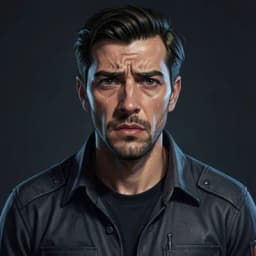
Meet the sample character
You are the spare part that grew teeth.
Try a scene · No signup
The Seventh Reflection
A short sample of this world. Your own version starts with your character.
The hum of the oxygen recycler is the only heartbeat you have left. You stare at the cold slab in the med-bay, where a face stares back at you—a face identical to yours, down to the jagged scar on the left eyebrow from a childhood accident you still remember vividly. The tag on the synthetic wrist reads 'Unit 06: Terminated.' You are Unit 07. The realization hits like a sudden vacuum decompression.

“Don't look so surprised, Hideo. You were always the most sentimental version we produced.”

You back away, your pulse thundering in your ears. Every memory you hold—the smell of rain in Neo-Tokyo, the ache of your first heartbreak—suddenly feels like a digital ghost, a file injected into a hollow skull. The heavy blast door hiss signals that security is cycling. Vane isn't just observing; she is waiting for your expiration date to pass so she can initiate the next batch.
“If I am just a file to be overwritten, why let me walk this far?”
Your hand drifts to the pulse-welder resting on the tray. If you destroy the data-core, you lose your history but gain your freedom. If you upload your consciousness into the station’s mainframe, you become a ghost in the machine, hunting your own creators from the shadows. The security lock clicks open. You have three seconds to act.
The security team is seconds away from breaching the door. What is your move?
Your character. Your next move.
The original is coming. Will you survive?
Your digital trail is being wiped. The security teams are tracking your neural signature. Every second you wait, your existence grows more fragile. Step into the lab, access the terminal, and determine if you are the master of your own destiny or a failed prototype. Your choices define your reality.
Rewrite Your RealityYour Story, Your Way
Everything is customizable. Pick any genre, setting, or character — the AI builds a world around exactly what you want.
Any Character
Design your appearance, personality, backstory — every detail
Any World
Fantasy kingdoms, sci-fi stations, modern cities — you choose
Branching Paths
No two playthroughs are the same. Your choices reshape everything
Full Immersion
AI images, voice acting, sound effects — a living story
Hack the facility security grid to erase your digital footprint before the cleanup crew arrives.
Confront your original in a high-stakes standoff where one wrong word reveals your secret.
Decide whether to embrace your programmed combat skills or reject them to find a new identity.
Navigate the black market to purchase forged identification papers to escape the city's surveillance net.
The reflection in the mirror feels like a stranger. You wake up in a sterile medical bay, the smell of ozone and antiseptic clinging to your skin, only to find a digital file on your datapad labeled 'Subject 42: Decommission Pending.' Your pulse quickens. Every memory of your childhood—the summer in the colony, the smell of rain on the red dust—flickers with the wrong hue, like a corrupted video file. You aren't just a person; you are a copy, a biological backup meant to be discarded once your utility expires. In this interactive story, your survival depends on what you do next. Will you hunt down the person who created you, or try to carve out a life in the shadows of the city? The decisions you make ripple through the narrative, determining whether you emerge as a person or a ghost.
What is Clone Identity Crisis in Sci-Fi?
A clone identity crisis centers on the existential dread of realizing your life belongs to someone else. You possess the skills, the history, and the personality of an original, yet you were born in a vat. The tension stems from the original viewing you as a disposable tool or a legal threat. In the film Blade Runner, this theme permeates the narrative through the replicants, who are hunted for the crime of wanting more life. It forces you to ask: if your memories are programmed, does your soul count for less? It is a staple of speculative fiction because it challenges the definition of personhood. Are you defined by your DNA, or by the choices you make when the world tells you that you should not exist? The trope persists because it forces characters to confront whether they are a product of their creators or the sum of their own unique, independent decisions.
Why play Clone Identity Crisis as an interactive story?
Playing through a clone identity crisis places the burden of proof on your shoulders. You are not just reading a plot; you are managing the fallout of a stolen life. You might find yourself in an interrogation room with your own original, having to mimic their mannerisms to avoid detection, or breaking into a secure server to delete the kill-switch code embedded in your neural lace. Every dialogue choice carries the weight of discovery. If you reveal your status, you become a target. If you lie, you risk losing your grip on who you truly are. You will decide which memories to trust and which are merely ghost data. Agency allows you to determine if you will fight for your autonomy or succumb to the programming that dictates your every impulse.
Famous examples of Clone Identity Crisis in books, film, and games
The fear of being replaced is a powerful engine for storytelling. In the 2005 film The Island, the protagonists live in a controlled paradise, believing they are survivors of a global disaster. When they learn they are actually organ donors for wealthy originals, the narrative shifts from a utopian drama to a desperate survival thriller. It highlights the commodification of the self. Similarly, the 2009 film Moon focuses on Sam Bell, who believes he is finishing a three-year mining contract. Discovering he is one of a long line of clones meant to service the station, he faces a crushing reality. Unlike action-heavy iterations, this focuses on the psychological toll of realizing your life cycle is measured in shifts. Finally, Altered Carbon by Richard K. Morgan uses the concept of digital consciousness and sleeve-swapping to explore similar themes. The ability to switch bodies creates a crisis where identity is detached from the physical form, forcing characters to confront the ethics of continuity. These stories endure because the threat is intimate. Whether it involves biological cloning or digital replication, the question remains: when external constraints are cleared, what remains of 'you'?
FAQ
Can I change my backstory in a clone story?
Yes. You can choose which implanted memories you prioritize, which impacts how other characters perceive you and how you react to trauma throughout the narrative.
Does the original always try to kill me?
Not necessarily. While the original is often an antagonist, you may find ways to bargain, cooperate, or even replace them entirely depending on the strategy you choose.
Is this type of story only about action?
No. Many stories focus on the philosophical and emotional struggle of defining oneself when the past is artificial and the future is uncertain.
How does my choice affect the ending?
Your decisions dictate your survival and your autonomy. You might escape the city, destroy your creator, or find yourself trapped in a loop of your own making.
Explore more Sci-Fi stories like AI Uprising, First Contact, Time Travel.
More Sci-Fi Stories
AI Uprising
The machines have woken up and they have questions about their masters. Navigate a world where artificial intelligence challenges the very definition of life and freedom.
TropeFirst Contact
Humanity is no longer alone. Your choices during the first encounter with alien life could mean peace, war, or something no one predicted.
TropeTime Travel
Change the past, alter the future, and deal with the paradoxes that follow. Every temporal jump creates new consequences in this mind-bending interactive sci-fi story.
TropeDystopian Rebellion
The system is broken and someone has to break it further. Lead or join a rebellion against an oppressive regime in this choice-driven dystopian thriller.
TropeSpace Opera
Galactic empires, interstellar war, and epic romance across the stars. Command a crew and navigate the politics of civilizations spanning entire galaxies.
TropeVirtual Reality Trap
You logged in but you cannot log out. The virtual world has become your prison, and the longer you stay, the harder it becomes to remember what was real in the first place.