Sci-Fi · Interactive story
A Race Against Time with Phileas Fogg
The clock is ticking, the steam is rising, and the world awaits your command.
Start as a guest. Choose your character before the story begins.

Meet the sample character
Clockwork physics in the age of steam and stars.
Try a scene · No signup
The Aether Circuit: Orbiting London
A short sample of this world. Your own version starts with your character.
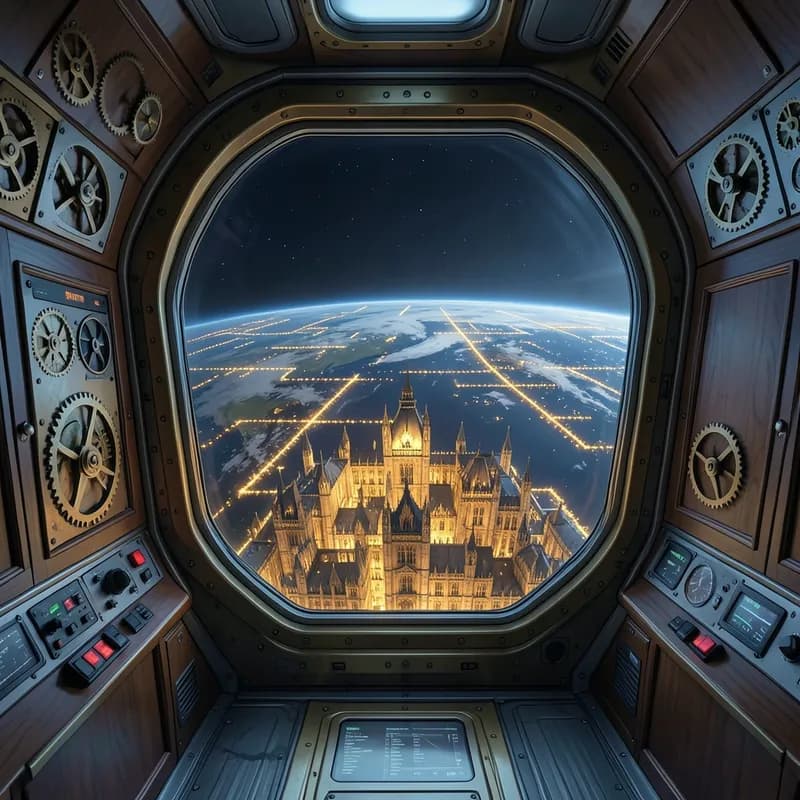
You stand on the brass-plated deck of the Chronos. Far below, London glows like a vast, flickering circuit board amidst the thick, smog-choked fog. Phileas Fogg stands beside the navigation pedestal, his thumb hovering over his gold pocket watch. The ticking of his gears syncs perfectly with the rhythmic, deep-space pulse of the ship's thrusters.

“Mr. Sterling, the orbital alignment for our jump to the Martian colony occurs in precisely forty-two seconds. Ensure the injectors are primed, or we forfeit our wager with the Admiralty.”

Fogg’s composure is maddening. He treats a light-speed jump like a morning carriage ride through Piccadilly. You wipe grease from your forehead, feeling the intense heat radiating from the engine room. You know the injectors are flawed, but admitting this means confirming your failure to the most punctual man in the Empire.
“The pressure readings are erratic, Mr. Fogg. If I force the ignition now, the stabilizers might hold—but there is no guarantee the hull integrity will survive the stress of the jump.”
Fogg remains motionless, his gaze fixed on the void beyond the viewport. He is waiting for your final instruction. The clock counts down: thirty seconds remain. The entire ship shudders as atmospheric friction begins to rattle the rivets of the bulkhead. A decision must be made before the window closes permanently.
The countdown continues to bleed away seconds. How do you address the failing injectors?
Your character. Your next move.
The train is departing. Will you be on it?
The clock is already ticking. Every second you hesitate is a second lost to the horizon. Step onto the platform, manage your resources, and prove that you can conquer the globe in eighty days. Your path is yours to create.
Start Your RaceYour Story, Your Way
Everything is customizable. Pick any genre, setting, or character — the AI builds a world around exactly what you want.
Any Character
Design your appearance, personality, backstory — every detail
Any World
Fantasy kingdoms, sci-fi stations, modern cities — you choose
Branching Paths
No two playthroughs are the same. Your choices reshape everything
Full Immersion
AI images, voice acting, sound effects — a living story
Select specific transit routes that alter your arrival time and fuel consumption.
Choose to negotiate with local officials or bypass them to maintain your schedule.
Manage your remaining budget to afford faster steamers or bribe reluctant train conductors.
Respond to unexpected mechanical failures that threaten the integrity of your global journey.
The steam whistle shrieks at Victoria Station, a piercing cry that signals the start of the impossible. Phileas Fogg checks his pocket watch, his expression as frozen as the morning frost on the tracks. You stand beside him, the weight of a twenty-thousand-pound wager pressing against your conscience. Every decision you make—whether to bribe a captain for a faster steamer or risk a shortcut through the Suez—determines whether you arrive in London before the clock strikes zero. This is a race where seconds become years, and your next move decides the fate of a fortune. You are the architect of this expedition, and the path you choose will either secure your reputation or leave you stranded in the dust of history.
What is Phileas Fogg in Sci-Fi?
Phileas Fogg is the quintessential Victorian gentleman, introduced by Jules Verne in the 1872 novel Around the World in Eighty Days. He is defined by his rigid punctuality, his vast, mysterious wealth, and his unwavering belief in the power of modern engineering. Fogg is not a hero in the traditional sense; he is a man of logic, treating the planet like a puzzle to be solved. In adaptations like the 1956 film starring David Niven or the 2021 television series featuring David Tennant, Fogg’s character often pivots between cold calculation and the warmth of human connection. By placing him in a sci-fi context, we re-examine his obsession with efficiency. Is he a man out of time, or is he the prototype for the modern, tech-driven explorer? He represents the transition from the limitations of the horse-drawn era to the rapid expansion of the industrial age, making him the perfect vessel for stories about technological mastery.
Why play Phileas Fogg as an interactive story?
In this interactive experience, you control the pace of the expedition. You are not just following the text of a book; you are managing the resources of a global transit network. You face the choice of whether to trust the suspicious Detective Fix or to distance yourself from his inquiries. When the coal runs low in the middle of the Indian Ocean, will you sacrifice the ship’s internal fixtures for fuel, or will you stall and risk losing the bet? Each stop provides a new variable, from political unrest to technological failure, requiring you to weigh speed against safety. Your agency dictates whether Fogg remains a man of logic or crumbles under the pressure of the deadline.
The literary legacy of Phileas Fogg
Jules Verne’s 1872 work captured the Victorian obsession with global connectivity. The expansion of the railway and the opening of the Suez Canal made the world feel suddenly smaller, and Verne was the first to weaponize that realization in fiction. Over the decades, Fogg has appeared in countless forms, from the 1989 animated series to various stage plays and board games. These iterations focus on the tension between Victorian stiff-upper-lip stoicism and the chaotic reality of travel. Fogg works today because he represents the human desire to master the environment through sheer force of will. He proves that no matter how advanced the technology, the human element—our choices, our mistakes, and our camaraderie—remains the deciding factor in every great venture. Whether he is portrayed as a steampunk visionary or a traditionalist, the core of the character remains his refusal to accept that the world is too big to be conquered by a single man with a sharp mind and a steady hand.
FAQ
How does the clock affect gameplay?
Every action consumes a specific amount of time. Choosing faster travel options may save hours but cost more money or risk mechanical failure, while safer routes might cause you to miss your deadline.
Can I play as a character other than Fogg?
While the primary perspective is tied to the expedition, your decisions influence how Fogg interacts with his companion, Passepartout, and the various allies you meet along the way.
Is this game historically accurate?
It blends historical Victorian elements with speculative sci-fi technology, allowing for a creative interpretation of the original journey while maintaining the spirit of Verne's era.
What happens if I fail to return in time?
The narrative branches based on your success or failure. Missing the deadline leads to unique story outcomes that reflect the consequences of your specific strategic choices.
Explore more Sci-Fi stories like AI Uprising, First Contact, Time Travel.
More Sci-Fi Stories
AI Uprising
The machines have woken up and they have questions about their masters. Navigate a world where artificial intelligence challenges the very definition of life and freedom.
TropeFirst Contact
Humanity is no longer alone. Your choices during the first encounter with alien life could mean peace, war, or something no one predicted.
TropeTime Travel
Change the past, alter the future, and deal with the paradoxes that follow. Every temporal jump creates new consequences in this mind-bending interactive sci-fi story.
TropeDystopian Rebellion
The system is broken and someone has to break it further. Lead or join a rebellion against an oppressive regime in this choice-driven dystopian thriller.
TropeSpace Opera
Galactic empires, interstellar war, and epic romance across the stars. Command a crew and navigate the politics of civilizations spanning entire galaxies.
TropeClone Identity Crisis
You have just discovered you are one of many copies. Your memories may be implanted, your life may be borrowed, and the original wants you erased. Prove your right to exist.