
Sword & Sorcery · Interactive story
The Gorgon's Shadow: Hunt the Medusa as Perseus
A polished shield, a sharp blade, and a monster that kills with a glance.
Start as a guest. Choose your character before the story begins.
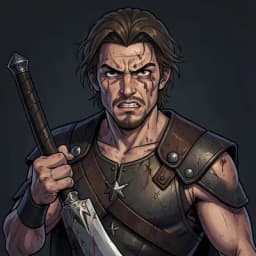
Meet the sample character
The price of glory is written in stone.
Try a scene · No signup
Gorgon's Grin
A short sample of this world. Your own version starts with your character.
You stand at the threshold of the petrified garden. The air tastes of ozone and stale dust. Around you, statues of once-great heroes stare with sightless, stone eyes, their last expressions frozen in raw terror. The silence is heavy, broken only by the rhythmic scrape of scales against damp stone.

“The winged sandals will not save you if you blink, boy. Keep the shield polished, or you will join the gallery.”

You adjust your grip on the polished surface, your knuckles white against the metal. The darkness ahead shifts. A wet, slithering sound echoes from the rafters above. Somewhere in the gloom, a thousand serpents hiss in unison. You aren't just hunting a monster; you are walking into a tomb where the only way out is through the blood of a queen.
“I did not cross the world to become a garden ornament. Tell the gods to hold their breath for the funeral.”
The ceiling groans as a shadow detaches itself from the stalactites, looming over you with the predatory grace of a nightmare. You feel the heat of a gaze that could strip the life from your bones. You have one chance to strike before the living stone locks you into place forever.
The serpent-crowned head turns toward your reflection in the shield. How do you meet the monster?
Your character. Your next move.
Claim your blade and face the Gorgon.
The king is waiting for your return, and the Gorgon’s lair is growing colder. Will you use the winged sandals to outrun your fate, or will you stand your ground and meet Medusa head-on? Your choices in the dark will define your legacy. Start your hunt now.
Begin your huntYour Story, Your Way
Everything is customizable. Pick any genre, setting, or character — the AI builds a world around exactly what you want.
Any Character
Design your appearance, personality, backstory — every detail
Any World
Fantasy kingdoms, sci-fi stations, modern cities — you choose
Branching Paths
No two playthroughs are the same. Your choices reshape everything
Full Immersion
AI images, voice acting, sound effects — a living story
Choose whether to accept divine artifacts that demand a heavy sacrifice in return.
Navigate the treacherous stone garden while avoiding the fatal gaze of the Gorgon.
Decide the fate of Andromeda, weighing political alliances against the risk of combat.
Manage your limited endurance against the relentless pace of a monster-hunting expedition.
The salt air of Seriphos stings your lungs. You stand before the king, tasked with a chore designed to end your life. Bring back the head of the Gorgon, or watch your mother suffer in chains. You have no divine army, only the winged sandals strapped to your feet and a mirror-bright shield that reflects the world as it truly is. In these stories, the path you carve through the serpent-haired horrors is yours alone. Every decision—from which god to petition for aid to how you approach the cavern entrance—shifts the weight of your fate. You are not a spectator to this ancient bloodletting; you are the hand that grips the sword. The cavern walls are slick with the remains of those who failed before you, and silence is the only thing keeping you alive. Whether you survive the encounter depends entirely on how you handle the tools of the trade and the shifting sands of divine favor.
What is Perseus in Sword & Sorcery?
Perseus is the original hero of the Greek myths, a demigod defined by cunning rather than raw, mindless strength. Unlike Heracles, who solved problems with a club, Perseus relied on divine favors and his own wits to survive impossible odds. He is the archetypal monster-slayer, most famous for decapitating Medusa, whose gaze turned all living things into calcified statues. You see this archetype echoed in everything from the gritty, practical monster-hunting of The Witcher novels by Andrzej Sapkowski to the high-stakes combat of games like God of War. Even the 1981 film Clash of the Titans cemented his image as the man who stares down death. Perseus represents the turning point where human intelligence overcomes supernatural terror. In sword and sorcery, he functions as the blueprint for the hero who must navigate the whims of fickle gods while keeping their feet firmly planted in the mud of the mortal world. He does not rely on destiny; he relies on the edge of his blade and the clarity of his reflection.
Why play Perseus as an interactive story?
You are not just following a script; you are deciding how to survive the Gorgon's lair. Will you rely on Athena’s wisdom, or will you attempt to bargain with the Graeae to find the path? The tension comes from the cost of your gear and the brevity of your life. One wrong step near the stone garden, and you become a permanent fixture in Medusa’s collection. You must manage your resources—your stamina, your divine gifts, and your own resolve—as you move through a landscape where sorcery is as dangerous as a sharpened blade. Each choice ripples outward: offending a god might leave you without a guide, while showing mercy to a captive might provide you with an unexpected ally in the deepest dark. The agency you hold changes the outcome of the myth, forcing you to choose between the path of the hero and the path of the survivor.
The literary legacy of Perseus
The legend of Perseus, as chronicled in Ovid’s Metamorphoses, remains one of the most enduring templates for the hero’s journey. Born from a shower of gold and cast into the sea, Perseus’s story is a classic rise from ignominy to glory. Throughout history, he has been reinterpreted to fit the anxieties of the age. In the Renaissance, he was a symbol of virtue overcoming vice, captured perfectly in Benvenuto Cellini’s famous bronze sculpture. In the 20th century, the Clash of the Titans film franchise transformed him into a more traditional action hero, emphasizing the spectacle of his battles against the Kraken and the Gorgon. What makes the Perseus myth so resilient is the central conflict: a man with limited tools facing an infinite, god-given horror. It is the perfect setup for modern sword and sorcery, where the stakes are visceral and the victory is never guaranteed. He remains the standard for the hero who survives by his wits, proving that even a demigod is only as good as his preparation and his ability to see the truth through a mirror. Today, he continues to inspire stories where the mortal hero must outthink the divine to carve a name into history.
FAQ
What is the focus of this Perseus interactive story?
It focuses on the tactical and narrative choices involved in hunting Medusa, managing divine favor, and surviving the hazards of ancient Greece.
How does the combat work?
Combat relies on your decision-making and character stats rather than twitch reflexes, emphasizing resource management and strategic preparation.
Can I change the outcome of the myth?
Yes, your choices allow you to deviate from the traditional legend, potentially leading to different endings based on the alliances you build and the risks you take.
Is this story appropriate for someone new to Greek mythology?
Absolutely. The narrative provides all necessary context while remaining engaging for those who already know the legend.
Explore more Sword & Sorcery stories like Barbarian Quest, Ancient Tomb Raid, Sorcerer Duel.
More Sword & Sorcery Stories
Barbarian Quest
You come from the wild lands with nothing but a blade and iron will. Carve your path through civilized treachery, ancient ruins, and sorcerous enemies who underestimate the fury of the uncivilized.
TropeAncient Tomb Raid
A forgotten king's tomb lies unsealed, its corridors lined with traps, curses, and treasures that haven't seen daylight in millennia. Plunder the dead — if you can survive what guards them.
TropeSorcerer Duel
Two wielders of dark power face off in a contest of will, cunning, and raw magical force. Challenge a rival sorcerer to a duel where the loser pays with far more than their life.
TropeMercenary Contract
Gold is gold, and you don't ask questions — until the job turns out to be far darker than the contract described. Navigate double-crosses, moral dilemmas, and enemies on every side.
TropeGladiator Arena
The crowd roars and the gate rises. Fight beasts, warriors, and sorcerers on the blood-soaked sand, winning your freedom one kill at a time — or die entertaining the masses.
TropeCursed Blade
The sword whispers to you, promising victory at a terrible cost. Wield a weapon of legendary power that feeds on your soul, and discover whether you master the blade or it masters you.