
Sword & Sorcery · Interactive story
Blood, Gold, and Broken Oaths
The employer paid half up front, but the real cost is your soul.
Start as a guest. Choose your character before the story begins.
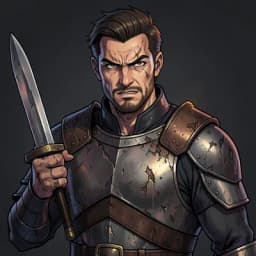
Meet the sample character
The contract was simple; the outcome is anything but.
Try a scene · No signup
Blood and Parchment
A short sample of this world. Your own version starts with your character.
You stand in the suffocating heat of the vault, the air heavy with the scent of ozone and rotting fruit. Your boots crunch on fine, gray ash that wasn't there when you signed the contract. Vane promised a simple grab-and-go, a retrieval of a relic from the Old King. Instead, you stare at a row of iron cages, each holding a child shivering in the dark.

“Don't stare at the cargo, Harek. Focus on the binding rune on the center pillar. Get it, or we both lose our heads.”

You feel the hilt of your broadsword, the leather worn smooth against your palm. The weight of the gold purse in your belt suddenly feels like lead. Vane’s hand drifts toward his own dagger, his eyes darting toward the cages. You see the twitch in his jaw; he is not just here for the scroll, and his intentions are far bloodier than he let on.
“These aren't artifacts, Vane. You lied about the job, and I don't work for kidnappers.”
The iron floor beneath you groans, the seal on the center pillar beginning to glow a sickly, pulsing violet. A deafening screech echoes from the darkness behind the cages—something massive is waking up. Vane draws his steel, his face pale as he realizes the contract is about to cost more than just his reputation. The beast shifts in the shadows, and you are trapped.
The beast is emerging and Vane is panicking; how do you handle this breach of contract?
Your character. Your next move.
The contract is signed. The gold is waiting.
Your patron is waiting in the shadows of the Blackwood Tavern. They claim the task is simple, but the weight of the silver in your palm feels wrong. Step into the boots of a sellsword where every coin represents a life, and every promise is a gamble. Will you finish the job, or will you find out why the last mercenary never returned?
Accept the ContractYour Story, Your Way
Everything is customizable. Pick any genre, setting, or character — the AI builds a world around exactly what you want.
Any Character
Design your appearance, personality, backstory — every detail
Any World
Fantasy kingdoms, sci-fi stations, modern cities — you choose
Branching Paths
No two playthroughs are the same. Your choices reshape everything
Full Immersion
AI images, voice acting, sound effects — a living story
Negotiate your fee with suspicious patrons before entering dangerous, uncharted territory.
Choose whether to uphold your oath or abandon the job when the employer lies.
Manage your inventory and weapon durability during long, subterranean combat encounters.
Decide which factions to align with when the contract turns into a political snare.
Rain slicked the cobblestones of Oakhaven as Jorgas checked his coin purse for the third time. The employer, a cloaked figure with a voice like grinding stones, wanted a relic retrieved from the Sunken Crypt. Simple enough for a man who had survived the siege of Kaltos. But as Jorgas pushed open the crypt’s iron doors, the air didn't smell like damp earth; it smelled of ozone and fresh blood. You are the one holding the blade in the dark, and every decision you make ripples through the silence of the tomb, determining whether you collect your bounty or become another cautionary tale for the next sellsword to wander through. This is an interactive story where your choices dictate whether you walk away with the gold or end up as a stain on the dungeon floor.
What is Mercenary Contract in Sword & Sorcery?
A mercenary contract is the ultimate setup for a sword and sorcery story because it immediately establishes the stakes. You are a professional, not a hero. You have a goal, a price, and a set of rules. The conflict arises when the world tries to break those rules. Think of Geralt of Rivia from The Witcher—he takes a contract to hunt a monster, but the village politics and the creature’s hidden intelligence complicate a simple kill. The trope works because it forces a collision between your character’s greed or necessity and their moral compass. When the employer hides the true nature of the target, the contract shifts from a business transaction into a fight for survival. It acts as an engine for discovery, as you must uncover why you were truly hired, often finding that the person who paid you is a greater threat than the beast you were sent to slay. This structure provides a clear framework for the narrative, allowing the player to engage with a world that is often indifferent to their survival.
Why play Mercenary Contract as an interactive story?
Playing through a mercenary contract allows you to decide exactly how much your character values their own skin compared to their word. You aren't just reading about a sellsword’s dilemma; you are the one staring at the gold, weighing it against the looming threat of a double-cross. Will you uphold the oath despite the mounting evidence of a trap, or will you take the coin and run before the blade hits your back? You decide how your character interacts with the world. Do you negotiate for more pay, intimidate informants, or rely on your blade to clear a path? The tension comes from the limited information you have at the start of the mission and the way your choices reveal the hidden agendas of your patrons. Every interaction is a chance to define your reputation in a world where a bad name can get you killed.
Famous examples of Mercenary Contract in books, film, and games
The mercenary contract is a cornerstone of the genre because it grounds high-fantasy stakes in relatable, grubby reality. In Joe Abercrombie’s The First Law trilogy, the characters are rarely motivated by honor. They are driven by survival and the next paycheck, which turns every mission into a masterclass in tension. The contract provides a framework for the narrative, allowing the author to drop the protagonist into a new, hostile environment with a clear objective. Similarly, in the video game Dragon's Dogma, the cycle of taking jobs from local boards often leads to encounters that spiral into massive, world-altering events. The trope endures because it is inherently modular; it allows for a diverse range of stories, from small-scale tavern brawls to epic quests that involve gods and kings. Whether it is a bounty hunter in The Mandalorian or a sellsword in classic pulp fiction, the contract acts as a tether that pulls the protagonist—and the reader—into the heart of the action. It is the perfect device to focus on the raw, desperate reality of the trade, turning a simple job into a test of character.
FAQ
What is a mercenary contract story?
It is a narrative centered on a professional sellsword tasked with a specific job that inevitably spirals into a complex moral or physical crisis.
Why is this trope effective for interactive fiction?
It gives you a clear goal at the start, which makes every choice feel weighted by the potential reward or the risk of death.
Can I play a character who breaks their contract?
Yes, your choices define your character’s integrity. You can choose to walk away, betray your patron, or fight for your own interests.
Is this genre only about fighting monsters?
No, while combat is a major part, these stories often involve investigation, negotiation, and navigating the social webs of the cities you operate in.
Explore more Sword & Sorcery stories like Barbarian Quest, Ancient Tomb Raid, Sorcerer Duel.
More Sword & Sorcery Stories
Barbarian Quest
You come from the wild lands with nothing but a blade and iron will. Carve your path through civilized treachery, ancient ruins, and sorcerous enemies who underestimate the fury of the uncivilized.
TropeAncient Tomb Raid
A forgotten king's tomb lies unsealed, its corridors lined with traps, curses, and treasures that haven't seen daylight in millennia. Plunder the dead — if you can survive what guards them.
TropeSorcerer Duel
Two wielders of dark power face off in a contest of will, cunning, and raw magical force. Challenge a rival sorcerer to a duel where the loser pays with far more than their life.
TropeGladiator Arena
The crowd roars and the gate rises. Fight beasts, warriors, and sorcerers on the blood-soaked sand, winning your freedom one kill at a time — or die entertaining the masses.
TropeCursed Blade
The sword whispers to you, promising victory at a terrible cost. Wield a weapon of legendary power that feeds on your soul, and discover whether you master the blade or it masters you.
TropeDemon Summoning
You draw the circle, speak the words, and something hungry answers from the void. Bind a demon to your will and wield its power — but every summoning erodes the barrier between your world and the abyss.