
Solarpunk · Interactive story
The Sun is Our Battery
Harness the light to power the revolution before the grid goes cold.
Start as a guest. Choose your character before the story begins.

Meet the sample character
The sun is our only employer now.
Try a scene · No signup
The Last Watt
A short sample of this world. Your own version starts with your character.
The inverter screams, a high-pitched whine that rattles your teeth. You wipe sweat from your eyes, your fingers dancing over the frayed wiring of the main relay. Outside the shed, the massive, fan-like solar collectors tilt toward the horizon, tracking the light with a rhythmic, mechanical groan. If the connection drops now, the irrigation pumps for the community garden will seize, and the harvest will wither before sundown.

“The load is spiking, Ren! The battery banks can’t take the surge unless we dump the excess into the auxiliary grid—but the corporation will see that ping immediately.”
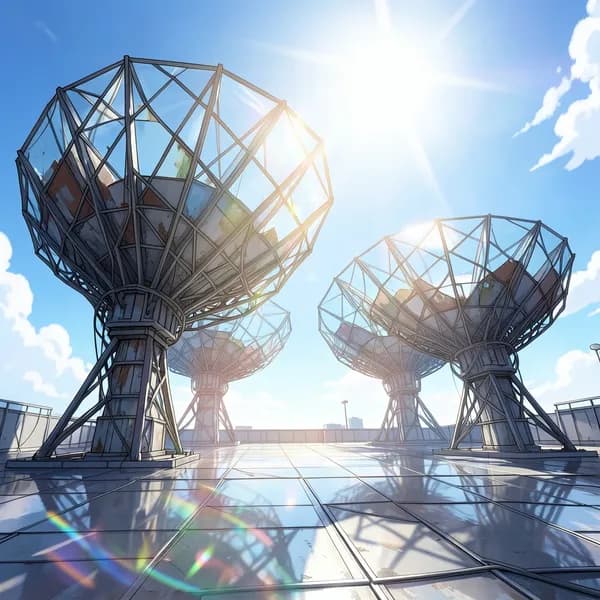
Sora’s voice is frantic, her face smudged with soot and oil. You glance at the monitor; the flickering red line shows the community's energy demand skyrocketing as the heat intensifies. If you connect to the central hub, you gain stability but lose your autonomy. If you push the current through your jerry-rigged capacitors, you risk a total blackout across the entire block.
“We didn't reclaim this land to beg for crumbs from their grid. We hold the line here, even if it means frying every circuit in the shed.”
Your hand hovers over the copper bypass switch. Behind you, the heavy steel door groans under the pressure of the wind, or perhaps something heavier outside. The choice is instantaneous: force the power through the failing capacitors, tap into the corporate grid and pray they don't trace the signal, or initiate a controlled shutdown and lose the crop. The light reflects off your skin, harsh and blinding.
The smell of melting insulation fills the air. How do you stabilize the Zenith Array before the grid fails?
Your character. Your next move.
Claim your sun and power your future.
The corporate grid is failing, and your neighbors are looking to you for a solution. Will you finalize the designs for the new array, or will you spend your remaining time negotiating for more supplies? Every wire you connect and every vote you cast changes the outcome for your settlement. Start your solar harvest and build a world that lasts.
Begin Your Solar HarvestYour Story, Your Way
Everything is customizable. Pick any genre, setting, or character — the AI builds a world around exactly what you want.
Any Character
Design your appearance, personality, backstory — every detail
Any World
Fantasy kingdoms, sci-fi stations, modern cities — you choose
Branching Paths
No two playthroughs are the same. Your choices reshape everything
Full Immersion
AI images, voice acting, sound effects — a living story
Calibrate voltage regulators to ensure the community grid survives the peak usage hours.
Negotiate with the corporate blockade for rare components without compromising your autonomy.
Choose between open-source designs to help neighbors or secure patents for future growth.
Allocate limited solar energy between the hydroponic gardens and the town’s heating system.
The hum of the converter is the only sound in the canyon as the sun dips behind the ridge. You adjust the final coupling on the glass array, watching the indicator light flicker from red to a steady, hopeful green. For years, the city elders relied on the flickering fossil fuel lines controlled by the corporations in the lowlands, but those days end now. You stand on the precipice of energy independence, holding the wrench that changes everything. In this interactive narrative, your decisions determine whether the community grid holds during the coming storm or if the old powers manage to silence your progress. Every adjustment to the voltage regulator and every conversation with the town council echoes through the streets. You decide if you prioritize immediate survival or long-term infrastructure, knowing that your choices shape the path of the entire settlement.
What is Solar Harvest in Solarpunk?
The Solar Harvest trope focuses on the transition from scarcity to abundance through localized, renewable technology. Unlike traditional post-apocalyptic tales where characters scavenge for scraps, a Solar Harvest narrative centers on the ingenuity required to build a self-sustaining system. It is a story about reclaiming the means of production—specifically, the energy required to light, heat, and grow. This trope highlights the tension between centralized control and decentralized autonomy. You aren't just surviving; you are creating a new societal foundation. In Hayao Miyazaki’s 'Nausicaä of the Valley of the Wind,' the wind-powered infrastructure of the valley serves as the heartbeat of the community, representing a quiet defiance against the encroaching toxicity of a dying industrial world. Similarly, in Ursula K. Le Guin’s 'The Dispossessed,' the struggle to maintain technological systems on a harsh planet mirrors the Solar Harvest ethos: the idea that technology must be shared and understood by the collective to be truly free. This trope turns the act of engineering into a political statement. It posits that a better future isn't given; it is manufactured by those brave enough to look at the sun and see a power source that no corporation can tax or toggle off.
Why play Solar Harvest as an interactive story?
Playing through a Solar Harvest narrative puts the weight of the grid on your shoulders. You are not a passive observer; you are the lead engineer and community advocate. You face the immediate pressure of failing batteries during a heatwave and the long-term political pressure of deciding who gets priority power when resources are thin. The stakes are tangible. If you focus solely on industrial efficiency, you might alienate the artists and gardeners who need that same sunlight for their crops. If you prioritize community consensus, the hardware might remain unfinished before the winter storms arrive. You will find yourself debating with local leaders, negotiating for raw materials with scavengers, and deciding whether to keep your blueprints open-source or protect your intellectual property to ensure the tech doesn't fall into the wrong hands. The agency lies in balancing technical reality with social harmony. Do you build a massive, fragile array that powers the whole town, or smaller, resilient units for every household? Your choices define the culture of your home.
Famous examples of Solar Harvest in books, film, and games
The Solar Harvest trope appears whenever a story focuses on the radical act of independence through energy. In the video game 'Horizon Zero Dawn,' while the setting is post-apocalyptic, the core narrative drive involves Aloy interacting with ancient energy systems and solar-integrated technology to understand and eventually restore a balanced ecosystem. It captures the essence of using high-tech tools to heal a scarred landscape. Another compelling look at this can be found in the manga 'Blame!' by Tsutomu Nihei, where the focus on massive, self-sustaining structures that capture and distribute energy becomes the central mystery of the world. Even in 'Wall-E,' the ship's reliance on solar energy and the eventual return to earth to cultivate life mirrors the transition from corporate-controlled stagnation to a self-sufficient solar future. These stories endure because they offer a blueprint for hope. They move away from the nihilism of 'everything breaks' and toward the constructive satisfaction of 'we can fix this.' The trope works because it validates the reader's desire to see technology used for the common good rather than for destruction. It transforms the cold, clinical nature of engineering into an act of love for one's community, making the final 'harvest' of energy feel like a hard-won victory.
FAQ
What is the core conflict in a Solar Harvest story?
The conflict usually pits the community's need for energy independence against external corporate interests or internal resource scarcity. You have to balance the technical challenge of building the system with the social challenge of keeping the community united.
Can I play as a technician or a politician?
Yes. The narrative allows you to choose your focus. You can prioritize the mechanical engineering of the solar arrays or the diplomatic work of convincing the town to adopt your new, cleaner energy solutions.
Is this genre always about building things?
While building is central, the genre is also about maintenance and community. It explores the social impact of energy. You might spend as much time managing a town council meeting as you do soldering wires on a roof.
How does the AI handle my technical choices?
The system tracks your resource allocation and political stances. If you prioritize efficiency over accessibility, the community might react with distrust, affecting how much support you receive for future projects.
Explore more Solarpunk stories like Green City Utopia, Community Garden Revolution, Eco-Sabotage.
More Solarpunk Stories
Green City Utopia
The city breathes. Vertical gardens climb every building, solar panels coat every surface, and the air is cleaner than it has been in centuries. But maintaining this utopia requires sacrifices not everyone is willing to make.
TropeCommunity Garden Revolution
It started with a single garden and grew into a movement. You lead a community that is reclaiming urban space one plot at a time, feeding neighborhoods and challenging the corporations that control the food supply.
TropeEco-Sabotage
The megacorp's pipeline will destroy the last wild river. Legal channels have failed, and you face the moral weight of sabotage—breaking the law to save what cannot speak for itself.
TropeCooperative Governance
No presidents, no kings—just the community deciding together. You navigate the messy, beautiful reality of cooperative governance where every voice matters and consensus is both the goal and the greatest challenge.
TropeRewilding Mission
The concrete is being torn up and the forests are coming back. You lead a rewilding mission to restore a devastated landscape, reintroducing species and rebuilding ecosystems that took millennia to develop.
TropeOcean Cleanup
The ocean is choking and your team is its last hope. You deploy experimental cleanup technology across the most polluted waters on Earth, battling storms, equipment failures, and the sheer scale of the damage.