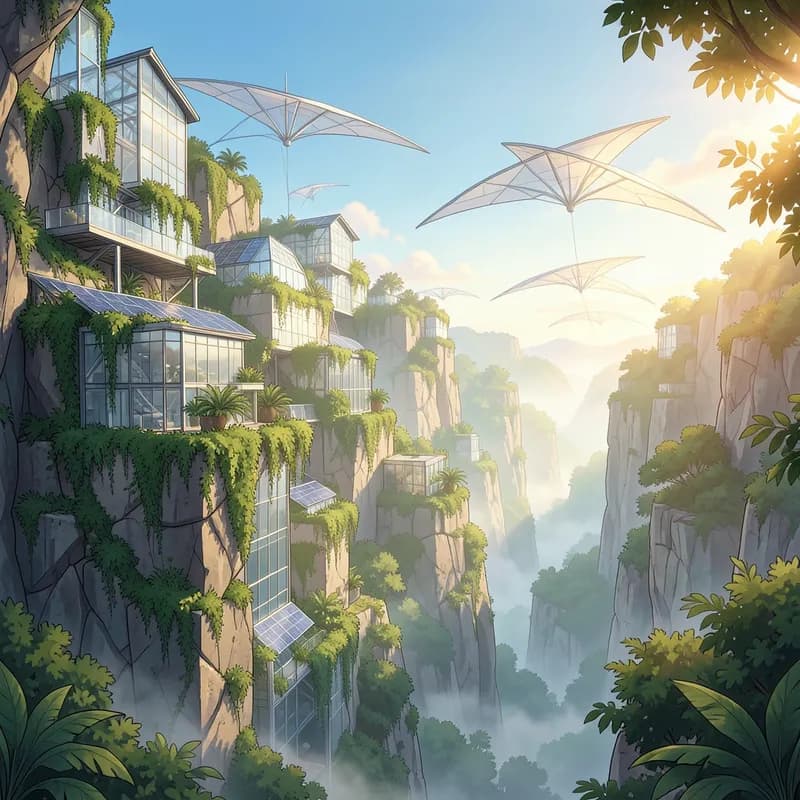
Solarpunk · Interactive story
The Architecture of Hope: Designing Your Green City Utopia
Where the skyline breathes and every choice sows the seeds of a new world.
Start as a guest. Choose your character before the story begins.

Meet the sample character
The price of a perfect garden.
Try a scene · No signup
Rust Among the Terraces
A short sample of this world. Your own version starts with your character.
Your boots crunch softly against the moss-lined path of the terrace. High above, the solar-sails pivot in unison to catch the dawn, casting the city in a shifting dance of light and shadow. You stare at the fern wall in front of you; the leaves are yellowing, curling into brittle, blackened claws despite your best efforts.

“The harvest report from Sector 4 is late, Junko. The council is starting to ask why the nutrient output is stalling while the rest of the city thrives.”

You feel the weight of the tablet in your pocket, containing the encrypted diagnostics that prove the blight is systemic, not seasonal. If you show him the data, the council will burn the entire terrace to save the upper levels. If you stay silent, the rot will spread to the central irrigation hub by morning.
“It’s a minor calibration issue with the misting cycles, Kenji. I have it under control. You don't need to involve the council yet.”
Kenji steps closer, his shadow stretching across the wilting plants. He taps his own wrist-interface, a notification pinging loudly in the quiet terrace. 'I just received a red-alert ping from the sensor array near the main pump,' he whispers, his eyes narrowing. 'This isn't a misting issue, is it?'
The sensor array has alerted the council. How do you handle Kenji's discovery?
Your character. Your next move.
Start building your green future today.
The city is waiting for your leadership. Will you prioritize the vertical gardens that feed your people, or the solar arrays that power their future? Every decision is a step toward a world that works. Begin your story now and find out if your vision of a green city can survive the test of time.
Start Your StoryYour Story, Your Way
Everything is customizable. Pick any genre, setting, or character — the AI builds a world around exactly what you want.
Any Character
Design your appearance, personality, backstory — every detail
Any World
Fantasy kingdoms, sci-fi stations, modern cities — you choose
Branching Paths
No two playthroughs are the same. Your choices reshape everything
Full Immersion
AI images, voice acting, sound effects — a living story
Allocate limited water reserves between public vertical farms and residential cooling systems.
Mediate conflicts between technological integrationists and those favoring traditional, low-impact artisan craftsmanship.
Design city-wide energy distribution grids to survive seasonal environmental shifts and storms.
Choose to prioritize long-term ecological restoration over immediate, short-term economic output.
Morning light hits the glass panels of the district, warming the hydroponic moss that blankets the south-facing walls. You stand on the balcony of the communal hub, watching the automated harvesters glide through the rooftop orchards. Below, the streets are quiet—no combustion, no smog, just the low hum of kinetic pavers generating electricity under the footsteps of the residents. You hold a data pad displaying a critical shortfall in the district’s water reclamation system. To fix it, you must decide whether to throttle the irrigation for the public garden or redirect energy from the residential climate control. Your choice determines whether the greenery survives the heatwave or the neighbors endure a restless night. This is a story where the survival of your home depends on your willingness to balance human comfort with the needs of the ecosystem.
What is Green City Utopia in Solarpunk?
The Green City Utopia is a narrative trope that shifts the focus from dystopian survival to the practical maintenance of a sustainable society. Unlike settings that focus on the collapse of civilization, this trope explores the messy, quiet work of keeping a garden-city alive. It asks: what happens when the revolution succeeds? In Ernest Callenbach’s *Ecotopia*, the protagonist enters a breakaway nation that has fully integrated technology with ecological preservation. The tension does not come from external villains, but from the internal struggle to maintain equilibrium. Similarly, Hayao Miyazaki’s *Nausicaä of the Valley of the Wind* portrays a community struggling to live alongside a toxic jungle, highlighting how even a 'utopian' existence requires constant, active participation. It is a genre that rejects the idea of a perfect, static ending. Instead, it frames progress as a living organism that needs pruning, care, and sometimes, difficult sacrifices of one’s own desires for the benefit of the whole. This trope highlights the beauty of collective action and the reality that a better world is not a gift, but a constant project.
Why play Green City Utopia as an interactive story?
Playing through a Green City Utopia forces you to act as a steward rather than a conqueror. You are not fighting for power; you are fighting for efficiency, harmony, and resilience. You will face moments where the needs of the collective clash with the needs of the individual. For instance, do you prioritize the expansion of the vertical forest to purify the air, or do you allocate those resources to upgrade the community’s solar-battery storage before the upcoming monsoon? You might be tasked with mediating a dispute between the city planners who want to automate the harvest and the elders who insist on manual labor to maintain social cohesion. Every decision leaves a mark on the city's infrastructure and the morale of its people. You witness the direct consequences of your policies as the city either flourishes or begins to wither. The tension arises from the realization that in this version of the future, there is no 'winning'—only the ongoing, vital work of keeping the balance.
Famous examples of Green City Utopia in books, film, and games
The Green City Utopia appears in various forms, each offering a different take on how humanity reconciles with nature. In Kim Stanley Robinson’s *Pacific Edge*, the setting is a near-future California that has successfully transitioned to a green economy. Robinson focuses on the granular details of local governance and the personal lives of people trying to live ethically in a post-capitalist society. It is a stark contrast to the high-stakes, dramatic landscapes found in other genres, proving that political stability can be just as compelling as war. Another example is found in the video game *Cloudpunk*, which, while leaning into cyberpunk, features verticality and dense environmental integration that hint at the solarpunk potential of dense, multi-layered urban spaces. In manga, *Aria the Animation* presents a terraformed Mars (Aqua) where the city of Neo-Venezia is built on water and tradition, emphasizing harmony with the environment as a spiritual requirement. These works endure because they provide a blueprint for a life that feels achievable. They move away from the nihilism of the early 21st century and instead offer a look at what happens when humanity stops fighting its environment and starts working with it.
FAQ
What is the main conflict in a Green City Utopia story?
The conflict is rarely about defeating a singular enemy. It is about the friction between competing goods: the need for growth versus preservation, individual liberty versus community stability, and technological advancement versus ecological harmony.
How does an interactive story change the solarpunk experience?
Interactive fiction puts the responsibility of the 'utopia' on your shoulders. You aren't just reading about a perfect world; you are making the hard choices that prevent it from sliding into disrepair or resource exhaustion.
Is this a post-apocalyptic genre?
Not exactly. While many solarpunk stories imply the world has moved past a crisis, the focus is on the reconstruction and the new, healthier systems being built, rather than the rubble left behind.
Can I play as a villain in this setting?
You can choose to prioritize policies that lead to inequality or environmental decay. The 'villain' here is often someone who ignores the delicate balance of the system for short-term gain.
Explore more Solarpunk stories like Community Garden Revolution, Solar Harvest, Eco-Sabotage.
More Solarpunk Stories
Community Garden Revolution
It started with a single garden and grew into a movement. You lead a community that is reclaiming urban space one plot at a time, feeding neighborhoods and challenging the corporations that control the food supply.
TropeSolar Harvest
The sun provides everything your community needs—if you can build the technology to harvest it. You race to complete a solar array that will free your people from dependency on fossil fuel corporations.
TropeEco-Sabotage
The megacorp's pipeline will destroy the last wild river. Legal channels have failed, and you face the moral weight of sabotage—breaking the law to save what cannot speak for itself.
TropeCooperative Governance
No presidents, no kings—just the community deciding together. You navigate the messy, beautiful reality of cooperative governance where every voice matters and consensus is both the goal and the greatest challenge.
TropeRewilding Mission
The concrete is being torn up and the forests are coming back. You lead a rewilding mission to restore a devastated landscape, reintroducing species and rebuilding ecosystems that took millennia to develop.
TropeOcean Cleanup
The ocean is choking and your team is its last hope. You deploy experimental cleanup technology across the most polluted waters on Earth, battling storms, equipment failures, and the sheer scale of the damage.