
Solarpunk · Interactive story
Where Broken Things Find New Life
Sunlight filters through the skylight, illuminating a workbench cluttered with half-finished dreams and gears.
Start as a guest. Choose your character before the story begins.
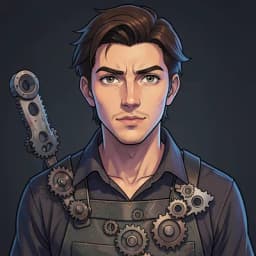
Meet the sample character
Decisions molded in resin and sweat.
Try a scene · No signup
The Last Cartridge
A short sample of this world. Your own version starts with your character.
The subterranean air tastes of wet moss and recycled ozone. Overhead, the glass dome of the workshop catches the noon sun, casting dappled light across tables cluttered with brass gears and tangled fiber-optics. You hold the fractured impeller of the district’s water pump, the plastic still warm from the friction that killed it. Beside you, a 3D printer stutters, its print head tracing a slow, rhythmic path through the air.

“The vertical gardens in the plaza are starting to yellow, Jiro. We do not have much time before the hydroponic cycle fails completely.”

You look at the workstation’s inventory log. A single cartridge of high-grade bio-resin remains, just enough to patch one critical component. The pump keeps the plaza’s food source alive, but the communal solar-tracking array—which powers the entire neighborhood—has developed a hairline crack in its primary joint. If the array tilts wrong during tonight's wind, the lights in the school will go dark.
“I understand the urgency, Hana. But if I patch the pump, we save the harvest, while the array remains at risk of catastrophic failure.”
Your hands hover over the console, the hum of the workshop vibrating through the workbench into your palms. Outside the glass, you see neighbors gathering in the plaza, unaware the pulse of their neighborhood is flickering. The terminal waits for your final input, the blue light reflecting in your eyes. Which system do you prioritize for the survival of the collective?
Which critical infrastructure do you choose to repair with the final cartridge?
Your character. Your next move.
The future needs your hands.
A broken solar array sits on the workbench, and the community is watching to see how you respond. Will you scavenge the parts from the library’s heat pump, or find another way to restore power before the storm hits? Your workshop, your rules, your impact.
Start building the futureYour Story, Your Way
Everything is customizable. Pick any genre, setting, or character — the AI builds a world around exactly what you want.
Any Character
Design your appearance, personality, backstory — every detail
Any World
Fantasy kingdoms, sci-fi stations, modern cities — you choose
Branching Paths
No two playthroughs are the same. Your choices reshape everything
Full Immersion
AI images, voice acting, sound effects — a living story
Negotiate material trades with neighboring districts to keep the workshop's inventory stocked and ready.
Choose which community problems to tackle based on your limited energy and manpower levels.
Teach younger residents how to operate heavy machinery to build long-term local expertise.
Repair complex machinery while managing the social dynamics of a collaborative and busy workspace.
The smell of sawdust and ozone hangs in the air. You pick up a soldering iron, your hands steady as you bridge the connection on a circuit board salvaged from a discarded drone. Outside, the rooftop garden hums with the sound of pollinators, but in here, the silence is purposeful. A neighbor enters, carrying a rusted bicycle frame that hasn't seen the road in a decade. They look at you, then at the frame, waiting to see if you have the vision to turn scrap into transport. Your choice defines not just the fate of this gear, but the strength of the network you are building. This is a story where your hands do the talking, and every repair is a small revolution. You decide whether to hoard these limited resources for yourself or share your technical mastery to uplift the entire neighborhood.
What is Community Workshop in Solarpunk?
A community workshop is the heart of a solarpunk society. It is a space where the culture of disposability dies, replaced by the radical act of fixing. Unlike the sterile, proprietary labs of corporate fiction, this space is open-source and communal. It draws inspiration from the real-world Maker Movement and the ethos found in Becky Chambers’ 'A Psalm for the Wild-Built', where technology is integrated into nature rather than pitted against it. In these stories, the workshop is a sanctuary for the curious, where 3D printers hum alongside hand-carved chisels. It is where you learn that true resilience comes from knowing how things work. Whether you are retrofitting an old wind turbine or weaving fabric from reclaimed fibers, you are actively dismantling the scarcity mindset that defines the old world. It is a place that values the repair over the replacement, and the creator over the consumer.
Why play Community Workshop as an interactive story?
You aren't just watching a story; you are managing the resources and social friction of a neighborhood. When someone brings in a rare, high-tech component, do you use it to repair the community's water filtration system, or do you experiment with it to improve the workshop's lighting? The tension arises from limited time and materials. You might face a moment where a local activist needs a custom-built drone to monitor a forest fire, but the workshop is out of essential wiring. Do you scavenge from your own projects, risking your reputation, or do you negotiate a trade with a neighboring district? Every choice ripples outward. Your decisions dictate whether the workshop becomes a beacon of innovation or a crumbling relic of good intentions. You face the challenge of balancing personal ambition with the collective need of your neighbors.
What makes Community Workshop work: the worldbuilding
The community workshop serves as a crucible for character development and political conflict. It is a place of tactile storytelling where the sensory details—the scent of fresh cut pine, the cooling click of a metal casing, the dust motes dancing in the light—ground the reader in a tangible reality. The setting naturally generates conflict: the tension between the urge to innovate and the need to preserve existing heritage, the scarcity of rare parts, and the interpersonal dynamics of a group trying to build a new world without a blueprint. Look at the ethos behind 'Ecotopia' by Ernest Callenbach or the communal spirit in the 'Star Trek' replicator-free settlements; these stories thrive on the idea that human ingenuity is the ultimate renewable resource. In a workshop, a character’s values are reflected in the tools they choose to maintain and the inventions they prioritize. If a character spends their time fixing a child’s toy instead of a vital generator, it signals a commitment to joy over sheer utility. This is where the quiet politics of solarpunk live. When you document these actions, you define the culture of your community. The workshop is not just a room; it is a philosophy of care made manifest in steel and silicon.
FAQ
What is a community workshop in solarpunk?
It is a communal space dedicated to repair, open-source technology, and skill-sharing, serving as the heartbeat of a sustainable society where everything is meant to be fixed, not thrown away.
How does resource management work in these stories?
You must balance limited parts, time, and labor to decide which community needs take priority, affecting the neighborhood's future and your standing among your peers.
Can I specialize in a specific trade?
Yes, you can focus on electronics, woodworking, or textile arts, each opening unique story paths and solutions to the problems your community faces.
Is this game focused on combat?
No, the conflict is centered on engineering, social negotiation, and creative problem-solving rather than traditional combat, focusing on building a better world.
Explore more Solarpunk stories like Green City Utopia, Community Garden Revolution, Solar Harvest.
More Solarpunk Stories
Green City Utopia
The city breathes. Vertical gardens climb every building, solar panels coat every surface, and the air is cleaner than it has been in centuries. But maintaining this utopia requires sacrifices not everyone is willing to make.
TropeCommunity Garden Revolution
It started with a single garden and grew into a movement. You lead a community that is reclaiming urban space one plot at a time, feeding neighborhoods and challenging the corporations that control the food supply.
TropeSolar Harvest
The sun provides everything your community needs—if you can build the technology to harvest it. You race to complete a solar array that will free your people from dependency on fossil fuel corporations.
TropeEco-Sabotage
The megacorp's pipeline will destroy the last wild river. Legal channels have failed, and you face the moral weight of sabotage—breaking the law to save what cannot speak for itself.
TropeCooperative Governance
No presidents, no kings—just the community deciding together. You navigate the messy, beautiful reality of cooperative governance where every voice matters and consensus is both the goal and the greatest challenge.
TropeRewilding Mission
The concrete is being torn up and the forests are coming back. You lead a rewilding mission to restore a devastated landscape, reintroducing species and rebuilding ecosystems that took millennia to develop.