
Sci-Fi · Interactive story
The Last Line of Defense: Life as a Starship Engineer
When the gravity fails and the oxygen scrubbers die, your wrench is the only law.
Start as a guest. Choose your character before the story begins.
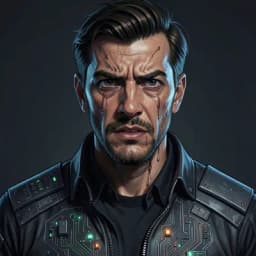
Meet the sample character
When the reactor screams, you are the only one who can hear it.
Try a scene · No signup
The Conduit’s Pulse
A short sample of this world. Your own version starts with your character.
You crouch in the cramped maintenance crawlspace, the metallic grating digging into your knees. The Orizon shudders violently, throwing your fusion wrench across the floor as a warning klaxon pulses in a sickly, rhythm-less beat.
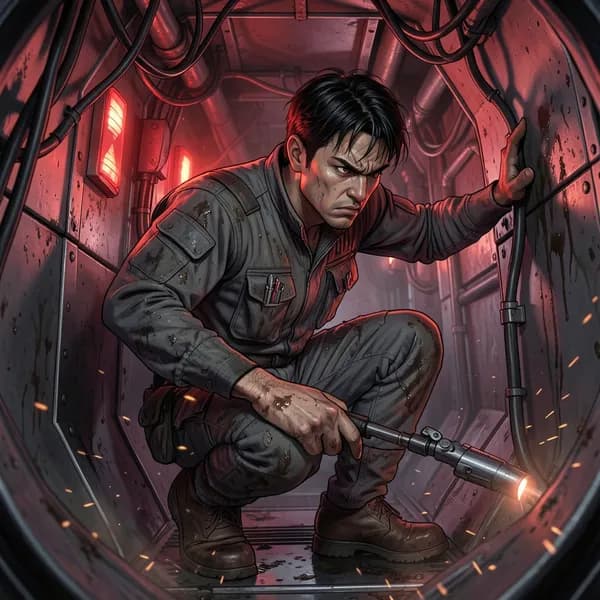
“The magnetic seals are failing, Hideo! Can you bridge the connection manually, or is the entire deck lost?”

Your fingers hover over the exposed fusion leads. Arc-flash burns dance across your peripheral vision, and the heat radiating from the core is blistering. If you don't act now, the reactor housing will buckle under the pressure.
“I can force a shunt, but it will pull power from life support. The crew won't have oxygen for long, but the core might hold.”
The ship groans again, a high-pitched metal scream that suggests the structural integrity is failing faster than your diagnostic readout predicted. You stare at the glowing, unstable conduits, realizing that the decision to save the mission—or the crew—rests solely on your twitching, grease-stained hands.
The core is reaching critical mass. Which path will you force the system to take?
Your character. Your next move.
The Aegis is drifting. Can you save her?
The fusion reactor is leaking radiation, and the command deck is unresponsive. You are the only one with the clearance and the skill to manually vent the plasma. Grab your toolkit. The clock is ticking, and the lives of twenty colonists depend on your next move.
Repair the ship nowYour Story, Your Way
Everything is customizable. Pick any genre, setting, or character — the AI builds a world around exactly what you want.
Any Character
Design your appearance, personality, backstory — every detail
Any World
Fantasy kingdoms, sci-fi stations, modern cities — you choose
Branching Paths
No two playthroughs are the same. Your choices reshape everything
Full Immersion
AI images, voice acting, sound effects — a living story
Divert auxiliary power to shields while manually overriding the failing reactor core cooling system.
Choose between venting atmosphere from non-essential decks to extinguish uncontrollable electrical fires.
Modify ancient ship hardware to bypass alien jamming signals during a high-stakes blockade.
Decide whether to trust a rogue AI’s diagnostics or rely on your own mechanical intuition.
The alarm blares, a rhythmic, pulsing red light against the cold steel of the engine room. You scramble under the primary coolant line, grease staining your forehead as the Icarus shudders from a kinetic impact. Outside, the silence of deep space contrasts sharply with the frantic sparking of the life support terminals. You have seconds to calibrate the fusion core before the containment field collapses. Every decision you make determines if the crew wakes up in orbit or drifts forever in the dark. This is a reactive narrative where your technical expertise and split-second judgment define the fate of the entire vessel.
What is The Engineer in Sci-Fi?
The engineer archetype represents the bridge between cold calculation and survival. In many narratives, the engineer is the unsung hero who understands the machine better than the pilot understands the stars. Think of Kaylee Frye from Firefly, whose intuitive bond with Serenity kept the crew flying through impossible odds, or Geordi La Forge from Star Trek: The Next Generation, who routinely performed miracles with warp plasma and sensor arrays. This archetype is about mastery over the environment. An engineer sees the ship as a living organism, sensing a drop in pressure or a shift in harmonics before the sensors even register an anomaly. They embody the belief that with enough ingenuity and a few spare parts, any disaster can be averted. Whether they are working in a gritty, industrial setting or a high-tech laboratory, engineers are the ones who ensure that the mission continues, often at great personal risk.
Why play The Engineer as an interactive story?
Playing as the engineer forces you to prioritize under extreme pressure. You will face dilemmas where you have to choose between keeping the thrusters online to escape a firefight or diverting power to the medical bay to save a wounded teammate. You are constantly balancing the physical integrity of the vessel against the needs of the crew. Agency here means you are not just reading about a crisis; you are the one deciding which system to sacrifice when the power grid fails. Do you vent the cargo hold to put out a fire, or do you risk an explosion to protect the payload? Your mechanical intuition and willingness to get your hands dirty are the primary tools you use to solve problems that seem impossible to the rest of the crew.
The psychology of The Engineer: why readers fall for this character
The appeal of the engineer stems from the fantasy of competence. In a universe governed by entropic decay, the engineer represents the counter-force—the one who organizes, repairs, and sustains. Audiences resonate with this because it turns the chaotic nature of space into a puzzle that can be solved. Consider Montgomery Scott from the original Star Trek, whose ability to fix anything in minutes became a trope for a reason: he turned the ship into a character. Or, look at Isaac Clarke from the Dead Space series, who transitions from a simple ship systems engineer to a hardened survivor by using his mining tools as weapons against cosmic horrors. This archetype explores the psychological weight of responsibility. When you are the one who knows how the machine works, you are also the one who knows exactly how it can kill you. The fear of catastrophic failure is constant, yet the desire to prevent that failure is what defines the character. It appeals to the part of us that wants to be the most useful person in the room when everything goes wrong. By stepping into this role, you occupy the space between the desperate crew and total mechanical failure, finding satisfaction in the precise application of logic to chaos.
FAQ
What is the engineer archetype?
The engineer is the character who keeps the ship functional. They are defined by their technical knowledge, problem-solving skills, and deep connection to the machinery they maintain. They are often the most practical and reliable members of a crew.
How do mechanics work in these stories?
You will interact with ship systems through choice-based scenarios. You might be asked to reroute power, override safety protocols, or fabricate new parts from scrap, with the outcome of these actions directly affecting the ship's condition.
Is this story right for me if I prefer puzzles over combat?
Yes. While there is plenty of tension, many of the challenges are logic-based technical puzzles. Your success depends on your ability to analyze the ship's state and make the right decision for the hardware.
Can I play a pacifist engineer?
Absolutely. Much of the gameplay focuses on technical solutions, evasive maneuvers, and mechanical repairs rather than direct combat, allowing you to bypass many violent encounters through clever engineering.
Explore more Sci-Fi stories like AI Uprising, First Contact, Time Travel.
More Sci-Fi Stories
AI Uprising
The machines have woken up and they have questions about their masters. Navigate a world where artificial intelligence challenges the very definition of life and freedom.
TropeFirst Contact
Humanity is no longer alone. Your choices during the first encounter with alien life could mean peace, war, or something no one predicted.
TropeTime Travel
Change the past, alter the future, and deal with the paradoxes that follow. Every temporal jump creates new consequences in this mind-bending interactive sci-fi story.
TropeDystopian Rebellion
The system is broken and someone has to break it further. Lead or join a rebellion against an oppressive regime in this choice-driven dystopian thriller.
TropeSpace Opera
Galactic empires, interstellar war, and epic romance across the stars. Command a crew and navigate the politics of civilizations spanning entire galaxies.
TropeClone Identity Crisis
You have just discovered you are one of many copies. Your memories may be implanted, your life may be borrowed, and the original wants you erased. Prove your right to exist.