
Sci-Fi · Interactive story
Beyond the Law: The Rogue Captain's Frontier
Your cargo is illegal, your ship is failing, and the blockade is closing in.
Start as a guest. Choose your character before the story begins.

Meet the sample character
The bounty is locked, the reactor is dying, and the Syndicate is closing in.
Try a scene · No signup
Static in the Void
A short sample of this world. Your own version starts with your character.
You hover the Iron Moth near the cooling vents of the derelict station. Static bites at your ears, the sound of a thousand dead channels clawing for purchase. Outside the viewport, the nebula glows a sickly, radioactive violet. Your fuel gauge flickers amber. If the engines do not kick over in the next sixty seconds, you are drifting into the gravity well of a collapsing star.
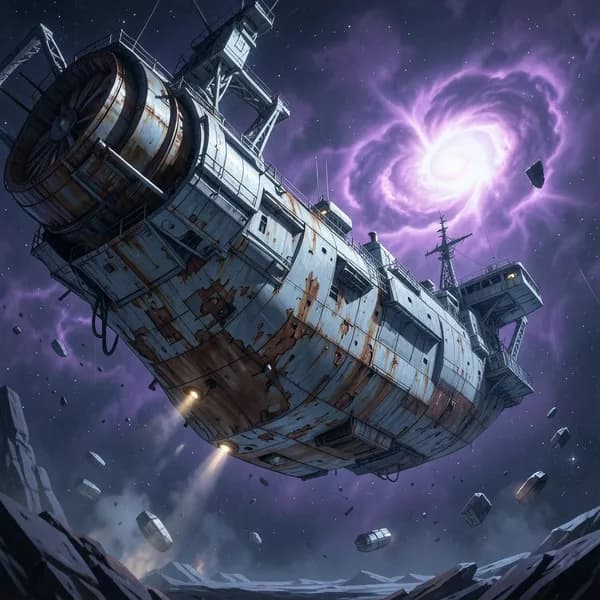
“Halloway, if you do not engage the docking clamps now, I am venting the cargo bay to save weight.”

Your hands hover over the control console. Jiro is sweating, his palms slick against the interface. You smell the ozone from the overheating power core. The sensor array pings—a heavy cruiser has dropped out of slipspace, and their target lock is already painting your hull in a steady, rhythmic red.
“Hold your nerve, Jiro. If we dock now, we are trapped, but if we burn the last of the reserves, we are a sitting target.”
The cruiser’s comms frequency opens, a cold voice demanding immediate surrender. You check the fuel reserves; there is enough for one reckless burn, or you could dump the illegal haul to confuse their sensors. Alternatively, you could try to pull the ship into the derelict's crumbling hangar and pray the station’s rusted shielding holds against their boarding parties.
The cruiser is closing the distance. How do you silence their guns?
Your character. Your next move.
Take the Helm and Plot Your Course
The sector patrol has you locked in their tractor beam. Do you overheat your reactor to break free, or do you open a channel and talk your way out of a prison sentence? Your ship, your decisions. Start your story now and see if you have what it takes to survive the outer rim.
Begin Your Smuggling CareerYour Story, Your Way
Everything is customizable. Pick any genre, setting, or character — the AI builds a world around exactly what you want.
Any Character
Design your appearance, personality, backstory — every detail
Any World
Fantasy kingdoms, sci-fi stations, modern cities — you choose
Branching Paths
No two playthroughs are the same. Your choices reshape everything
Full Immersion
AI images, voice acting, sound effects — a living story
Reroute power to shields or engines during high-speed chases through asteroid fields.
Negotiate smuggling contracts with suspicious contacts in deep-space docking bays.
Resolve crew disputes that threaten to trigger a mutiny mid-flight.
Repair critical systems under fire to prevent a total ship failure.
Vane wipes coolant from his forehead, his fingers hovering over the ignition sequence of the Rusty Needle. Outside the cockpit, the neon glow of the orbital station bleeds into the void, while the interceptor squadron on his tail demands he power down. He could surrender, pay the fines, and watch his ship get impounded—or he could push the thrusters past their safety limits and gamble on a blind jump into hyperspace. You are the one who decides whether he fights, flees, or negotiates his way out of this corner. Every adjustment to the ship’s navigation array and every word spoken to the authorities echoes through the hull, shaping the path of a smuggler living on the edge of the galactic core. The weight of the pilot’s seat rests on your choices, where one wrong calculation turns a routine delivery into a desperate stand against the law.
What is a Rogue Captain in Sci-Fi?
The rogue captain is a staple of science fiction, defined by a fierce commitment to independence. These characters reject the rigid hierarchies of planetary governments or military fleets, preferring the uncertain freedom of the cockpit. They operate in the gray areas of the law, trading in black-market goods, escorting desperate clients, or simply surviving on the fringes of the charted galaxy. Unlike a traditional hero bound by oath or duty, the rogue captain’s primary responsibility is to their ship and their crew. A defining example is Malcolm Reynolds from Firefly, a man shaped by the scars of a lost war who chooses to keep his ship flying rather than bow to the Alliance. Similarly, Han Solo in Star Wars represents the quintessential smuggler—a man who claims to care only for his credits but consistently finds himself entangled in the moral dilemmas of a larger conflict. This archetype thrives on the tension between self-interest and the hidden, stubborn spark of integrity that forces them to act when the stakes turn dire.
Why play Rogue Captain as an interactive story?
Playing as a rogue captain places the burden of command directly in your hands, where every decision carries tangible consequences for your vessel’s integrity and your reputation. You are not watching a story unfold; you are managing the volatile relationship between your engine’s output and the local space authorities. When a patrol ship hails you for an inspection, you must judge whether to bluff, bribe, or engage the thrusters. These moments force you to weigh the risk of a firefight against the cost of losing your cargo. Agency changes the experience from simple observation to high-stakes resource management. You decide how to distribute power between life support and weapon systems during a tense intercept, or how to handle a crew member who disagrees with your latest contract. The narrative adapts to your specific brand of morality, whether you play as a cold-blooded mercenary or a reluctant savior of the downtrodden.
The psychology of Rogue Captain: why readers fall for this character
The appeal of the rogue captain lies in the fantasy of total autonomy. In a world increasingly governed by complex social and political structures, the rogue captain represents a return to the frontier, where one’s success is determined solely by skill, intuition, and the reliability of their ship. This archetype activates the human desire for self-determination; they answer to no one but themselves. Consider Spike Spiegel from Cowboy Bebop, whose past is a labyrinth of shadows, yet he remains anchored to his ship, the Bebop, as his only true home. Spike demonstrates the archetype’s fatalistic charm—a character who knows the odds are stacked against him but continues to play the hand anyway. Then there is the distinction seen in characters like Star-Lord from Guardians of the Galaxy, who brings a layer of erratic, emotional vulnerability to the role. While Spike is stoic and haunted, Star-Lord is chaotic and driven by found-family dynamics. Both demonstrate that the rogue captain is rarely a true loner; they are often the center of a makeshift, dysfunctional family unit. The reader is drawn to this because it mirrors the human condition: we are all trying to navigate our own ships through chaotic conditions, often relying on a small, imperfect group of allies to keep the engines running. By stepping into this role, you engage with the fear of being adrift, tempered by the thrill of absolute freedom.
FAQ
What distinguishes a rogue captain from a traditional military hero?
A military hero operates within a chain of command and follows a set code of conduct. The rogue captain operates without a safety net, making decisions based on personal values or survival rather than mission objectives or orders from above.
Can I choose to be an honest trader instead of a criminal smuggler?
Yes. The narrative adapts to your decisions. If you choose to avoid illegal contracts and prioritize legitimate transport, the story will branch to reflect your reputation as a reliable, lawful pilot.
How does the ship management affect the story?
Your ship is an extension of your character. If you neglect maintenance or choose to upgrade weapons over cargo space, you will find yourself in different situations, such as being forced into combat because you lack the speed to escape.
Is this experience suitable for fans of space opera RPGs?
Absolutely. It focuses on the same elements found in tabletop space RPGs: balancing crew loyalty, managing ship resources, and navigating complex political landscapes through dialogue and high-stakes choices.
Explore more Sci-Fi stories like AI Uprising, First Contact, Time Travel.
More Sci-Fi Stories
AI Uprising
The machines have woken up and they have questions about their masters. Navigate a world where artificial intelligence challenges the very definition of life and freedom.
TropeFirst Contact
Humanity is no longer alone. Your choices during the first encounter with alien life could mean peace, war, or something no one predicted.
TropeTime Travel
Change the past, alter the future, and deal with the paradoxes that follow. Every temporal jump creates new consequences in this mind-bending interactive sci-fi story.
TropeDystopian Rebellion
The system is broken and someone has to break it further. Lead or join a rebellion against an oppressive regime in this choice-driven dystopian thriller.
TropeSpace Opera
Galactic empires, interstellar war, and epic romance across the stars. Command a crew and navigate the politics of civilizations spanning entire galaxies.
TropeClone Identity Crisis
You have just discovered you are one of many copies. Your memories may be implanted, your life may be borrowed, and the original wants you erased. Prove your right to exist.