Sci-Fi · Interactive story
Breach the Event Horizon: Quantum Research Lab
The particle accelerator is humming, and the laws of nature are starting to scream.
Start as a guest. Choose your character before the story begins.

Meet the sample character
When the constants stop being constant.
Try a scene · No signup
The Singularity Leak
A short sample of this world. Your own version starts with your character.
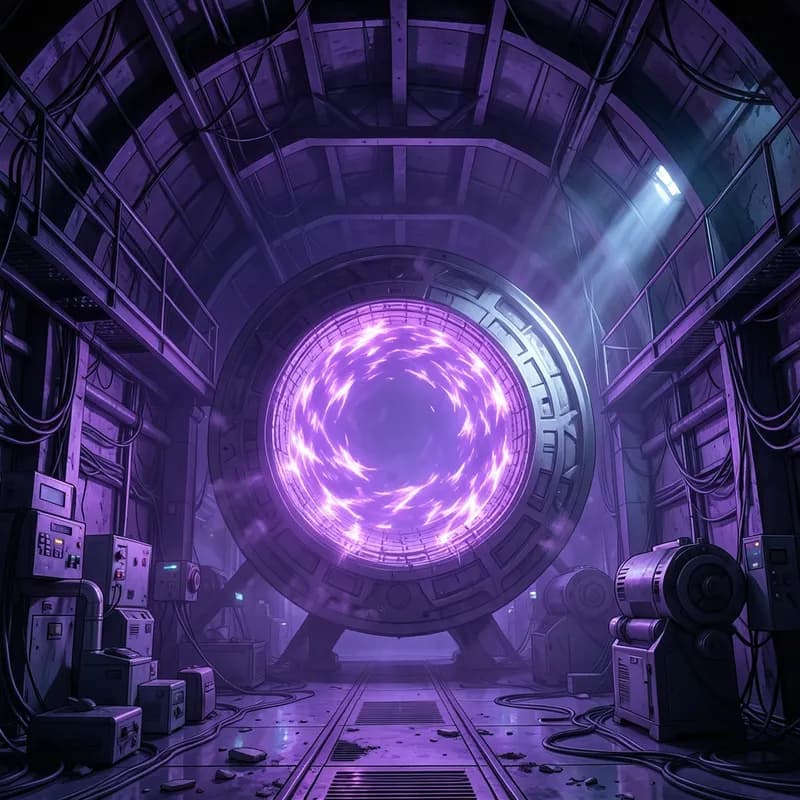
The air in Sub-level 9 tastes of ozone and burnt sugar. You watch the containment field shimmer, not with the steady blue of a controlled reaction, but with a chaotic, prismatic violet that should not exist. Gravity flickers, lifting your boots an inch off the grated floor before slamming them back down with teeth-jarring force. The sensors are screaming, their output graphs replaced by jagged, nonsensical geometry.

“Hideo, the pressure gauges are reading negative infinity. Shut it down before the floor decides it does not want to be solid anymore!”

You grip the edge of the console, your knuckles white against the cool steel. The hum of the machine has shifted from a low, rhythmic thrum to a high-pitched, harmonic shriek that vibrates deep in your inner ear. You know the sequence to purge the core, but if you do, you lose the data—the only proof that your life’s work actually worked.
“If I terminate the feed now, we lose everything we have calculated for the last three years. I need five more seconds to stabilize the quantum bridge!”
The ceiling panels above you begin to fold inward, reality bending like wet paper. A rift of pure, white static opens in the center of the room, pulling at your lab coat, your tools, and your very skin. Sian lunges for the emergency lever, but the air has become too thick to move through. You have to decide: risk the total collapse or lose your legacy.
The rift is expanding; how do you regain control of the dying machine?
Your character. Your next move.
Secure the Core or Let Reality Fracture
The containment field is failing, and the lab is bleeding into a parallel dimension. Do you initiate the total facility lockdown, trapping your colleagues inside to save the world, or do you attempt a desperate manual reset that might shatter your own timeline? Your decision changes everything.
Begin the ExperimentYour Story, Your Way
Everything is customizable. Pick any genre, setting, or character — the AI builds a world around exactly what you want.
Any Character
Design your appearance, personality, backstory — every detail
Any World
Fantasy kingdoms, sci-fi stations, modern cities — you choose
Branching Paths
No two playthroughs are the same. Your choices reshape everything
Full Immersion
AI images, voice acting, sound effects — a living story
Recalibrate the particle containment field before the breach consumes the facility’s lower decks.
Decide whether to trust the erratic readings of an AI that claims to be you.
Execute emergency lockdown protocols while navigating corridors that shift their spatial orientation in real-time.
Choose which research data to salvage when the facility begins to dissolve into non-existence.
The air in Sector 4 tastes like ozone and copper. Dr. Aris Thorne stares at the monitor as the containment field ripples, not with energy, but with images of a room that shouldn't exist—a room from a thousand years ago. Gravity shifts, pulling loose pens toward the ceiling while the floor beneath your feet turns translucent, revealing a void of swirling, iridescent mist. You hold the override key. The alarm is a rhythmic, frantic pulse, but the silence inside the chamber is worse. Every choice you make here ripples through the timeline, potentially collapsing the very reality you are trying to save. In this interactive story, the consequences of your hesitation are as lethal as the experiment itself.
What is Quantum Research Lab in Sci-Fi?
A Quantum Research Lab setting acts as a crucible for high-stakes science fiction. It is a place where theoretical physics meets tangible, terrifying application. Unlike a standard space opera, the drama here is internal and atmospheric, centered on the breakdown of observable reality. Think of the unsettling tension in 'Annihilation' or the desperate, calculated problem-solving found in 'Arrival.' These stories thrive on the 'what if' factor—what if we could fold space, peer into parallel dimensions, or rewrite the past? In fiction, the lab serves as a microcosm for the universe. When the experiment goes wrong, it is not just about a fire or a containment breach; it is about the fundamental rules of existence—causality, mass, and time—becoming suggestions rather than laws. It is a playground for intellectual curiosity, where the protagonist must grasp complex, alien concepts to survive. The lab provides a static, confined space that contrasts sharply with the cosmic, infinite horror of the anomalies being unleashed.
Why play Quantum Research Lab as an interactive story?
Playing in a Quantum Research Lab forces you to balance scientific rigor with survival instincts. You are not just a spectator; you are the lead researcher holding the literal fabric of the universe together. You will face moments where the data contradicts your senses, forcing you to choose between trust in the math or trust in your eyes. Do you vent the core and lose years of progress to save your team, or do you push the experiment further, risking a total reality collapse for a breakthrough that could change humanity forever? The tension arises from the weight of your authority. Every dial you turn and every protocol you follow alters the environment, changing the gravity, the light, and even the people around you. You must decide who is expendable when the lab begins to leak into other dimensions.
What makes Quantum Research Lab work: the worldbuilding
The most effective 'lab gone wrong' narratives rely on the atmosphere of isolation. The setting should feel claustrophobic, even if the scope is cosmic. Works like 'Half-Life' masterfully demonstrate this by grounding the player in a mundane, industrial environment before introducing the surreal, eldritch elements of a resonance cascade. Similarly, the film 'Coherence' shows how a simple, localized quantum event can dismantle interpersonal relationships and social order. To build this setting, focus on the sensory decay of the environment. The lights should not just flicker; they should strobe in patterns that feel sentient. Sound is critical—the hum of the collider should change pitch as reality destabilizes, moving from a steady drone to a discordant, metallic shriek. Character archetypes are essential for grounding the chaos. You need the obsessive lead scientist who sees the disaster as a success, the pragmatic security chief who only understands physical threats, and the junior researcher who is the first to notice the laws of physics are failing. The conflict should always stem from the tension between the quest for knowledge and the preservation of the self. If the lab feels like a tomb for the ego, you have succeeded.
FAQ
What defines a quantum research story?
It is a sub-genre where the scientific method is a weapon and the environment is a primary antagonist. The story centers on the immediate, often catastrophic consequences of theoretical physics being pushed beyond safe limits.
How do physics experiments affect the narrative?
They act as the catalyst for environmental shifts. As the experiment progresses or fails, the internal rules of the setting change, altering gravity, light, or time, which forces the player to adapt their strategy.
Can I play as a non-scientist?
Yes. You can assume roles like security, administration, or even an external auditor. Each role offers a unique perspective on the facility's collapse.
Is the science in these stories accurate?
These stories use real quantum concepts as a foundation for speculative fiction. The goal is to prioritize dramatic tension and 'what if' scenarios over rigid textbook accuracy.
Explore more Sci-Fi stories like AI Uprising, First Contact, Time Travel.
More Sci-Fi Stories
AI Uprising
The machines have woken up and they have questions about their masters. Navigate a world where artificial intelligence challenges the very definition of life and freedom.
TropeFirst Contact
Humanity is no longer alone. Your choices during the first encounter with alien life could mean peace, war, or something no one predicted.
TropeTime Travel
Change the past, alter the future, and deal with the paradoxes that follow. Every temporal jump creates new consequences in this mind-bending interactive sci-fi story.
TropeDystopian Rebellion
The system is broken and someone has to break it further. Lead or join a rebellion against an oppressive regime in this choice-driven dystopian thriller.
TropeSpace Opera
Galactic empires, interstellar war, and epic romance across the stars. Command a crew and navigate the politics of civilizations spanning entire galaxies.
TropeClone Identity Crisis
You have just discovered you are one of many copies. Your memories may be implanted, your life may be borrowed, and the original wants you erased. Prove your right to exist.