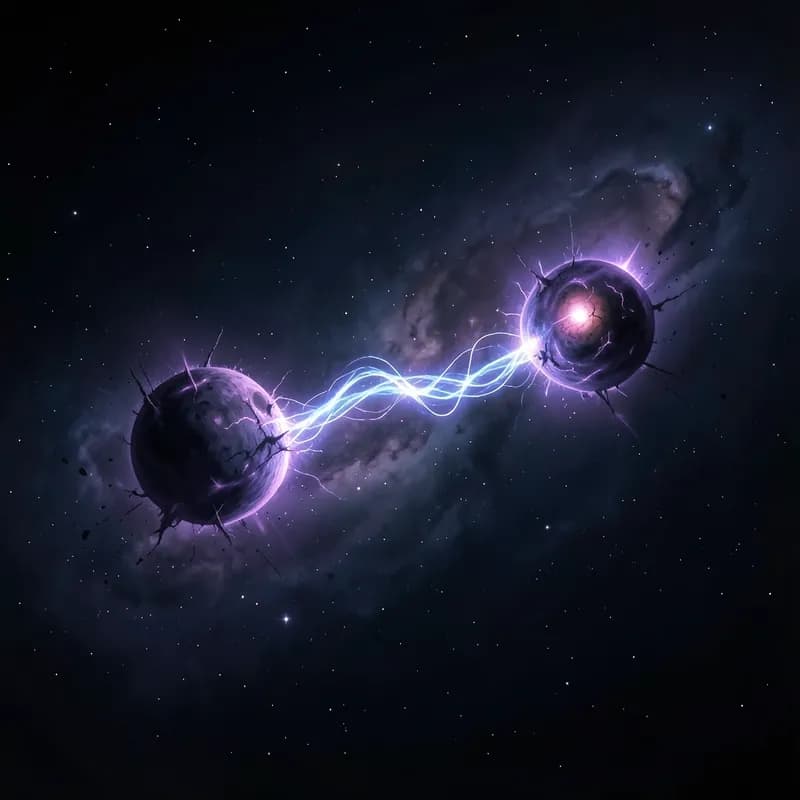
Sci-Fi · Interactive story
Bound by the Stars: A Quantum Connection
Your heartbeat is no longer yours alone; it belongs to the void.
Start as a guest. Choose your character before the story begins.
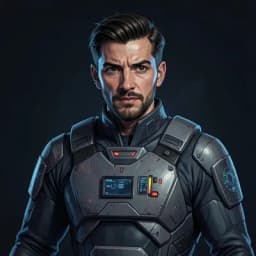
Meet the sample character
Distance is a lie written in the stars.
Try a scene · No signup
Pulse of the Shared Nerve
A short sample of this world. Your own version starts with your character.
You press your fingers against the cool glass of the monitor, watching the waveform sync perfectly with your own pulse. The station hums, a low-frequency vibration that matches the jagged rhythm echoing in your chest. Somewhere, thousands of lightyears away, the stranger you are tethered to is shivering. The telemetry readout blinks crimson: synchronization at ninety-eight percent.
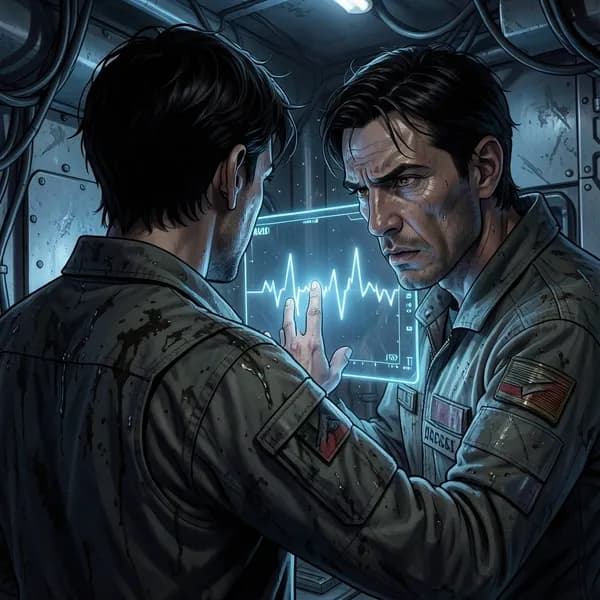
“The drift is accelerating, Koji. If you don't anchor the tether now, the feedback loop will liquefy your gray matter.”

You ignore the warning, staring at the feed. The stranger on the other end isn't just suffering; they are bleeding out. You taste the sharp, metallic tang of copper in your own mouth, despite the sterile air of the station. Your left hand begins to convulse, mirroring a struggle occurring in a cockpit lightyears away. The choice is yours: cut the link and survive, or endure their final moments.
“If I break the tether, I end them. There has to be a way to transfer the damage to the station grid instead.”
The station alarm flares, an amber strobe bathing the room in frantic, rhythmic light. The stranger on the other end screams—a sound transmitted not through audio, but through the quantum bridge directly into your nervous system. You have seconds before the feedback reaches critical mass. Do you force a severance, or bridge the current to share the weight of their demise?
The feedback is peaking. How do you handle the quantum tether?
Your character. Your next move.
Will you protect them, or will you break the link?
The signal is fading. Your counterpart is cornered in the lower decks, their heart rate spiking in your own chest. Do you risk your position to save them, or do you cut the tether and save yourself? Your choices determine who survives the vacuum. Step into the connection and decide the fate of two worlds.
Link Your Fates NowYour Story, Your Way
Everything is customizable. Pick any genre, setting, or character — the AI builds a world around exactly what you want.
Any Character
Design your appearance, personality, backstory — every detail
Any World
Fantasy kingdoms, sci-fi stations, modern cities — you choose
Branching Paths
No two playthroughs are the same. Your choices reshape everything
Full Immersion
AI images, voice acting, sound effects — a living story
Decide whether to dampen the link, risking mental isolation to protect your own sanity.
Interpret sensory hallucinations from your partner to navigate hazardous alien environments remotely.
Sacrifice your physical health to provide a temporary, life-saving adrenaline boost to your counterpart.
Choose to hide your connection from hostile factions to avoid becoming a military target.
The pulse in your wrist does not match your own. It skips when you are calm, races when you are still, and stutters when you are miles from another human soul. You are a test subject in a forgotten project, permanently linked to a stranger on a mining colony near the Andromeda fringe. When they bleed, you feel the metallic sting of iron on your tongue. When they dream, you see flashes of red dust and twin suns. You are two halves of an equation that should never have been solved. In this interactive experience, your decisions do not just dictate your own survival; they ripple across the vacuum to determine the fate of your unseen counterpart. Every action taken in the sterile corridors of your station has a direct, physical consequence for them, and every danger they face reflects back into your own reality. You are never truly alone, and the distance between you is only as far as your next heartbeat.
What is Quantum Entanglement in Sci-Fi?
Quantum entanglement describes a physical phenomenon where particles interact in such a way that the quantum state of each cannot be described independently. In fiction, this concept is pushed to its extreme: two consciousnesses or bodies share a single existence across vast distances. Think of the series Sense8, where the connection is psychic and intense, allowing characters to share skills and sensory input. Or consider the film Source Code, which toyed with the idea of consciousness tethered to another vessel across a fractured reality. It remains a powerful narrative tool because it forces immediate intimacy. Distance, often the barrier to connection, becomes irrelevant. The drama arises from the vulnerability of having your life tethered to someone you may never meet, someone who might be your enemy, your savior, or your mirror image. It turns the cold, vast emptiness of space into a claustrophobic, shared bedroom. This trope challenges the traditional boundaries of the individual, forcing characters to confront their own weaknesses through the lens of another. When the physical laws of the universe are bent to force two people together, the resulting tension provides a fertile ground for high-stakes storytelling.
Why play Quantum Entanglement as an interactive story?
Playing a story centered on quantum entanglement turns every choice into a high-stakes calculation. You are not just solving a puzzle; you are managing a living, breathing connection. If your counterpart is being hunted by security drones on a derelict freighter, you must decide whether to sabotage your own life-support systems to create a diversion—knowing the sudden drop in pressure will cause them to faint. You will face moral dilemmas where helping yourself means hurting the person you are linked to. Do you trust them? If they are a prisoner, does your connection make you an accomplice to their crimes? The tension stems from the lack of total autonomy. You are never truly alone, and your agency is constantly constrained by the needs, location, and suffering of the other person. You will handle dialogue trees that require you to interpret the sensory fragments they send you, turning raw, alien emotions into actionable intelligence. The result is a narrative that constantly forces you to weigh your self-preservation against the survival of a stranger.
Famous examples of Quantum Entanglement in books, film, and games
The trope of the quantum bond appears in works that prioritize the impossible intimacy of the sci-fi genre. In the novel The Gone-Away World by Nick Harkaway, reality itself is fractured, and the characters navigate a landscape where the laws of physics are merely suggestions, playing with the idea of linked fates. Another example is the video game Beyond: Two Souls, which explores a literal tethering between a human and an ethereal entity, forcing the player to balance the needs of two very different states of existence. These stories work because they remove the safety of individuality. In The Left Hand of Darkness by Ursula K. Le Guin, while not strictly quantum, the concept of a deep, alien connection that defies traditional understanding serves a similar purpose, challenging the protagonist's perception of self. This trope endures because it speaks to a fundamental human fear: being truly known, or worse, being truly understood by someone who can destroy you. It turns the vast, indifferent universe into a mirror, forcing characters to confront their own weaknesses through the lens of another. Whether through psychic bonds or technological tethers, the core appeal remains the same: the loss of the solitary self in exchange for a connection that defies the vacuum of space.
FAQ
How does the link affect my character's physical health?
The link acts as a bridge for sensory and physical trauma. If your partner is exposed to extreme cold or injury, you will experience the phantom sensations, which can impair your ability to perform tasks or make critical decisions.
Can I choose to sever the quantum connection?
Some narratives allow you to seek out technology to dampen or break the link, but doing so often comes with permanent psychological side effects or the loss of crucial information provided by your partner.
Are the choices in this story truly impactful?
Every decision you make alters the trajectory of both characters. A choice to prioritize your safety might leave your counterpart defenseless, changing the narrative flow and the world state for both of you.
What genre elements are most prominent in these stories?
Expect a blend of psychological thriller and hard sci-fi. The focus remains on the interpersonal dynamic, but the backdrop of space travel, advanced physics, and corporate espionage provides the setting for your choices.
Explore more Sci-Fi stories like AI Uprising, First Contact, Time Travel.
More Sci-Fi Stories
AI Uprising
The machines have woken up and they have questions about their masters. Navigate a world where artificial intelligence challenges the very definition of life and freedom.
TropeFirst Contact
Humanity is no longer alone. Your choices during the first encounter with alien life could mean peace, war, or something no one predicted.
TropeTime Travel
Change the past, alter the future, and deal with the paradoxes that follow. Every temporal jump creates new consequences in this mind-bending interactive sci-fi story.
TropeDystopian Rebellion
The system is broken and someone has to break it further. Lead or join a rebellion against an oppressive regime in this choice-driven dystopian thriller.
TropeSpace Opera
Galactic empires, interstellar war, and epic romance across the stars. Command a crew and navigate the politics of civilizations spanning entire galaxies.
TropeClone Identity Crisis
You have just discovered you are one of many copies. Your memories may be implanted, your life may be borrowed, and the original wants you erased. Prove your right to exist.