
Sci-Fi · Interactive story
Shadows of the Old World: Survival After the Fall
The cities are silent, the power is dead, and every decision is a matter of survival.
Start as a guest. Choose your character before the story begins.
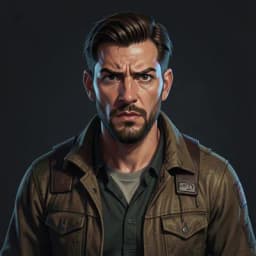
Meet the sample character
Try a scene · No signup
Static in the Rebar Sky
A short sample of this world. Your own version starts with your character.
You crouch behind a slab of jagged rebar, your boots pressed into pulverized concrete. The skeletal remains of the city sprawl beneath you, choked by thick, bioluminescent moss that pulses with a rhythmic, sickly light. Somewhere in the distance, a scrap-drone whirs, searching for heat signatures. You grip your welding torch, knuckles white, scanning the ruins for the telltale flicker of an ancient power core.

“Stop staring at the horizon, Joren. The drones aren't looking for the past; they’re hunting us.”

You pull your gaze away, heart hammering against your ribs like a trapped bird. Mira is right—the machines have upgraded their sensors. You glance back at the derelict substation, where a single, impossible blue light hums in the shadows. It shouldn't be powered, not after three hundred years of silence, yet it beckons with a steady, hypnotic rhythm.
“If that light is real, Mira, it’s the only way to restart the filtration system. We can't survive another winter on recycled dust.”
The air grows heavy, smelling of ozone and rot. A metallic screech echoes from the stairwell behind you, signaling that your position has been compromised. You have seconds to decide: do you gamble your life to reach the power source, or do you stand your ground against a machine designed for total annihilation?
The drone is closing in. How do you secure your future?
Your character. Your next move.
The ruins are waiting. Will you rebuild or burn?
The radio is crackling with a signal from a distant settlement, but your water is nearly gone. Do you answer the call, or head into the desert to find a new source? Your path is yours to define. Start your story now and see what kind of leader you become in the aftermath.
Begin Your Survival StoryYour Story, Your Way
Everything is customizable. Pick any genre, setting, or character — the AI builds a world around exactly what you want.
Any Character
Design your appearance, personality, backstory — every detail
Any World
Fantasy kingdoms, sci-fi stations, modern cities — you choose
Branching Paths
No two playthroughs are the same. Your choices reshape everything
Full Immersion
AI images, voice acting, sound effects — a living story
Trade precious, limited ammunition to secure a safe path through radioactive ruins.
Choose to hoard supplies for yourself or share them to build a community.
Decide the fate of a captured rival to either gain intelligence or invite vengeance.
Repair ancient technology found in the wild to gain a tactical combat advantage.
Rust-caked skeletons of skyscrapers claw at a gray, indifferent sky. Below, the wind whistles through shattered glass, carrying the scent of ozone and dry earth. You pull your collar tight against the biting chill, your boots crunching on debris that was once someone’s life. A flickering map in your hand marks a cache of water three miles out, but the trek requires crossing territory claimed by the Steel-Tooth scavengers. Behind you, the flickering fire of your camp offers safety, but the supplies are running thin. In this interactive story, your choices determine whether you become a legend among the survivors or just another ghost haunting the ruins. Every scrap of wire, every rusted blade, and every whispered rumor in the dark carries weight. You do not just witness the collapse; you decide how the future begins to take shape from the jagged remains of the past.
What is Post-Apocalyptic Earth in Sci-Fi?
Post-apocalyptic fiction focuses on the immediate or long-term aftermath of a global catastrophe that renders current civilization obsolete. Unlike traditional science fiction that looks toward shiny, advanced futures, this subgenre examines how humanity reverts to primal instincts when technology, infrastructure, and government fail. It is a study of scarcity and the moral compromises required to stay alive when the rule of law is replaced by the rule of whoever has the most ammunition or the cleanest water. Consider Cormac McCarthy’s *The Road*, which emphasizes the bleak, harrowing isolation of the landscape, or the *Fallout* game series, which highlights the dark humor and retro-futuristic decay of a nuclear-scorched America. These stories thrive on the tension between the memory of what was lost and the brutal reality of what remains. Whether the catalyst is war, climate collapse, or a mysterious technological failure, the setting provides a blank slate for exploring how people form new societies. It forces characters to redefine value; gold is worthless, but a working water filter or a box of antibiotics becomes the most precious commodity on the planet. It is a genre defined by grit, resourcefulness, and the persistent, stubborn refusal of the human spirit to vanish entirely.
Why play Post-Apocalyptic Earth as an interactive story?
Agency is the most vital resource in a world where everything else has been stripped away. In this interactive story, the narrative reacts to your priorities. Do you focus on fortifying your settlement against raiders, or do you dedicate your limited energy to restoring a defunct power grid that might benefit the entire region? The tension arises from the fact that no choice is truly 'good' or 'bad'—only survivable or fatal. You might encounter a traveling merchant with a rare medicine, but to get it, you must decide whether to trade your only working firearm, leaving your camp defenseless, or attempt to steal it, risking a permanent rift with the only trade route in the wasteland. Your character’s reputation grows based on your actions. If you provide shelter to refugees, you might gain loyal allies, but you also attract more mouths to feed, straining your rations. If you play as a ruthless scavenger, you may thrive in the short term, but you will find yourself isolated when a larger threat emerges. The gameplay forces you to balance long-term goals against immediate survival needs, ensuring that every encounter with a stranger or discovery of a hidden bunker feels like a high-stakes turning point.
What makes Post-Apocalyptic Earth work: the worldbuilding
Successful post-apocalyptic worldbuilding relies on sensory decay and the presence of 'ghosts'—the remnants of the old world that contrast with the harshness of the new. The best stories in this genre, such as *Station Eleven* by Emily St. John Mandel or the film *Mad Max: Fury Road*, excel because they treat the setting as a character. The environment should feel worn, tired, and hostile. You notice the dust on the floor, the metallic tang of recycled water, and the oppressive silence of a city that has forgotten how to be loud. Conflict in this setting is naturally generated by the struggle for resources. When the systems that distributed food, power, and security vanish, power vacuums appear instantly. Factions form around ideologies—some clinging to old-world ideals, others embracing a brutal, new-world Darwinism. Character archetypes thrive here: the weary drifter, the visionary builder, the ruthless warlord, and the scavenger who remembers the world before the fall. To make this setting effective, the storytelling must focus on the 'ecology of the ruin.' How do plants reclaim the concrete? What religions or myths have sprouted in the absence of science? In *The Last of Us*, the nature reclaiming the urban landscape serves as a reminder that the earth is moving on, with or without humanity. By grounding your choices in these physical realities—whether it is the state of your boots, the reliability of your weapon, or the trust of your fellow survivors—the story transforms from a passive observation into a lived experience. You aren't just reading about the end; you are actively negotiating the terms of the new beginning.
FAQ
What makes this different from a standard survival game?
While survival games focus on inventory management and health bars, this interactive story prioritizes narrative choice and character development. Your decisions dictate how the world evolves, how factions treat you, and whether your personal history shapes the rebuilding of civilization, rather than just keeping a hunger meter full.
Can I play as a villain in this wasteland?
Yes. The story adapts to your moral compass. You can choose to be a benevolent leader, a cold-hearted mercenary, or a pragmatic survivor who does whatever is necessary to reach the next dawn. Your reputation will follow you, and the world will react to your actions accordingly.
Does the story have a definitive ending?
The ending depends on your priorities. You might find a way to restore power to a city, disappear into the wilderness to start a new life, or become the leader of a burgeoning community. Your final chapter is written based on the path you carved through the ruins.
Is this setting right for me if I prefer action over dialogue?
The narrative includes high-stakes combat encounters, tense standoffs, and dangerous exploration missions. You will often find yourself making split-second decisions during raids or ambushes, where your tactical choices determine who survives the encounter.
Explore more Sci-Fi stories like AI Uprising, First Contact, Time Travel.
More Sci-Fi Stories
AI Uprising
The machines have woken up and they have questions about their masters. Navigate a world where artificial intelligence challenges the very definition of life and freedom.
TropeFirst Contact
Humanity is no longer alone. Your choices during the first encounter with alien life could mean peace, war, or something no one predicted.
TropeTime Travel
Change the past, alter the future, and deal with the paradoxes that follow. Every temporal jump creates new consequences in this mind-bending interactive sci-fi story.
TropeDystopian Rebellion
The system is broken and someone has to break it further. Lead or join a rebellion against an oppressive regime in this choice-driven dystopian thriller.
TropeSpace Opera
Galactic empires, interstellar war, and epic romance across the stars. Command a crew and navigate the politics of civilizations spanning entire galaxies.
TropeClone Identity Crisis
You have just discovered you are one of many copies. Your memories may be implanted, your life may be borrowed, and the original wants you erased. Prove your right to exist.