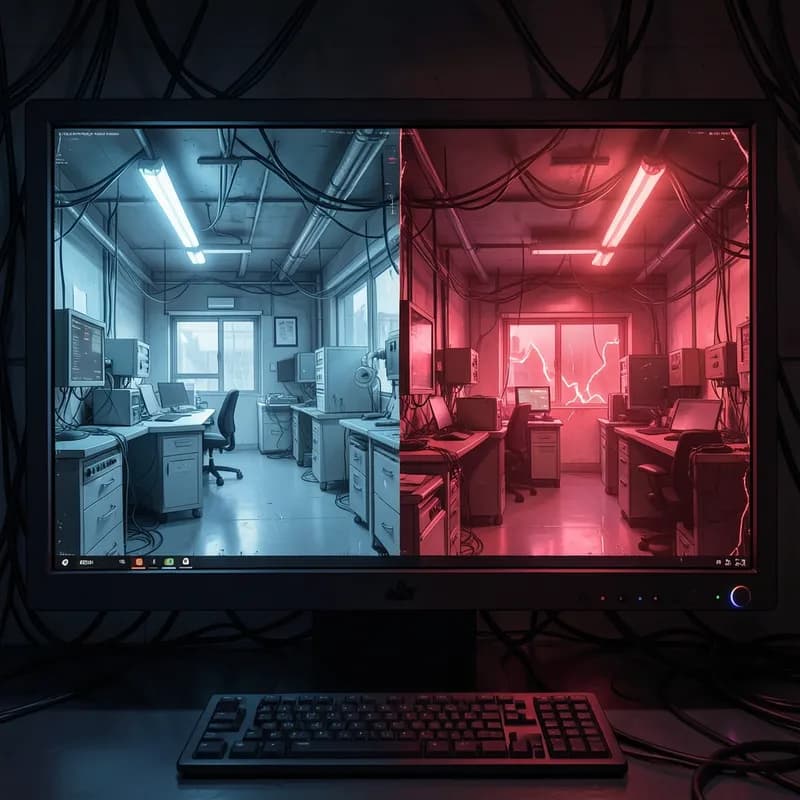
Sci-Fi · Interactive story
Shadows of a Different Reality
One wrong turn, one different choice, and you are no longer where you belong.
Start as a guest. Choose your character before the story begins.

Meet the sample character
The reflection staring back isn't yours anymore.
Try a scene · No signup
Static in the Mirror
A short sample of this world. Your own version starts with your character.
You stare at the monitor, but the waveform isn't pulsing with the usual rhythmic hum of the collider. Instead, the screen displays a static-filled feed of your own office. You see your chair, your coffee mug, and the stack of circuit boards exactly where you left them. But the lighting in the office on the screen is deep crimson, casting jagged shadows that should not exist in this facility.
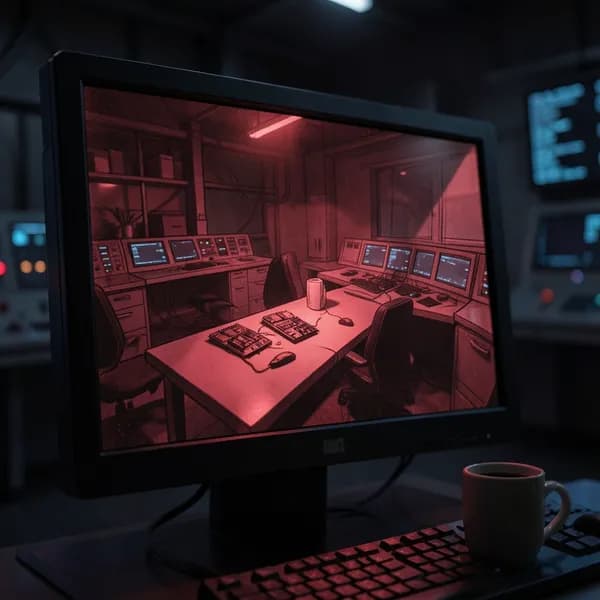
“Jiro, stop the calibration immediately—that is not a reflection of our lab; it is a window into somewhere else.”
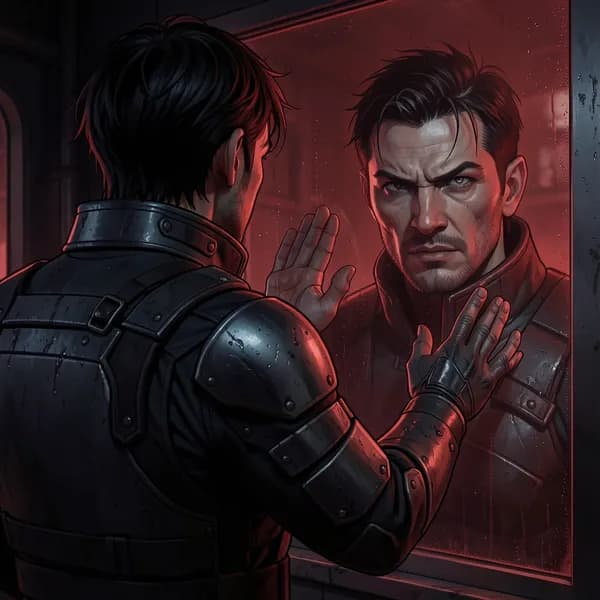
You reach for the emergency shutter, but your fingers hover inches from the red lever. Through the reinforced glass, you see someone sitting in your chair. They turn, and you realize with a jolt of ice in your veins that it is you, but scarred and wearing the brutalist uniform of a regime you have never heard of. They raise a hand to the glass, their eyes cold and calculating.
“If I cut the power, I might trap them—or I might tear the barrier between us down entirely.”
The screens flicker, and the figure on the other side stands up, pulling a heavy, metallic pistol from a holster. They aren't looking for a conversation; they are looking for a target. The hum of the facility rises to an ear-splitting shriek, and the magnetic containment field begins to buckle, threatening to pull you into their reality or drag their nightmare into yours.
The containment field is failing. How do you respond to the threat on the other side of the glass?
Your character. Your next move.
The Mirror is Cracking—What Will You Do?
You have stepped into a world where your life is a stranger’s story. The local authorities are closing in, and your only lead is a journal left behind by your alternate-reality counterpart. Every second spent here changes you. Will you fight to return to your own timeline, or will you seize the life that was never meant for you?
Find Your Way HomeYour Story, Your Way
Everything is customizable. Pick any genre, setting, or character — the AI builds a world around exactly what you want.
Any Character
Design your appearance, personality, backstory — every detail
Any World
Fantasy kingdoms, sci-fi stations, modern cities — you choose
Branching Paths
No two playthroughs are the same. Your choices reshape everything
Full Immersion
AI images, voice acting, sound effects — a living story
Navigate social interactions where you must bluff to hide your identity from suspicious counterparts.
Analyze environmental clues to determine exactly when the timeline diverged from your own history.
Decide whether to sabotage the local infrastructure to return home or protect this reality.
Confront alternate versions of yourself and determine if they are allies or mortal enemies.
You wake up in your apartment, but the air smells like ozone and the city skyline outside the window features towers that should not exist. Your coffee mug sits on the wrong side of the coaster. The silence is heavy, broken only by the hum of a power grid that sounds slightly off-key. You reach for your phone, but the interface is alien, displaying symbols you recognize but cannot read. This is not a dream; it is an echo of a life you never lived, a version of history that branched off at a moment you cannot recall. Every action you take now ripples through this unfamiliar landscape. Your decisions determine whether you can find your way back to the original timeline or if you are destined to become a ghost in this strange, parallel reflection of your home.
What is Parallel Universe in Sci-Fi?
Parallel universes operate on the premise that every choice creates a divergence. In fiction, this trope allows for 'what if' scenarios—what if you had made that one decision differently? What if the laws of physics shifted just enough to change the trajectory of human progress? The concept relies on the tension between the familiar and the uncanny. You see your own face in a mirror, but the person looking back holds a position of power you never achieved or carries a scar you never earned. This trope thrives on the realization that reality is fragile. Consider the film Coherence, where a passing comet creates a localized rift, forcing characters to confront versions of themselves from adjacent realities. The horror is not just in the anomaly; it is in the creeping suspicion that the other version might be more capable, more dangerous, or simply more desperate to claim your place.
Why play Parallel Universe as an interactive story?
In this interactive format, the tension stems from managing the unknown. You are not just observing a character; you are managing the consequences of their displacement. You might find yourself in a briefing room with colleagues who expect you to know classified information, or standing before a version of your spouse who is waiting for a secret password you do not know. The weight of your choices is immediate. Do you bluff your way through a high-stakes negotiation, or do you confess to the truth, risking imprisonment or worse? You must evaluate every interaction, piece together the history of this alternate dimension, and decide if you want to fix the rift or make this life your own.
Famous examples of Parallel Universe in books, film, and games
The multiverse narrative is a playground for examining human nature. In Dark Matter by Blake Crouch, the protagonist is kidnapped and thrust into a series of alternate realities, each defined by the professional and personal choices he made earlier in life. The story forces him to confront his own regrets, showing that a parallel universe is often just a mirror reflecting our own missed opportunities. Similarly, in the game BioShock Infinite, the concept of constants and variables illustrates how certain events will always occur regardless of the specific reality, while others are entirely dependent on chance. This trope endures because it speaks to a universal human curiosity: the desire to know if a different path would have led to a better outcome. It turns the abstract concept of quantum mechanics into a personal drama, removing the comfort of a single, predictable life and replacing it with the terrifying, exhilarating prospect of infinite possibilities.
FAQ
What makes this different from time travel?
Time travel involves moving along a single timeline to change past or future events, whereas a parallel universe involves moving laterally between distinct, co-existing realities that branched off from your own.
Can I return to my original reality?
That depends on the choices you make throughout the story, as you must navigate the specific physics of the dimension you have landed in to find a way back.
Will my previous choices affect how characters treat me?
Absolutely; every interaction is tracked, and non-player characters will remember your past decisions, changing their loyalty and behavior accordingly.
Is this story suitable for beginners?
Yes, the narrative adapts to your input, allowing for a personalized experience regardless of your previous familiarity with science fiction tropes.
Explore more Sci-Fi stories like AI Uprising, First Contact, Time Travel.
More Sci-Fi Stories
AI Uprising
The machines have woken up and they have questions about their masters. Navigate a world where artificial intelligence challenges the very definition of life and freedom.
TropeFirst Contact
Humanity is no longer alone. Your choices during the first encounter with alien life could mean peace, war, or something no one predicted.
TropeTime Travel
Change the past, alter the future, and deal with the paradoxes that follow. Every temporal jump creates new consequences in this mind-bending interactive sci-fi story.
TropeDystopian Rebellion
The system is broken and someone has to break it further. Lead or join a rebellion against an oppressive regime in this choice-driven dystopian thriller.
TropeSpace Opera
Galactic empires, interstellar war, and epic romance across the stars. Command a crew and navigate the politics of civilizations spanning entire galaxies.
TropeClone Identity Crisis
You have just discovered you are one of many copies. Your memories may be implanted, your life may be borrowed, and the original wants you erased. Prove your right to exist.