
Sci-Fi · Interactive story
Life Aboard the High-Orbit Frontier
One hull breach separates you from the abyss. How will you respond?
Start as a guest. Choose your character before the story begins.
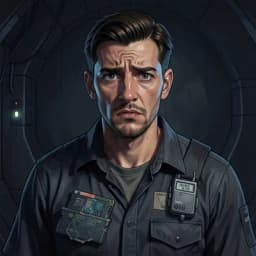
Meet the sample character
The oxygen levels are failing, and someone locked the maintenance override.
Try a scene · No signup
Pressure Drop at Vector-9
A short sample of this world. Your own version starts with your character.
Your fingers ache as you tighten the final bolt on the primary scrubber’s housing. A jagged red alarm flashes across your retinal display, signaling a pressure drop in Sector C. The station groans—a long, mournful sound of twisting titanium—as gravity stabilizers fluctuate, throwing you against the bulkhead. You clutch the cold metal, your heart hammering against your ribs while the station's integrity alarms begin a rhythmic, deafening wail.
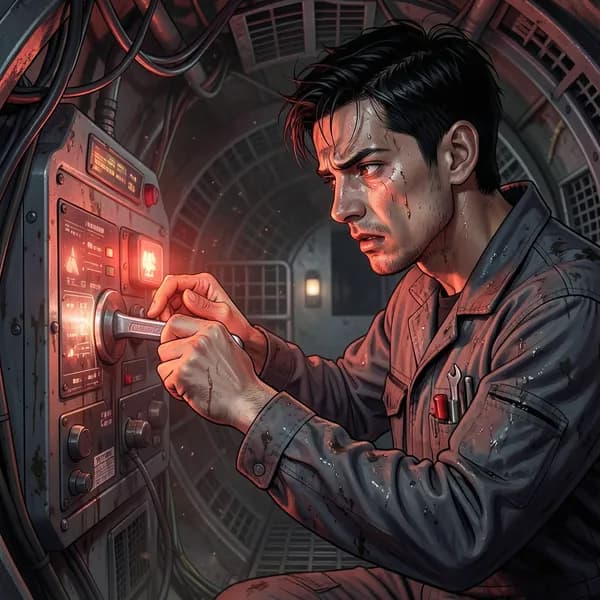
“Stop the diagnostic, Varma. The board has already decided the sector is a total loss. Leave the shaft immediately.”
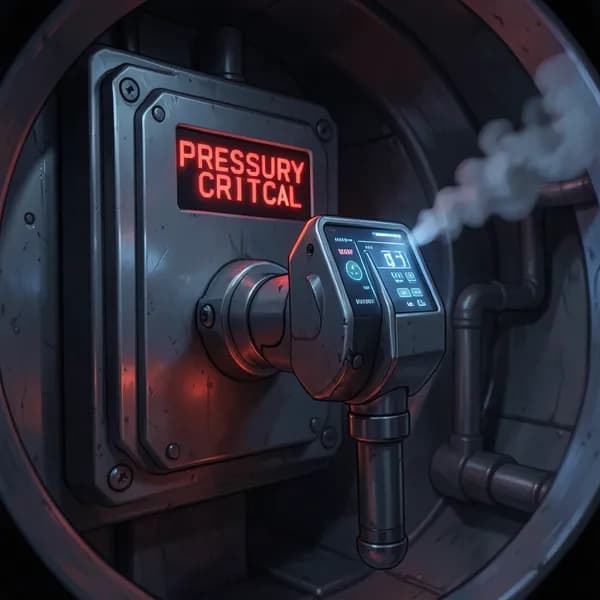
Halloway’s voice crackles through your comms, devoid of any urgency despite the hundreds of crew members currently sleeping in the pressurized sleeping pods of Sector C. You look at the manual release lever near your left hand. If you pull it, you might stop the venting, but you will trigger a lockdown that locks you inside the shaft indefinitely. Your hands are slick with sweat, the interface blinking a warning that you have seconds before the bulkhead seals permanently.
“With all due respect, Director, I am not letting five hundred people suffocate just because your insurance policy prefers it.”
The station tilts violently as an external thruster misfires. The alarm tone shifts from a steady pulse to a continuous, soul-piercing shriek. You look at the manual release lever, the heavy blast door behind you, and the flickering data pad in your pocket. One wrong move will vent your own air supply into the void, or worse, expose the illegal data you've been hiding.
The blast door is closing rapidly; how do you intervene?
Your character. Your next move.
Command the Station: Your Decisions, Your Consequences.
You are the acting commander of the Aethelgard Station. A distress signal has just arrived from an unregistered vessel, and your oxygen levels are dropping. Do you ignore the ship to preserve your crew, or risk everything for a potential rescue? The hull is groaning under the pressure of your choice.
Start Your Station CommandYour Story, Your Way
Everything is customizable. Pick any genre, setting, or character — the AI builds a world around exactly what you want.
Any Character
Design your appearance, personality, backstory — every detail
Any World
Fantasy kingdoms, sci-fi stations, modern cities — you choose
Branching Paths
No two playthroughs are the same. Your choices reshape everything
Full Immersion
AI images, voice acting, sound effects — a living story
Authorize emergency airlock seals during a sudden, catastrophic micrometeoroid impact event.
Negotiate trade terms with corporate delegates while managing fluctuating oxygen levels.
Decide whether to sacrifice station power to encrypt stolen, classified research data.
Choose which sector to evacuate when a suspicious biological contaminant is detected.
The hum of the atmospheric scrubbers is the only clock you have. Outside the reinforced quartz viewport, the blue curve of Earth bleeds into the infinite black. Gravity is a constant, subtle tug provided by the station's relentless rotation, a reminder that you are thousands of miles above the planet you once called home. You are not just a passenger here; you are an operator in a fragile, metallic lung clinging to the edge of the atmosphere. When a critical warning light flashes on the console, you choose which sector to vent and which to seal. Every decision ripples through the station’s pressurized corridors, changing the fate of thousands who rely on your judgment. In this interactive story, your choices dictate whether the base remains a beacon of human achievement or becomes a drifting tomb.
What is Orbital Space Station in Sci-Fi?
An orbital space station is a pressurized habitat established in Earth's orbit, functioning as a hub for research, military surveillance, or trade. Unlike planetary settings, these structures are defined by their isolation and the constant threat of mechanical failure. In fiction, the station acts as a pressure cooker where diverse characters are forced together in extreme conditions. Look at Babylon 5, where the station acts as a neutral ground for warring alien factions, or the claustrophobic tension of the film Europa Report, which captures the precise, technical anxiety of life beyond the atmosphere. These settings remove the comforts of home, replacing them with strict protocols, recycled air, and the ever-present danger of the vacuum outside. Whether it is a luxury habitat or a decaying industrial outpost, the orbital station represents humanity's tenuous grip on the stars.
Why play Orbital Space Station as an interactive story?
Playing through an orbital station story forces you to manage resources while navigating complex social hierarchies. You are not just reading; you are managing oxygen levels, deciding whether to authorize a docking request from a suspicious vessel, or choosing which faction to support when a power grid failure threatens the entire station. You might face the dilemma of overriding a security protocol to save a colleague, knowing it risks a station-wide lockdown. The tension arises from knowing that in zero gravity, there is no place to run. Your agency dictates whether the station becomes a beacon of human progress or a wreckage drifting in the dark.
What makes Orbital Space Station work: the worldbuilding
The power of an orbital station setting lies in its inherent claustrophobia and the constant threat of the environment. Unlike planetary exploration, the station is a finite, engineered space where every inch of wall is a barrier against death. The best stories in this setting, such as those found in The Expanse or the station-based arcs in Star Trek: Deep Space Nine, excel by highlighting the dependency of life on technology. The conflict is rarely just about external threats; it is about the fragility of the systems that keep you alive. Character archetypes thrive here: the weary station commander, the rogue engineer who knows every loose wire, or the corporate spy hiding in the shadows of the ventilation shafts. Sensory details are vital—the metallic tang of ozone, the rhythmic thrum of the centrifuge, and the eerie silence during a comms blackout. When you write or play in this setting, you must emphasize the cost of every action. If you reroute power to the navigation array, the hydroponics bay might die, leading to food shortages in three weeks. This creates a chain reaction of consequences that makes the environment feel alive and hostile. The station is a character itself, with its own moods and breaking points.
FAQ
What is an orbital station story?
It is a narrative centered on the challenges of living and working in a space habitat, focusing on survival, politics, and technology in a closed environment.
How do choices impact my survival?
Your decisions determine resource allocation, diplomatic standing, and the structural integrity of the station itself. A single wrong choice can lead to a system failure.
Can I play as a station commander?
Yes, you can step into leadership roles where your orders dictate the daily operations, security protocols, and crisis management of the habitat.
Is this setting similar to planetary sci-fi?
It differs by focusing on claustrophobia and mechanical reliance rather than broad exploration or wilderness survival. The environment is always artificial and fragile.
Explore more Sci-Fi stories like AI Uprising, First Contact, Time Travel.
More Sci-Fi Stories
AI Uprising
The machines have woken up and they have questions about their masters. Navigate a world where artificial intelligence challenges the very definition of life and freedom.
TropeFirst Contact
Humanity is no longer alone. Your choices during the first encounter with alien life could mean peace, war, or something no one predicted.
TropeTime Travel
Change the past, alter the future, and deal with the paradoxes that follow. Every temporal jump creates new consequences in this mind-bending interactive sci-fi story.
TropeDystopian Rebellion
The system is broken and someone has to break it further. Lead or join a rebellion against an oppressive regime in this choice-driven dystopian thriller.
TropeSpace Opera
Galactic empires, interstellar war, and epic romance across the stars. Command a crew and navigate the politics of civilizations spanning entire galaxies.
TropeClone Identity Crisis
You have just discovered you are one of many copies. Your memories may be implanted, your life may be borrowed, and the original wants you erased. Prove your right to exist.