
Sci-Fi · Interactive story
Shadows of the Vertical Sprawl
Thirty million souls, one vertical cage, and a secret that could collapse the foundation.
Start as a guest. Choose your character before the story begins.
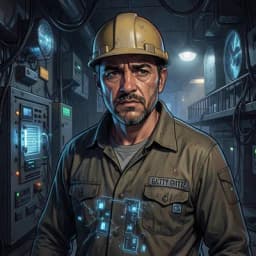
Meet the sample character
The lower levels keep their secrets under ten miles of steel.
Try a scene · No signup
Neon Rot, Wired Dreams
A short sample of this world. Your own version starts with your character.
You are dangling by a frayed safety harness in the ventilation shaft of Sub-Level 89. Above you, the city is a suffocating weight of concrete and steel, while down here, only the red blinking of a faulty circuit breaker provides illumination. Your fingers ache from wrestling with the corroded bulkhead plate, but the prize you just pulled from the wiring—a glowing data-shard—demands your full attention.

“You shouldn't have touched that, Jiro. That isn't just copper; that's a corporate uplink, and it's already screaming for a host.”

You freeze, the shard buzzing against your skin. Koto, the neighborhood scrapper, watches you from the shadows of a rusting support beam. He knows as well as you do that possession of corporate tech is a death sentence in the shadows of the megacity. The silence in the tunnel is sudden and absolute, as if the massive city above has held its breath.
“Keep your voice down, Koto. If this is a corporate tracker, it’s already broadcast my location to the enforcement drones.”
Your terminal chimes, indicating a handshake request from the shard. Simultaneously, the sound of heavy hydraulic boots echoes from the tunnel entrance—enforcement units are closer than you expected. You have seconds to decide whether to integrate the data, wipe it, or physically destroy the evidence before the blast doors are kicked in.
The boot-thuds grow louder against the metal grate. What is your immediate move?
Your character. Your next move.
The Spires Await Your Ascent
The corporate elite are watching, and the Sump is rising. Every choice you make in this vertical maze alters your trajectory. Will you be the one to break the cycle, or will you become another ghost in the wiring? Log in now to begin your climb.
Enter the MegacityYour Story, Your Way
Everything is customizable. Pick any genre, setting, or character — the AI builds a world around exactly what you want.
Any Character
Design your appearance, personality, backstory — every detail
Any World
Fantasy kingdoms, sci-fi stations, modern cities — you choose
Branching Paths
No two playthroughs are the same. Your choices reshape everything
Full Immersion
AI images, voice acting, sound effects — a living story
Hack municipal transit systems to bypass corporate checkpoints during a high-stakes extraction mission.
Negotiate black-market deals in the Sump while avoiding facial recognition drones overhead.
Choose which sector’s oxygen supply to prioritize when the city’s life support fails.
Form alliances with rival factions to secure a penthouse apartment in the Spire.
Neon rain slicks the landing pad of Level 402. Above, the sky is a permanent bruise of smog and holographic advertisements for products you cannot afford. Below, the city descends into the Sump, where sunlight has not touched the pavement in forty years. You stand by the railing of your cramped hab-unit, watching the mag-lev transit lines flicker like veins in the dark. A message pings on your retinal display—an offer from a corporate fixer that could buy you a one-way ticket to the upper tiers or earn you a terminal deletion. In this environment, every decision ripples through the layers of the city. You decide whether to climb the social ladder or plunge into the depths to reveal what the architects are hiding. Your choices dictate the outcome of your struggle for survival in a place that demands everything from you.
What is Megacity of the Future in Sci-Fi?
A megacity is a living, breathing organism of steel and suffering. Think of the sprawling, rain-soaked urban density of Blade Runner or the suffocating verticality in Judge Dredd’s Mega-City One. These settings function as characters, defining the limits of what a person can achieve. Where space is the ultimate luxury, verticality becomes the primary marker of status. The rich bask in the filtered sunlight of the spires, while the poor exist in the perpetual twilight of the foundation levels, scavenging discarded tech and fighting for clean water. It is a setting defined by extreme disparity, where the infrastructure is as complex as the politics. Whether it is the decaying, retro-futuristic aesthetic found in Cyberpunk 2077 or the high-tech claustrophobia of Altered Carbon, the megacity provides a stage for stories about power, survival, and the erosion of humanity in the face of relentless efficiency.
Why play Megacity of the Future as an interactive story?
Playing in a megacity setup forces you to reconcile your morality with your survival. You are not just exploring a map; you are navigating a precarious social hierarchy. You might be asked to smuggle restricted data through a high-security transit hub, forcing you to choose between hacking the security grid or bribing an underpaid patrol officer. The tension comes from knowing that the city is watching. Every alleyway encounter or corporate negotiation carries the risk of exposure. You face dilemmas that require more than just reflexes—you must balance your resources, your reputation, and your conscience. Do you sabotage the power grid of an upper-tier district to aid a resistance cell in the Sump, knowing the authorities will track the surge back to your signal? The city remembers your failures and rewards your calculated risks.
What makes Megacity of the Future work: the worldbuilding
The effectiveness of a megacity setting lies in its inherent claustrophobia. Even with millions of people, the individual is often isolated by the scale of their environment. Writers use this to create high-stakes tension—where can a character hide when every square inch is monitored by surveillance networks? The most successful portrayals, such as the gritty urbanism in Ghost in the Shell, utilize the environment to mirror the protagonist's internal state. The city is a machine that consumes people, and the narrative conflict usually stems from trying to remain human within that machine. Sensory details are vital here: the smell of ozone from the mag-lev rails, the hum of neon signs, the relentless sound of ventilation fans in the lower levels, and the stark contrast between the sterile, white-lit corporate offices and the grime-slicked streets of the slums. Character types thrive here, from the disgruntled corporate whistleblower to the street-hardened courier who knows the tunnels better than the architects. The setting naturally generates conflict—resource scarcity, political corruption, and the friction between the social classes. By focusing on these elements, stories move beyond simple action and become examinations of how humanity survives when it is literally and figuratively crushed by its own creations.
FAQ
What makes a megacity story different from other sci-fi?
It places the focus on urban density and social stratification, turning the environment into an active antagonist that restricts movement and opportunity.
How does the verticality affect the plot?
It creates natural boundaries for characters, where ascending to higher levels or descending to the Sump reflects a change in status, safety, and risk level.
Is this setting suitable for mystery stories?
Absolutely. The layers of the city provide endless places to hide secrets, making it ideal for noir-inspired investigations and corporate espionage.
Can I play as a low-level citizen?
Yes, the narrative path allows you to start at the bottom and work your way up, or fight to dismantle the system from within.
Explore more Sci-Fi stories like AI Uprising, First Contact, Time Travel.
More Sci-Fi Stories
AI Uprising
The machines have woken up and they have questions about their masters. Navigate a world where artificial intelligence challenges the very definition of life and freedom.
TropeFirst Contact
Humanity is no longer alone. Your choices during the first encounter with alien life could mean peace, war, or something no one predicted.
TropeTime Travel
Change the past, alter the future, and deal with the paradoxes that follow. Every temporal jump creates new consequences in this mind-bending interactive sci-fi story.
TropeDystopian Rebellion
The system is broken and someone has to break it further. Lead or join a rebellion against an oppressive regime in this choice-driven dystopian thriller.
TropeSpace Opera
Galactic empires, interstellar war, and epic romance across the stars. Command a crew and navigate the politics of civilizations spanning entire galaxies.
TropeClone Identity Crisis
You have just discovered you are one of many copies. Your memories may be implanted, your life may be borrowed, and the original wants you erased. Prove your right to exist.