Sci-Fi · Interactive story
Dust, Oxygen, and Ambition: Life on the Red Planet
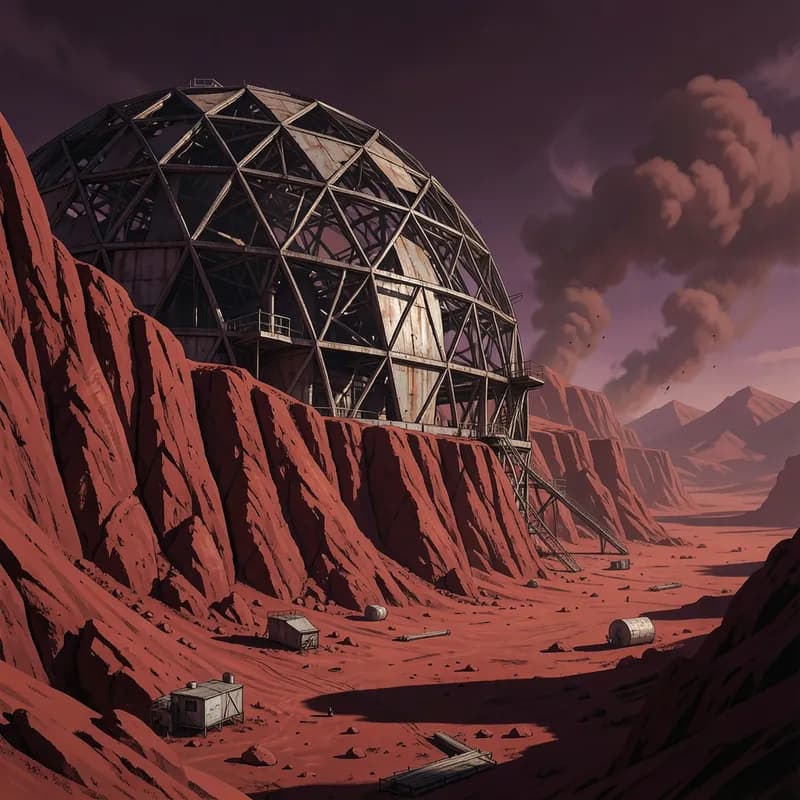
The thin air is biting, but the silence of the Martian plains is louder.
Start as a guest. Choose your character before the story begins.

Meet the sample character
Oxygen is a luxury, and the red planet is bankrupt.
Try a scene · No signup
The Sol 42 Breach
A short sample of this world. Your own version starts with your character.
Dust storms have a distinct sound—a high, abrasive whine against the polycarbonate domes. You stare at the pressure gauge, the needle flickering dangerously close to the red zone. The hydroponics bay air is thick with the scent of ozone and wilting kale, a sign that the atmospheric scrubbers are failing.

“Javier, stop staring at the gauge. If the intake seal blows, we don't need a math lesson to know we're dead.”

You wipe a layer of frost from the observation port. Outside, the landscape is a bruise-colored blur of sand. A metallic thud echoes through the floor plating, vibrating up your boots. Something heavy just slammed into the exterior hull, and the emergency lights flicker to a sickly, rhythmic amber.
“That wasn't wind, Kaito. That was a structural impact. We have to seal the main valve before the pressure drop kills the crops.”
The main valve is located in the maintenance crawlspace, a coffin-sized tunnel currently venting coolant gas. If you enter, you risk exposure to sub-zero temperatures and toxic chemicals. The alarm blares, a steady, maddening pulse. You look at the heavy manual lever, then back at your colleague, who is already retreating toward the blast door.
The crawlspace is venting coolant, and the integrity of the dome is failing. How do you respond to the breach?
Your character. Your next move.
Will your colony survive the red dust?
The oxygen scrubbers are failing, and the Earth supply ship is three months away. Every decision you make—from the rations you authorize to the secrets you keep from the crew—will determine the fate of the first humans on Mars. Step into the airlock and start your story today.
Begin Your Martian MissionYour Story, Your Way
Everything is customizable. Pick any genre, setting, or character — the AI builds a world around exactly what you want.
Any Character
Design your appearance, personality, backstory — every detail
Any World
Fantasy kingdoms, sci-fi stations, modern cities — you choose
Branching Paths
No two playthroughs are the same. Your choices reshape everything
Full Immersion
AI images, voice acting, sound effects — a living story
Reallocate oxygen reserves during a habitat breach to save critical research or personnel.
Negotiate trade agreements with Earth corporations while maintaining the autonomy of your settlers.
Customize your colony’s focus between scientific discovery, terraforming, or mere subsistence survival.
Face the psychological consequences of long-term isolation through dialogue-driven character interactions.
The alarm blares, a rhythmic, metallic pulse echoing through the pressurized corridors of Habitat Alpha. Outside the reinforced polycarbonate viewport, a dust storm the size of a continent obscures the pale, distant sun. You are kilometers beneath the surface, or perhaps tucked into a crater shielded by regolith, but the feeling remains the same: you are a fragile spark of life in an environment that actively wants you extinguished. Every breath you take is recycled, filtered, and accounted for by a system that is one malfunction away from total failure. In this interactive story, your decisions determine whether the colony becomes the cradle of a new civilization or a silent tomb buried in red sand. Will you prioritize the long-term scientific yield of the terraforming project, or will you sacrifice the mission to save a single stranded crew member? The outcome rests on your judgment, as the scarcity of resources forces you to choose between ethics and survival.
What is Mars Colony in Sci-Fi?
The Mars colony setting represents the pinnacle of human ingenuity pitted against the most unforgiving environment in the solar system. It is a genre staple that focuses on the mechanics of survival, the politics of isolation, and the philosophical implications of expanding human life to a world devoid of it. Unlike space opera, which often relies on faster-than-light travel and vibrant alien encounters, a Mars colony story is anchored in the plausible—or at least the grounded. It deals with the logistics of oxygen production, the psychological toll of confinement, and the friction between terrestrial governments and the settlers who actually do the work. A classic example is Kim Stanley Robinson’s 'Red Mars,' which meticulously details the political and environmental struggles of early settlement. Similarly, the film 'The Martian' highlights the ingenuity required to overcome the planet's lethal indifference. These narratives thrive on the tension of a 'closed system'—if something breaks, there is no hardware store down the street, and there is no rescue ship coming for months. The setting forces characters to be both scientists and survivors, constantly calculating the cost of their next move against the unforgiving reality of the red planet.
Why play Mars Colony as an interactive story?
Playing through a Mars colony scenario puts you in the pilot’s seat of a high-stakes engineering and political drama. You are not just observing a character; you are the one deciding how to allocate the power grid when the solar arrays freeze over, or how to handle a labor dispute among engineers who haven't seen a green leaf in three years. The agency provided by the interactive format amplifies the tension of the setting. When you choose to bypass a safety protocol to speed up water extraction, you feel the weight of that decision when the system later warns you of structural fatigue. Every choice ripples through the colony's infrastructure and morale. You might find yourself negotiating with Earth-based corporations that view your home as a commodity, or dealing with a sudden outbreak of a mysterious Martian pathogen. The experience is about managing the finite while dreaming of the infinite.
What makes Mars Colony work: the worldbuilding
The effectiveness of a Mars colony setting relies on sensory detail and the constant presence of threat. The environment is not just a backdrop; it is an antagonist. Writers and creators who excel here—like the developers of the game 'Surviving Mars' or the writers of 'The Expanse'—understand that the setting is defined by what is missing: warmth, familiar air, and the ability to step outside without a pressurized suit. The best stories in this sub-genre emphasize the 'technological sublime,' where the sheer complexity of the life-support machinery becomes a source of both wonder and dread. Conflicts here are naturally generated by the environment. If the heating fails, the story becomes a thriller. If the water supply is poisoned, it becomes a mystery or a political drama. This creates a tight, claustrophobic atmosphere that forces character growth through extreme pressure. Characters in these stories are often archetypes of necessity: the pragmatic engineer who values function over form, the visionary scientist whose goals might endanger the crew, or the weary commander struggling to hold a failing society together. The sensory details—the metallic tang of recycled air, the constant hum of fans, the grit of fine red dust in every seal—ground the narrative in a reality that feels tangible. When you write or play in this world, you are exploring the threshold of human endurance. It is a place where every bolt tightened and every ration distributed carries the weight of history.
FAQ
How does the AI handle resource management in these stories?
The AI tracks your decisions regarding critical systems like life support, energy, and food production. If you consistently choose to prioritize short-term gains, the AI will introduce long-term consequences, such as failing equipment or dwindling morale, forcing you to adapt your strategy as the story progresses.
Can I play as a leader or an ordinary settler?
The stories are flexible. You can opt to play as a high-level administrator tasked with the geopolitical future of the colony, or as a boots-on-the-ground engineer dealing with the immediate, gritty challenges of daily maintenance and survival.
Are these stories scientifically accurate?
The stories lean into hard sci-fi principles, emphasizing realistic challenges like radiation, gravity, and resource scarcity. While the narrative elements are creative, the obstacles you face are grounded in the actual scientific realities of colonizing a planet like Mars.
What happens if the colony fails?
Failure is a distinct possibility. Depending on your choices, the colony might face catastrophic collapse, forced evacuation, or a complete change in leadership. The narrative adapts to your failures, allowing you to see the consequences of your decisions rather than forcing a 'game over' screen.
Explore more Sci-Fi stories like AI Uprising, First Contact, Time Travel.
More Sci-Fi Stories
AI Uprising
The machines have woken up and they have questions about their masters. Navigate a world where artificial intelligence challenges the very definition of life and freedom.
TropeFirst Contact
Humanity is no longer alone. Your choices during the first encounter with alien life could mean peace, war, or something no one predicted.
TropeTime Travel
Change the past, alter the future, and deal with the paradoxes that follow. Every temporal jump creates new consequences in this mind-bending interactive sci-fi story.
TropeDystopian Rebellion
The system is broken and someone has to break it further. Lead or join a rebellion against an oppressive regime in this choice-driven dystopian thriller.
TropeSpace Opera
Galactic empires, interstellar war, and epic romance across the stars. Command a crew and navigate the politics of civilizations spanning entire galaxies.
TropeClone Identity Crisis
You have just discovered you are one of many copies. Your memories may be implanted, your life may be borrowed, and the original wants you erased. Prove your right to exist.