
Sci-Fi · Interactive story
Command the Last Starship
The engines are dying, the oxygen is thin, and the stars are indifferent.
Start as a guest. Choose your character before the story begins.
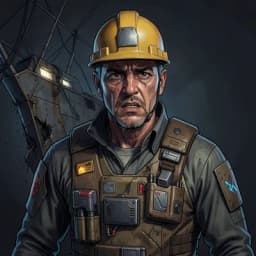
Meet the sample character
Oxygen is a luxury, and time is a finite resource.
Try a scene · No signup
The Long Drift of the Aethelgard
A short sample of this world. Your own version starts with your character.
The Aethelgard hums with the uneven vibration of a failing heart. You watch the pressure gauge needle twitch toward the red zone, rhythmic and taunting. A fine mist of coolant sprays from a hairline fracture in the overhead pipe, coating your face in stinging, metallic dew. Every breath you take tastes like recycled air and industrial decay.

“Hideo, the port thrusters are losing sync! If we don't vent the secondary reservoir, the whole manifold is going to liquefy.”

You wipe the coolant from your eyes, your hands trembling against the cold steel of the console. The schematics projected on your wrist display a grim reality: you have enough power to stabilize the thrusters or maintain oxygen levels for the cryo-pods, but not both. The ship is deathly cold, and the silence from the bridge suggests that no one is coming to help you make this call.
“If I shut the intake valves, the sleepers survive until we reach the terminus, but we lose all maneuverability. We become a floating tomb.”
The manifold groans, a sound of tortured metal echoing through the hull. You have ten seconds before the pressure differential tears the bulkhead apart. If you vent the reservoir, the ship becomes a drift-hull, aimless in the void. If you force the manifold shut, the ensuing explosion might kill everyone in the engine room instantly. The choice is yours.
The pressure alarm is screaming. How do you handle the manifold failure?
Your character. Your next move.
The void is waiting. Will you lead them home?
The life-support systems are flickering. The crew is looking to you for a decision that will either secure their future or seal their fate in the dark. Don't let their last hope vanish into the vacuum. Take the helm now and determine the fate of the final generation.
Take command of the shipYour Story, Your Way
Everything is customizable. Pick any genre, setting, or character — the AI builds a world around exactly what you want.
Any Character
Design your appearance, personality, backstory — every detail
Any World
Fantasy kingdoms, sci-fi stations, modern cities — you choose
Branching Paths
No two playthroughs are the same. Your choices reshape everything
Full Immersion
AI images, voice acting, sound effects — a living story
Allocate dwindling oxygen reserves between the active crew and thousands in cryogenic stasis.
Arbitrate disputes between rival factions over the limited remaining fuel cells for navigation.
Decide whether to investigate mysterious signals at the risk of exposing your location.
Manage the psychological breakdown of the crew as the reality of their exile settles.
The bulkhead groans under the pressure of a thousand lightyears. Outside, the void of space is absolute, a silent graveyard where Earth used to be. You stand on the bridge of the Aethelgard, the final vessel holding the flicker of a civilization that has nowhere left to call home. Rations are calculated to the milligram, and the air recyclers rattle with a rhythmic, mechanical cough that keeps every crew member awake at night. You hold the authority to decide who eats, who sleeps in the cryo-vaults, and which star systems are worth the fuel to investigate. Your decisions dictate the trajectory of this steel cocoon. Whether you lead these refugees to a verdant new world or drift into the silence of deep space depends entirely on the path you choose.
What is Last Starship in Sci-Fi?
The last starship trope is a staple of speculative fiction, rooted in the existential dread of a species pushed to the brink. It focuses on the microcosm of the ship, where the vessel itself becomes a surrogate for society, culture, and morality. Think of the 1978 Battlestar Galactica or the desperate, claustrophobic atmosphere of Aniara by Harry Martinson. These stories function as psychological pressure cookers. When the horizon is infinite and the resources are finite, the tension shifts from external threats—aliens or cosmic anomalies—to internal conflict. Who gets to define humanity when the planet that birthed you is a memory? It explores the erosion of ethics under extreme scarcity. The ship is not just a vehicle; it is a ticking clock, a fragile bubble of life navigating a universe that does not care if you survive the next jump.
Why play Last Starship as an interactive story?
In this interactive narrative, you are not merely a passenger. You are the architect of the final chapter. The tension arises from the weight of your authority: do you prioritize the immediate survival of the current crew or the long-term viability of the genetic stock in the cryo-bays? You might face a mutiny when the water reclamation system fails, forcing you to choose between strict rationing that breeds resentment or a dangerous scavenging mission that risks the ship's integrity. Every jump through hyperspace consumes energy that cannot be recovered. You will negotiate with desperate factions on board, balance the needs of scientists against the demands of the engineers, and decide whether to stop for a distress signal that might lead to salvation or a trap. Agency here means owning the consequences of your failures. If you lose control, the ship becomes a tomb. If you lead with resolve, you might just find a home among the stars.
Famous examples of Last Starship in books, film, and games
The last starship narrative persists because it mirrors our own anxieties about stewardship and survival. In the Battlestar Galactica reimagining, the trope centers on the constant pursuit—the fleet is always one step ahead of total annihilation, forcing its leaders to make increasingly draconian decisions to maintain order. It turns the starship into a political stage where democracy is a luxury they cannot afford. Contrast this with Wall-E, which uses the concept of the Axiom—a gargantuan, generation-spanning ship—to critique the stagnation of a humanity that has forgotten its purpose. While Battlestar focuses on the survival of the body, Wall-E focuses on the survival of the human spirit in a post-scarcity, post-ambition world. Then there is the bleak, existential dread found in Aniara, where the ship is knocked off course and drifts into the void forever. It serves as a meditation on how humans cope when they realize the destination is unreachable. These stories endure because they force us to confront the fragility of our systems. Whether it is a war-torn fleet or a drifting ark, the ship provides a contained environment to stress-test human values. We see these characters shed their old lives and adapt to the brutal reality of the void, showing us what remains when everything else is stripped away.
FAQ
What makes this trope so stressful?
It relies on finite resources. Every choice has a cost, and there are no perfect endings that satisfy everyone on board. You are constantly balancing survival against morality.
Is this game about space combat?
It can be, but the core tension is management and survival. You are often fighting against entropy, failing systems, and dwindling morale as much as external foes.
Can I choose to be a ruthless leader?
Yes. You can prioritize efficiency and survival at the cost of your crew's trust, or you can aim for a more democratic approach that might risk the ship's safety.
How do I win?
Winning is defined by your goals. Is it reaching a new planet, keeping the crew alive, or simply ensuring the survival of the human race, even if you don't survive to see the destination?
Explore more Sci-Fi stories like AI Uprising, First Contact, Time Travel.
More Sci-Fi Stories
AI Uprising
The machines have woken up and they have questions about their masters. Navigate a world where artificial intelligence challenges the very definition of life and freedom.
TropeFirst Contact
Humanity is no longer alone. Your choices during the first encounter with alien life could mean peace, war, or something no one predicted.
TropeTime Travel
Change the past, alter the future, and deal with the paradoxes that follow. Every temporal jump creates new consequences in this mind-bending interactive sci-fi story.
TropeDystopian Rebellion
The system is broken and someone has to break it further. Lead or join a rebellion against an oppressive regime in this choice-driven dystopian thriller.
TropeSpace Opera
Galactic empires, interstellar war, and epic romance across the stars. Command a crew and navigate the politics of civilizations spanning entire galaxies.
TropeClone Identity Crisis
You have just discovered you are one of many copies. Your memories may be implanted, your life may be borrowed, and the original wants you erased. Prove your right to exist.