Sci-Fi · Interactive story
Born in the Void: The Generation Ship
The hull is your horizon. The engine is your god. Make your choice.
Start as a guest. Choose your character before the story begins.

Meet the sample character
The air grows thin as the hull begins to weep.
Try a scene · No signup
Oxygen Debt
A short sample of this world. Your own version starts with your character.
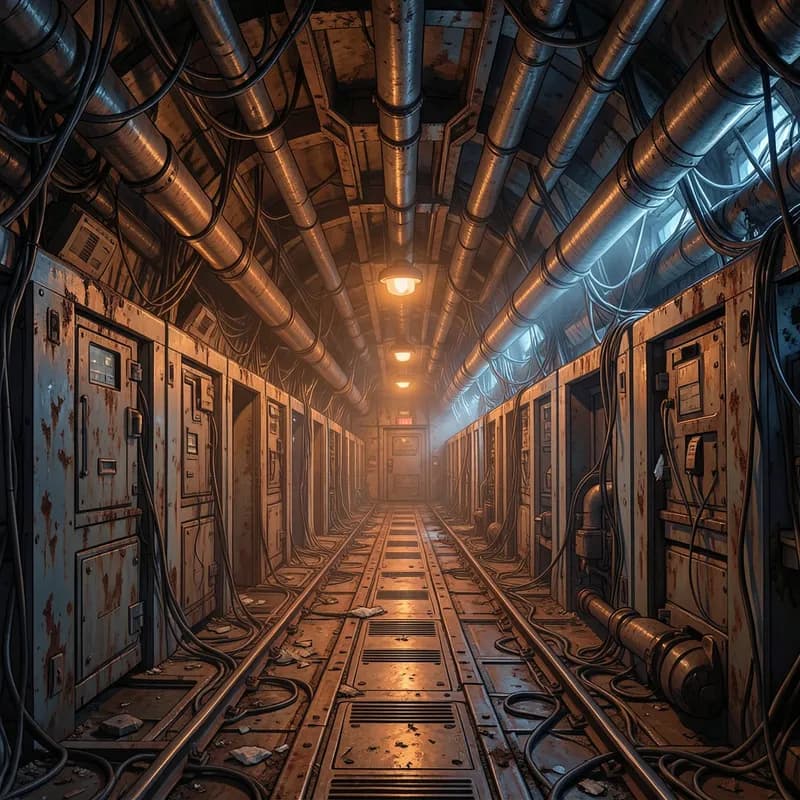
You wipe the frost from the observation port, but it isn't space you see—it's the scarred, rusted tangle of the outer hull. The air here tastes of recycled sweat and damp fertilizer. You shouldn't be in this sector after the cycle shift, but the humming of the oxygen scrubbers has turned into a rhythmic, metallic stutter that makes your teeth ache.

“Don't touch that valve, Jaren. It's fused shut for a reason.”

Mira stands in the shadow of the cooling towers, her hands stained with heavy engine grease. She grips a magnetic wrench so hard her knuckles are white. If she reports your presence to the Watch, you will be reassigned to the waste reclamation pits for the remainder of your life.
“If we don't open it, the pressure builds until the whole bulkhead fails. Do you want to suffocate or take the risk?”
The floor beneath your boots vibrates with a violent, deep-seated shudder. A warning light flickers amber, then fails entirely. You stare at the pressure gauge; the needle is pinned deep in the red, and the high-pitched screaming of the ventilation fans has suddenly cut to a terrifying silence.
The gauge is red-lining and the ventilation is dead. How will you stabilize the deck?
Your character. Your next move.
The destination is light-years away. Can you keep the ship alive?
The oxygen levels are dropping in Sector 4, and the Council is threatening to shut down the bridge. Your decisions will determine if the last of humanity reaches the stars or drifts forever in the dark. Take control of the vessel now.
Begin Your VoyageYour Story, Your Way
Everything is customizable. Pick any genre, setting, or character — the AI builds a world around exactly what you want.
Any Character
Design your appearance, personality, backstory — every detail
Any World
Fantasy kingdoms, sci-fi stations, modern cities — you choose
Branching Paths
No two playthroughs are the same. Your choices reshape everything
Full Immersion
AI images, voice acting, sound effects — a living story
Allocate power between life support, navigation, and the civilian sectors during critical failures.
Negotiate peace treaties between the ship’s warring factions before the next hull breach.
Choose to uphold the ship’s original mission or adapt to a new, local reality.
Uncover hidden logs from the original crew that challenge your understanding of the destination.
The vibration of the hull is the only heartbeat you have ever known. Outside, the black expanse remains silent, a static portrait of infinity that your ancestors spent their lives watching. You were born in the hydroponics bay of the vessel, destined to monitor the oxygen scrubbers until your own lungs give out, just like the generations before you. But today, the air tastes of ozone and metallic decay. A red light pulses in the maintenance corridor, and for the first time, you realize the ship might not be as eternal as the elders claim. Every decision you make—from how you distribute the dwindling energy reserves to which faction of the crew you choose to trust—will ripple through the metal veins of this floating city. You are the final variable in a journey that began long before you were born. In this interactive story, your choices determine if the vessel reaches its destination or becomes a drifting mausoleum.
What is a Generation Ship in Sci-Fi?
A generation ship is a starship designed to traverse interstellar distances over centuries, housing a self-contained human population that lives and dies within its walls. The mission is simple: reach a new home system, even if the original crew never sees the destination. Unlike cryosleep vessels, these ships are societies in miniature, complete with schools, class systems, and traditions that often morph into rigid superstitions. Authors have long used this setting to examine how humanity adapts to absolute isolation. In Brian Aldiss’s 'Non-Stop,' the inhabitants have forgotten they are on a ship at all, treating the corridors as a primitive, enclosed world. Conversely, Kim Stanley Robinson’s 'Aurora' examines the brutal mathematical reality of maintaining an ecosystem in deep space. These stories thrive on the tension between the ship’s finite resources and the infinite duration of the voyage. When a ship must sustain a population for hundreds of years, the primary conflict is rarely the destination; it is the internal decay, the political friction of a closed society, and the mechanical failure of the life-support systems that keep everyone breathing.
Why play a Generation Ship interactive story?
Playing through a generation ship narrative shifts the focus from exploration to management and survival. You are not a hero with a laser pistol; you are an engineer, a botanist, or a low-level administrator who suddenly has to make decisions that will affect thousands of lives. The tension comes from the scarcity of resources. When the water reclamation system fails, do you divert power from the hydroponics bay, knowing the food supply will drop, or do you leave the lower decks without water to maintain the structural integrity of the bridge? You must balance the needs of the ship against the desires of the people. You will encounter moments where you must decide whether to enforce the strict laws of the ship’s founders or allow a new, radical faction to take control of the navigation deck. Every choice shifts the internal culture of the vessel, creating a living narrative where the ship itself reacts to your leadership.
What makes Generation Ship work: the worldbuilding
The effectiveness of a generation ship setting lies in its claustrophobia. The environment is the antagonist. Because the characters cannot leave, every conflict—whether it is a resource shortage or a social uprising—happens in a space where there is nowhere to hide. Writers often use sensory details to emphasize this: the constant hum of the ventilation, the smell of recycled air, and the reliance on artificial lighting instead of a sun. These details create a sense of history. Because the ship has been traveling for centuries, the architecture itself tells a story. Older decks might be rusted and forgotten, while the newer sections are sleek and strictly monitored. Consider the mechanics found in works like 'Aniara,' where the psychological toll of the void becomes the central focus, or the classic 'Tau Zero,' which highlights the sheer physical peril of interstellar travel. A successful generation ship story requires a rigid social structure that is slowly cracking. The most effective narratives explore what happens when the 'religion' of the ship—the belief that they are going somewhere—is challenged. What happens when the destination is proven uninhabitable? What happens when the ship arrives, but no one remembers how to pilot it? The setting works because it forces the player to question the purpose of their own existence. Are you living for the mission, or are you living for the sake of the ship? By focusing on these internal pressures, the setting generates a unique form of drama that relies on the player's ability to maintain order in a world that is slowly falling apart.
FAQ
What is the primary conflict in a generation ship story?
The primary conflict is usually resource scarcity and social decay. Because the ship is a closed system, every decision to use energy, water, or food has a direct consequence for the population. This creates high-stakes political and ethical dilemmas.
How does the ship's age affect the narrative?
The older the ship, the more likely the inhabitants have developed unique customs, religions, or myths about the vessel. It allows for a setting that feels like a fantasy world hidden inside a sci-fi construct.
Is this a survival game or a political thriller?
It can be both. You might be managing oxygen scrubbers to prevent a slow death, or you might be navigating the political fallout of a generational divide between those who want to finish the mission and those who want to settle on the ship permanently.
Can I reach the destination in these stories?
Depending on your choices, yes. You might successfully guide the ship to a new star system, or your decisions might lead to the ship becoming a permanent habitat for humanity, abandoning the original mission entirely.
Explore more Sci-Fi stories like AI Uprising, First Contact, Time Travel.
More Sci-Fi Stories
AI Uprising
The machines have woken up and they have questions about their masters. Navigate a world where artificial intelligence challenges the very definition of life and freedom.
TropeFirst Contact
Humanity is no longer alone. Your choices during the first encounter with alien life could mean peace, war, or something no one predicted.
TropeTime Travel
Change the past, alter the future, and deal with the paradoxes that follow. Every temporal jump creates new consequences in this mind-bending interactive sci-fi story.
TropeDystopian Rebellion
The system is broken and someone has to break it further. Lead or join a rebellion against an oppressive regime in this choice-driven dystopian thriller.
TropeSpace Opera
Galactic empires, interstellar war, and epic romance across the stars. Command a crew and navigate the politics of civilizations spanning entire galaxies.
TropeClone Identity Crisis
You have just discovered you are one of many copies. Your memories may be implanted, your life may be borrowed, and the original wants you erased. Prove your right to exist.