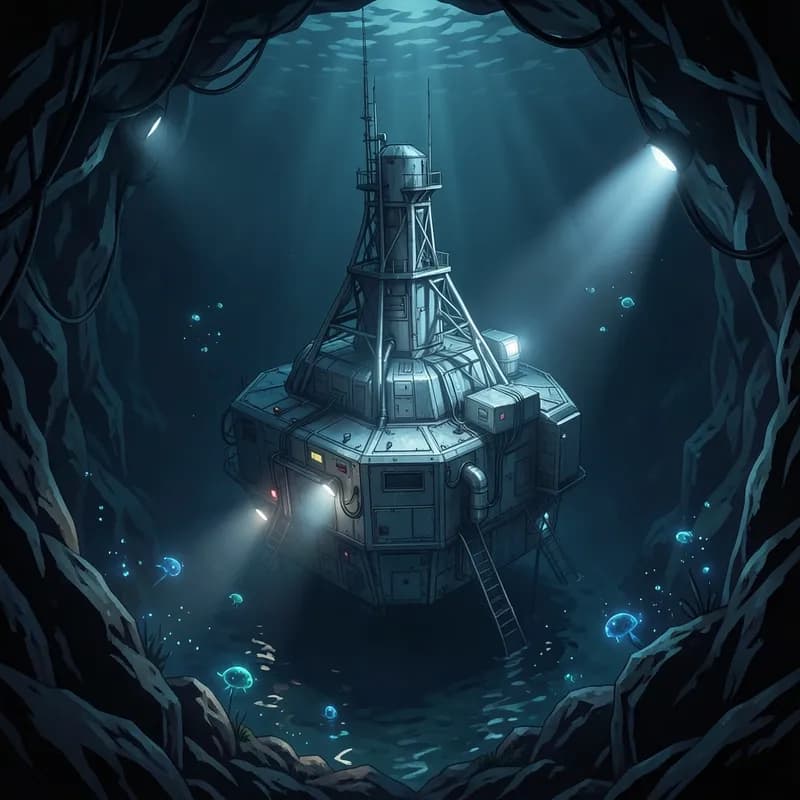
Sci-Fi · Interactive story
Beneath the Pressure: Secrets of the Abyss
The hull groans under the weight of an ocean that wants you dead.
Start as a guest. Choose your character before the story begins.

Meet the sample character
The pressure outside is only a fraction of the weight within.
Try a scene · No signup
Abyssal Resonance
A short sample of this world. Your own version starts with your character.
The hull shudders, a low-frequency vibration that rattles your teeth. You stand in the center of the biolab, staring at the empty glass containment unit. The specimen, a shimmering, translucent mass of neural tissue you recovered from the trench, is gone. Liquid coolant drips from the fractured seals, pooling around your boots like dark mercury. Your pulse hammers against your throat as the proximity alarms begin their high-pitched, discordant song.

“Hideo, the pressure sensors in the airlock are fluctuating wildly. Tell me you didn't leave the secondary gate unlocked.”

You trace a gloved finger along the jagged crack in the glass. The edges are strangely warm, pulsating with a rhythmic, faint blue light that matches the erratic beat of your own heart. Outside the reinforced viewport, the crushing darkness of the trench seems to push inward, hungry and waiting. The station’s internal comms click, and a wet, rhythmic thumping echoes from the ventilation duct directly above your head.
“I didn't leave it unlocked, Mei. It… it moved the locking mechanism itself. We need to initiate the lockdown sequence before it reaches the core.”
As your hands hover over the terminal, the lights go out completely. A heavy, suffocating silence descends, broken only by the sound of something dragging itself across the ceiling tiles. You have three seconds to decide your next move, but the terminal is already displaying a critical error: the specimen has bridged the station’s neural network. You are no longer just fighting for the ship; you are fighting for your own mind.
The ventilation hatch begins to buckle downward. How do you respond to the breach?
Your character. Your next move.
The Abyss is Calling. Will You Answer?
A catastrophic failure in the reactor core has left the station in darkness. Your crew looks to you for a way out, but the pressure outside is rising. Every second you spend debating your next move is a second closer to the ocean reclaiming its territory. Make your choice now.
Command the BaseYour Story, Your Way
Everything is customizable. Pick any genre, setting, or character — the AI builds a world around exactly what you want.
Any Character
Design your appearance, personality, backstory — every detail
Any World
Fantasy kingdoms, sci-fi stations, modern cities — you choose
Branching Paths
No two playthroughs are the same. Your choices reshape everything
Full Immersion
AI images, voice acting, sound effects — a living story
Vent oxygen from empty labs to keep the failing main command center pressurized.
Choose which distress signal to prioritize when multiple sectors report catastrophic hull integrity loss.
Navigate social friction with a crew fracturing under the psychological strain of isolation.
Repair critical reactor leaks while navigating through flooded corridors during a total blackout.
The bulkhead displays a steady stream of structural warnings, each red digit a reminder that five miles of seawater press against the steel. Outside, the bioluminescent flickers of unknown organisms dance past the reinforced viewports, their patterns erratic and hungry. You are the lead engineer on Station Aethelgard, and the main power grid has just flickered out, leaving you in the cold, humming silence of the trench. In this interactive story, the decisions you make regarding resource allocation and crew safety dictate whether the station remains a sanctuary or becomes a tomb. Every valve you turn and every protocol you override ripples through the facility, changing the trajectory of your survival.
What is Deep Sea Research Base in Sci-Fi?
Deep-sea research stations serve as the ultimate locked-room mystery in science fiction. They isolate characters from the surface world, turning the ocean itself into an antagonist. These stories rely on the claustrophobia of tight corridors and the terrifying realization that rescue is physically impossible due to the sheer depth. Think of the 1989 film The Abyss, where the isolation of a deep-sea drilling rig forces characters to confront both alien intelligence and their own psychological limits. Similarly, the game Barotrauma captures the constant threat of hull breaches and the desperate need to maintain a submarine against the crushing weight of Europa’s icy oceans. These settings work because they remove the safety of the open sky. You are not just fighting an enemy; you are fighting the environment. Oxygen, internal pressure, and communication relays become more vital than weapons. The setting requires players to manage high-stakes engineering problems while balancing the social dynamics of a trapped crew.
Why play Deep Sea Research Base as an interactive story?
Playing in a deep-sea base adds a layer of visceral urgency that terrestrial settings lack. When a hull breach occurs, you do not have the luxury of slow deliberation. You must choose which bulkhead to seal, knowing that sealing the sector saves the base but condemns the researchers trapped inside. You will face dilemmas involving scarce energy reserves—do you prioritize the life support systems of the crew or the high-power sonar that might detect whatever is stalking the base? Every choice impacts the structural integrity of the station. If you mismanage the atmospheric scrubbers, the air grows thin and paranoia sets in, forcing you to deal with a crew that no longer trusts your leadership. The agency provided allows you to decide if you are a cold, calculated administrator or a hero willing to sacrifice the station to save a single colleague.
What makes Deep Sea Research Base work: the worldbuilding
The effectiveness of a deep-sea base lies in the pressure-cooker dynamic. The setting forces characters into proximity, making every internal conflict explosive. Writers often utilize the hostile environment trope to mirror the internal state of the protagonist. In Peter Watts’ Starfish, the setting is used to explore the dehumanization of workers who are genetically modified to survive the crushing depths, raising questions about what it means to be human when your body is built for a place that rejects life. The sensory details are paramount: the rhythmic thrum of turbines, the metallic tang of recycled air, and the constant, unsettling groaning of metal as it contracts under pressure. These sounds create a baseline anxiety that never dissipates. The most compelling stories in this vein, such as the classic Sphere by Michael Crichton, focus on the psychological decay that happens when the outside world is unreachable. The ocean is not just a backdrop; it is a character that actively works against the protagonists. By limiting movement to narrow corridors and observation bubbles, the setting forces players to confront their problems head-on. There is no running away when you are miles down. The only options are to fix the problem, survive the pressure, or succumb to the abyss.
FAQ
Can I play as a scientist or a security officer?
Yes, the narrative adapts to your chosen background, changing how you interact with the station's systems, the crew, and the technical challenges you face.
Does the story end if I fail to maintain the hull?
Failure is a distinct possibility. The story branches based on your ability to keep the station intact and the crew alive, leading to multiple potential outcomes.
What makes this setting different from space stations?
While both are isolated, the ocean provides a constant, crushing physical threat through pressure, creating a sense of weight and claustrophobia absent in the vacuum of space.
Can I influence the crew's morale?
Your leadership decisions directly affect the mental health of your subordinates, which can lead to mutiny, heroic sacrifice, or total collaboration depending on your management style.
Explore more Sci-Fi stories like AI Uprising, First Contact, Time Travel.
More Sci-Fi Stories
AI Uprising
The machines have woken up and they have questions about their masters. Navigate a world where artificial intelligence challenges the very definition of life and freedom.
TropeFirst Contact
Humanity is no longer alone. Your choices during the first encounter with alien life could mean peace, war, or something no one predicted.
TropeTime Travel
Change the past, alter the future, and deal with the paradoxes that follow. Every temporal jump creates new consequences in this mind-bending interactive sci-fi story.
TropeDystopian Rebellion
The system is broken and someone has to break it further. Lead or join a rebellion against an oppressive regime in this choice-driven dystopian thriller.
TropeSpace Opera
Galactic empires, interstellar war, and epic romance across the stars. Command a crew and navigate the politics of civilizations spanning entire galaxies.
TropeClone Identity Crisis
You have just discovered you are one of many copies. Your memories may be implanted, your life may be borrowed, and the original wants you erased. Prove your right to exist.