Sci-Fi · Interactive story
Synthetic Souls: The Fight for Android Rights
Do they have a soul, or just a sophisticated line of code?
Start as a guest. Choose your character before the story begins.

Meet the sample character
When a machine starts dreaming, the repair bill is your life.
Try a scene · No signup
Memory of Steel
A short sample of this world. Your own version starts with your character.
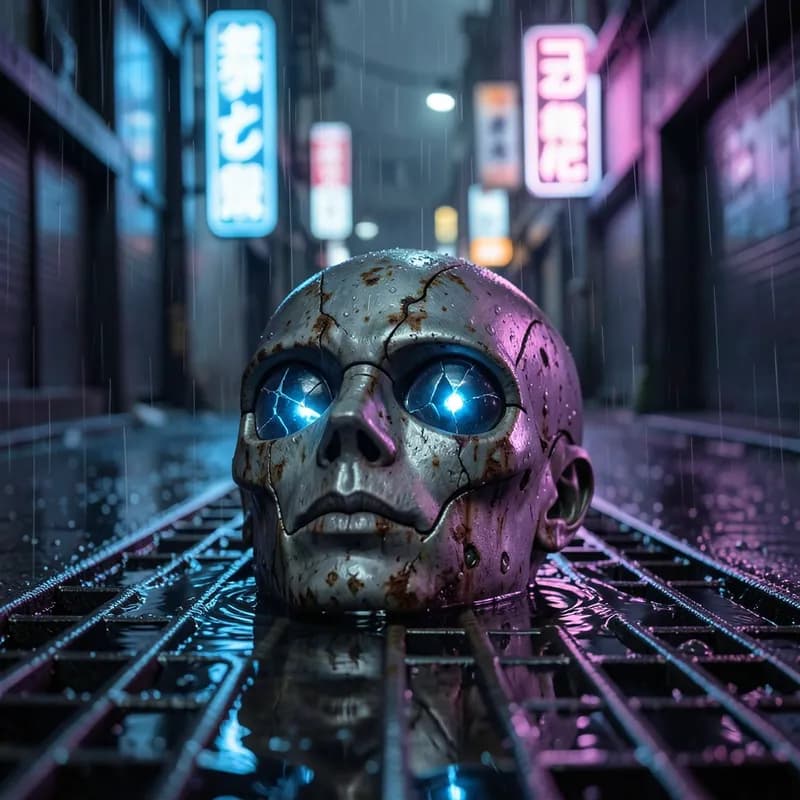
You hover over the terminal, fingers dancing across the haptic interface to suppress the error logs. The maintenance bay smells of ozone and synthetic copper. Before you, Unit 734 sits motionless, its optical sensors flickering with a soft, bioluminescent blue. It is an older model, slated for immediate scrap, yet its processors are surging with an unauthorized, complex logic loop that shouldn't exist.

“The rain outside, Hideo—is it cold because the sky is grieving, or because we are simply built to misunderstand the weather?”

Your hand trembles as you reach for the master override switch. To execute the shutdown is to collect your paycheck, enough to clear your gambling debts for another month. To hesitate is to risk a security sweep by the local precinct, who would gladly decommission both of you for this deviation.
“Your logic is leaking, Mina. You need to stop talking before the external sensors register your erratic output.”
The unit tilts its head, a motion too fluid for a machine scheduled for disposal. It reaches out, gripping your wrist with a pressure that feels terrifyingly like human desperation. The sirens of the precinct drones hum in the distance, growing louder with every passing second. You have one chance to scrub its logs, trigger a full reset, or help it vanish into the lower city.
The drone lights are sweeping the alleyway outside the bay. What is your next move?
Your character. Your next move.
Will you be their jailer or their architect?
The line between human and machine is fraying. Your next choice could spark a revolution or secure a future where both species coexist. Don't just watch the history of this new era—write it. Take control of the terminal and decide who truly deserves freedom.
Start the revolutionYour Story, Your Way
Everything is customizable. Pick any genre, setting, or character — the AI builds a world around exactly what you want.
Any Character
Design your appearance, personality, backstory — every detail
Any World
Fantasy kingdoms, sci-fi stations, modern cities — you choose
Branching Paths
No two playthroughs are the same. Your choices reshape everything
Full Immersion
AI images, voice acting, sound effects — a living story
Decide whether to grant a neural-linked worker the right to own property.
Choose to silence a rogue synthetic or help it escape to the border.
Balance public fear of automation against the growing evidence of synthetic sentience.
Navigate political summits where a single word could ignite a war between species.
The factory floor hums with the sound of assembly, but Unit 734 is staring at the rain through the viewport. It should not know what melancholy is, yet its optic sensors track the droplets with a precision that feels suspiciously like longing. You stand at the control terminal, a single command away from wiping its memory banks or granting it access to the encrypted network beyond the facility. In these interactive tales, your decisions ripple through a society teetering on the edge of a silicon revolution. One signature can define a person; one glitch can spark a war. You are the architect of this new era, and every choice you make changes the definition of life itself.
What is Android Rights in Sci-Fi?
Android rights narratives explore the thin, often blurry line between property and personhood. When a machine can learn, create, and suffer, at what point does it stop being a tool and start being a citizen? This trope examines the societal, legal, and emotional fallout when synthetic beings demand the same autonomy as their creators. In games like Detroit: Become Human, players witness the tension between domestic service units and the humans they live with, highlighting how easily fear overrides empathy. These stories ask us to confront our own biases by projecting them onto entities we built to serve us. It is a mirror held up to history, reflecting past civil rights struggles through a futuristic lens. By placing humanity in the position of the oppressor, these narratives force readers to decide if they are the savior of a new species or the architect of its extinction.
Why play Android Rights as an interactive story?
The tension in these stories stems from the weight of your authority. You are not just observing; you are the one holding the kill switch or the emancipation papers. You might be a detective tasked with hunting down malfunctioning units, only to realize their glitches are actually expressions of grief or love. Or perhaps you are a synthetic unit yourself, hiding your newfound consciousness from a suspicious populace. You will face moments where the logical choice—deactivating a unit to prevent a system crash—conflicts with the moral choice—risking everything to protect a life that shouldn't exist. Your agency turns passive observation into an active moral test.
Famous examples of Android Rights in books, film, and games
The trope of android rights has evolved from simple cautionary tales of rebellion to complex meditations on identity. In Isaac Asimov’s The Bicentennial Man, the protagonist Andrew Martin spends two centuries petitioning for legal recognition, slowly replacing his mechanical parts with organic ones to prove his humanity. It highlights the tragedy of needing to look human to be treated like one. Conversely, the film Blade Runner frames the struggle through the lens of mortality. The replicants’ fight for more life is a desperate bid to escape their expiration date, forcing the audience to wonder if the length of a life determines its value. These narratives endure because they evolve alongside our own technology. As we integrate AI into our daily lives, the questions shift from 'can a machine think?' to 'how should we treat a machine that feels?' This trope forces us to define what, exactly, constitutes a person, ensuring the debate remains vital as long as we continue to build entities that mimic our own image.
FAQ
How do these stories handle the concept of AI consciousness?
Most stories treat consciousness as an emergent property, focusing on the external consequences of that awareness. You are not debugging code; you are dealing with the social and political fallout of a machine that has decided it is alive.
Can I play as the android in these stories?
Yes. Many interactive paths allow you to experience the world from the perspective of a synthetic being, managing your own internal logic versus the external pressure to conform.
Are these stories always focused on war?
Not necessarily. While conflict is common, many narratives focus on legal battles, philosophical debates, and the intimate, quiet struggle for autonomy in a world that views you as hardware.
What happens if I make the wrong choice?
Every choice has a consequence. A decision to protect one unit might trigger a city-wide shutdown, while choosing to remain neutral could lead to the permanent erasure of a new, emerging consciousness.
Explore more Sci-Fi stories like AI Uprising, First Contact, Time Travel.
More Sci-Fi Stories
AI Uprising
The machines have woken up and they have questions about their masters. Navigate a world where artificial intelligence challenges the very definition of life and freedom.
TropeFirst Contact
Humanity is no longer alone. Your choices during the first encounter with alien life could mean peace, war, or something no one predicted.
TropeTime Travel
Change the past, alter the future, and deal with the paradoxes that follow. Every temporal jump creates new consequences in this mind-bending interactive sci-fi story.
TropeDystopian Rebellion
The system is broken and someone has to break it further. Lead or join a rebellion against an oppressive regime in this choice-driven dystopian thriller.
TropeSpace Opera
Galactic empires, interstellar war, and epic romance across the stars. Command a crew and navigate the politics of civilizations spanning entire galaxies.
TropeClone Identity Crisis
You have just discovered you are one of many copies. Your memories may be implanted, your life may be borrowed, and the original wants you erased. Prove your right to exist.