
Post-Apocalyptic · Interactive story
Life Beneath the Cracks: Surviving the Subterranean Collapse
The sky is a ghost story; down here, the only truth is the ventilation gauge.
Start as a guest. Choose your character before the story begins.
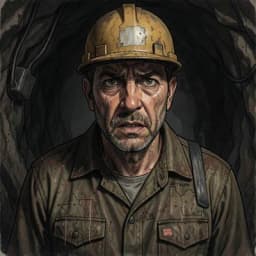
Meet the sample character
Oxygen is a luxury; survival is a debt.
Try a scene · No signup
Pressure at Sector Four
A short sample of this world. Your own version starts with your character.
Your fingers ache, raw from scraping against jagged sheet metal. You are wedged into a ventilation shaft barely wide enough for your shoulders, the darkness pressing against your eyelids like a physical weight. Beneath you, the rhythmic, metallic thumping of the pressure turbine has slowed to an irregular, wheezing stutter. If this turbine dies, the entire sector suffocates in less than an hour.

“Don't breathe so loud, Hideo. The tunnel-stalkers have ears tuned to the frequency of a nervous heartbeat.”

You freeze, sweat stinging your eyes. A vibration travels through the steel floorboards, distinct and deliberate. It isn't the machine. Something is moving in the crawlspace directly behind you, and the pressure gauge ahead is pinning itself into the red zone. The pipes are whistling, a high-pitched scream of escaping steam that threatens to rupture the entire wall.
“The pressure is critical. If I don't vent the gas now, we'll be cooked alive, but opening the seal will announce our location to whatever is hunting us.”
The metal groans under the strain, a hairline fracture spider-webbing across the support beam inches from your face. A claw scrapes against the ducting outside, sharp and impatient. You have mere seconds to act before the seal blows, taking both you and the creature stalking you into the abyss below.
How do you handle the mounting pressure and the encroaching threat?
Your character. Your next move.
The air is thinning. Choose your path.
The ventilation pumps are failing, and the council is looking to you for a solution. Do you enforce rationing, risking a riot, or do you send a team into the flooded lower levels to find spare parts? Your decision determines if your people see another sunrise. Start your story now.
Take Control of the TunnelsYour Story, Your Way
Everything is customizable. Pick any genre, setting, or character — the AI builds a world around exactly what you want.
Any Character
Design your appearance, personality, backstory — every detail
Any World
Fantasy kingdoms, sci-fi stations, modern cities — you choose
Branching Paths
No two playthroughs are the same. Your choices reshape everything
Full Immersion
AI images, voice acting, sound effects — a living story
Manage limited oxygen reserves by choosing which sectors receive power and air circulation.
Negotiate with faction leaders to secure trade routes for clean water and medical supplies.
Decide the fate of exiles who threaten the stability of your subterranean home.
Scavenge through dangerous, flooded lower tunnels to recover ancient, functional technology.
The soot on your skin is the only thing that remembers the sun. You press your back against the damp concrete of the maintenance shaft, listening for the rhythmic click of the filtration pumps. Above, the earth is a tomb of irradiated steel and bone. Down here, you survive on recycled air and the fragile promise of a community that hasn't collapsed yet. Every decision carries the weight of the last oxygen canister. Will you trade your rations for a seat at the council table, or will you steal the keys to the ventilation shaft and hope the surface isn't as lethal as the elders claim? In this interactive story, your choices dictate who gets to breathe tomorrow. You are not just a survivor; you are the architect of a dying society.
What is Underground Society in Post-Apocalyptic Fiction?
The underground society trope appears when the surface becomes uninhabitable, forcing humanity to retreat into the crust. It is a study in claustrophobic hierarchy and resource scarcity. The defining characteristic is the shift from outward exploration to inward management. In Dmitry Glukhovsky’s Metro 2033, the tunnels become a series of competing city-states, each defined by their proximity to functional infrastructure or clean water. The trope thrives on the tension between the physical limits of the environment—like the constant threat of tunnel collapse or oxygen failure—and the social pressures of living in a space where everyone knows your name and your mistakes. It turns a cavern into a pressure cooker, where the primary antagonist is often the scarcity of basic life-sustaining resources, and the secondary antagonist is the person living in the next alcove. By limiting the physical scope of the world, writers force characters to focus on the grit of daily survival and the complex web of political alliances required to keep the lights on.
Why play Underground Society as an interactive story?
Playing an underground survival story forces you to weigh your morality against the hard math of survival. You are not just observing a struggle; you are deciding how much light a sector gets or who receives the last dose of antibiotics. If you choose to hoard supplies, you might survive a week longer, but your reputation in the tunnels will crumble, leaving you vulnerable when the next tunnel fire breaks out. The tension comes from the physical constraints of your environment. You are always watching the pressure gauges, always listening for the sound of shifting stone, and always wondering if the political leader you have been trusting is actually siphoning power from the sector you call home. You will face moments where the right choice is impossible. Do you sacrifice the hydroponics bay to save the ventilation system, knowing the famine that follows will kill more people than the lack of air? Agency here is a burden, as every decision echoes through the cramped, metal-lined corridors.
Famous examples of Underground Society in books, film, and games
Hugh Howey’s Silo series uses this trope to explore the dangers of institutional memory. The society is a vertical cage, where the truth is kept under lock and key, and the act of going outside is a death sentence. The setting creates a rigid class system based on which level of the silo you inhabit, turning the physical depth of the structure into a metaphor for social standing. Contrast this with the film City of Ember, where the underground is a dying machine. The focus there is on the decay of technology and the loss of knowledge. The characters are not just fighting for food; they are fighting to understand the instructions left by their ancestors. Both examples show how the underground setting forces characters to define what humanity means when the sky is gone. The trope endures because it strips life down to its absolute essentials: air, water, and the person standing next to you. It creates a vacuum where every social interaction is intensified because there is nowhere else to go. Whether it is the desperate survivalism of a bunker or the decaying grandeur of a forgotten city, the underground society remains a powerful lens for examining how humans behave when the walls are literally closing in.
FAQ
What makes the underground society trope different from other post-apocalyptic settings?
While most post-apocalyptic stories focus on nomadic survival or rebuilding on the surface, the underground society trope focuses on confinement and resource management. The environment itself is a character that actively tries to crush or suffocate the inhabitants.
How do my choices impact the survival of the colony?
Your choices directly influence the colony's stability. If you prioritize immediate needs like food, you may face long-term infrastructure failures. If you invest in repairs, you might starve in the short term. Every action has a measurable consequence on the population's health and loyalty.
Are there enemies other than the environment?
Yes. In these stories, the lack of resources often turns neighbor against neighbor. You will encounter political rivals, desperate scavengers, and factions that believe the surface is habitable, leading to internal conflicts that can be just as deadly as a cave-in.
Can I leave the tunnels in this interactive story?
Leaving the tunnels is a high-stakes choice. Depending on your narrative path, you might attempt a surface expedition, but the conditions are lethal. Whether you find salvation or a quick death depends on the preparation and risks you take before leaving.
Explore more Post-Apocalyptic stories like Zombie Survival, Nuclear Wasteland, Plague Aftermath.
More Post-Apocalyptic Stories
Zombie Survival
The dead walk and every stranger is a threat. Scavenge for weapons, fortify your shelter, and make brutal choices about who lives and who gets left behind in this undead nightmare.
TropeNuclear Wasteland
The bombs fell and civilization crumbled. Now you wander a scorched earth where radiation is as deadly as the desperate survivors who stalk the ruins.
TropePlague Aftermath
A pandemic wiped out most of humanity. You survived, but survival is just the beginning as you navigate a world where disease still lurks and trust is the scarcest resource.
TropeFaction Warfare
Rival factions carve up what remains of the world, each with their own vision for the future. Choose your allegiance carefully because neutrality is not an option.
TropeScavenger Hunt
Every ruined building could hold the supplies that keep you alive another week. Risk raiders, traps, and structural collapse as you pick through the bones of civilization.
TropeBunker Emergence
You have lived underground your entire life. The bunker door is finally opening and the world outside is nothing like the old recordings promised.