
Post-Apocalyptic · Interactive story
Ashes of the Old World: A Nuclear Wasteland Story
The sky is gray, the water is toxic, and your next meal is a gamble.
Start as a guest. Choose your character before the story begins.
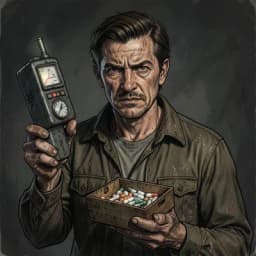
Meet the sample character
Nothing grows, but something always takes.
Try a scene · No signup
The Geiger Toll
A short sample of this world. Your own version starts with your character.
The wind tastes like copper and burnt plastic. You pull your respirator tighter, but the grit finds a way into your lungs anyway. Beneath your boots, the glass-fused sand of the old interstate crunches—a sound that carries far across the dead plains. You are not alone out here, and the silence is beginning to grow teeth.

“Don't stop, Hatcher. The scouts behind that ridge—they aren't looking for trade, they’re looking for spare parts and fresh meat.”

Your eyes scan the horizon, tracking the slow-moving plumes of dust kicked up by a pack of raider bikes. Jinx is shivering beside you, his hand gripping a rusted pipe like a holy relic. You hold the only map to the reservoir, and the ink is fading fast under your sweat-slicked thumb.
“Keep your breath steady, kid. If we run, we become targets. If we hide, we might end up buried.”
A low hum vibrates through the ground, the unmistakable grind of a heavy engine. The raiders are cutting off the main pass, and Jinx is starting to crack, his eyes wide and unfocused. You have seconds to move before their spotlights cut through the haze and pin you to the ash like a beetle.
The engine noise grows louder, echoing off the rusted relay tower. How do you evade the approaching raider pack?
Your character. Your next move.
Will you rebuild or will you vanish?
The horizon is burning, and your supplies are running thin. A group of desperate survivors is blocking the only bridge to the bunker, and they look hungry. Do you offer your last can of peaches to buy their loyalty, or do you draw your weapon and hope your aim is true? The story of the new world is waiting to be written by your hands. Start your journey through the ruins now.
Begin Your Survival StoryYour Story, Your Way
Everything is customizable. Pick any genre, setting, or character — the AI builds a world around exactly what you want.
Any Character
Design your appearance, personality, backstory — every detail
Any World
Fantasy kingdoms, sci-fi stations, modern cities — you choose
Branching Paths
No two playthroughs are the same. Your choices reshape everything
Full Immersion
AI images, voice acting, sound effects — a living story
Trade precious antibiotics to save a wounded stranger or hoard them for personal survival.
Scavenge through irradiated ruins for scrap metal to repair your failing water filtration system.
Choose between fighting a faction of raiders or attempting to negotiate a fragile truce.
Navigate treacherous weather patterns that force you to find shelter in dangerous underground tunnels.
The Geiger counter clicks a frantic rhythm against your hip, the only sound in a world that forgot the meaning of silence. You stand amidst the rusted skeletons of a city that once hummed with life, now just a graveyard of steel and shattered glass. Somewhere in the distance, a fire burns, but you cannot tell if it is a signal for help or a lure for the desperate. You clutch your makeshift spear, your throat dry, considering the weight of the canteen hanging from your belt. It is half-full, and you have two days of travel before you reach the rumored bunker in the hills. Every step you take, every alliance you forge, and every bullet you choose to hoard or spend changes the trajectory of your survival. You are the architect of your own fate in this radioactive expanse, where the only currency left is the will to see another sunrise. Your decisions dictate whether you become a legend among the ruins or just another bleached bone in the dust.
What is Nuclear Wasteland in Post-Apocalyptic fiction?
The nuclear wasteland trope centers on the aftermath of total atomic destruction. It is a setting defined by scarcity, radiation, and the collapse of societal norms. Unlike other apocalyptic genres that might focus on natural disasters or viral outbreaks, the nuclear wasteland is uniquely haunted by the ghost of human hubris—remnants of high technology buried beneath layers of fallout and neglect. In this setting, the environment itself is an antagonist. Players deal with contaminated water, mutated flora, and the crumbling infrastructure of a civilization that failed to save itself. A prime example is the 'Fallout' video game series, which highlights the juxtaposition of 1950s optimism and the grim reality of a radioactive desert. The trope asks a fundamental question: when the laws of the old world are gone, what replaces them? Is it tribalism, ruthless individualism, or a fragile hope for reconstruction? Readers and players are drawn to this setting because it strips away the trivialities of modern life, leaving only the raw necessity of survival. It is a blank slate for exploring human nature under extreme pressure, where one's morality is tested by the literal scarcity of clean air and bread.
Why play Nuclear Wasteland as an interactive story?
In a static book or film, you watch the protagonist struggle with hunger or fear from a distance. Here, the weight of those choices rests squarely on your shoulders. The tension comes from the scarcity of resources; when you have one ration left, you must decide whether to consume it to keep your strength up for a fight or trade it for information from a scavenger who might be leading you into a trap. Agency turns the trope from a passive observation into a high-stakes calculation. You might encounter a group of survivors huddled in a subway tunnel. Do you share your limited medicine, risking your own health, or do you ignore their pleas to preserve your supplies? Every choice ripples forward. If you save the child from the raiders, you might gain a scout who knows the mountain passes, but you might also lose precious ammunition that you desperately needed for the boss fight ahead. The unpredictability of the AI ensures that your path through the wastes is unique, reacting to your specific brand of morality or ruthlessness. You are not just following a script; you are defining the character of the wasteland.
Famous examples of Nuclear Wasteland in books, film, and games
The nuclear wasteland has been a staple of speculative fiction for decades, evolving alongside our fears of technology and global conflict. Cormac McCarthy’s 'The Road' offers the most somber interpretation of this trope. It focuses on the sheer, suffocating bleakness of a world where the sun is obscured by ash and every encounter with another human is a potential death sentence. It uses the wasteland to examine the bond between a father and son, showing how love persists even when the world offers no future. In stark contrast, George Miller’s 'Mad Max: Fury Road' treats the wasteland as a high-octane playground of aesthetic carnage. Here, the trope is used to explore resource scarcity—specifically water and gasoline—through the lens of hyper-stylized action. The wasteland is not just a place of death, but a theater for the bizarre, where survivors adopt cult-like religions and build societies around the worship of machines. Then there is the 'Metro' series by Dmitry Glukhovsky, which takes the trope into the claustrophobic confines of a subway system. By trapping humanity underground, the story highlights how quickly old political ideologies and prejudices can resurface even when the surface is a hellscape. What makes this trope endure is its versatility. Whether it is a backdrop for philosophical questioning, adrenaline-pumping action, or claustrophobic horror, the nuclear wasteland forces characters to confront the absolute limits of their humanity. It remains a mirror for our own societal anxieties, reflecting the fragility of our modern existence.
FAQ
How does radiation factor into the story mechanics?
Radiation acts as a persistent environmental pressure. Depending on your choices, you may accumulate radiation exposure, which impacts your character's health, stamina, and ability to perform certain tasks. You will need to manage your intake of clean food and water, or find anti-radiation medication to survive long-term exposure in high-risk zones.
Can I build my own community in this interactive story?
Yes. Your decisions regarding resource distribution and alliances directly influence the growth and stability of any camp or group you align with. You can play as a lone wolf or attempt to organize other survivors, but every leadership choice carries the risk of internal betrayal or external attack.
Is this game suitable for players who prefer stealth over combat?
Absolutely. The wasteland is hostile, and direct combat is often a death sentence. You can prioritize stealth, scavenging, and clever manipulation of the environment to bypass threats. Your character's skills and your strategic choices allow you to avoid direct confrontation whenever possible.
What makes this different from a standard survival game?
While many games focus on the technical aspects of survival, this interactive story prioritizes the narrative and character-driven consequences. It is about the moral dilemmas and the personal history you create, rather than just managing a hunger bar or crafting timers.
Explore more Post-Apocalyptic stories like Zombie Survival, Plague Aftermath, Faction Warfare.
More Post-Apocalyptic Stories
Zombie Survival
The dead walk and every stranger is a threat. Scavenge for weapons, fortify your shelter, and make brutal choices about who lives and who gets left behind in this undead nightmare.
TropePlague Aftermath
A pandemic wiped out most of humanity. You survived, but survival is just the beginning as you navigate a world where disease still lurks and trust is the scarcest resource.
TropeFaction Warfare
Rival factions carve up what remains of the world, each with their own vision for the future. Choose your allegiance carefully because neutrality is not an option.
TropeScavenger Hunt
Every ruined building could hold the supplies that keep you alive another week. Risk raiders, traps, and structural collapse as you pick through the bones of civilization.
TropeBunker Emergence
You have lived underground your entire life. The bunker door is finally opening and the world outside is nothing like the old recordings promised.
TropeLast City Standing
One city remains, ringed by walls and desperation. Inside, humanity clings to civilization while threats press from every direction. You must decide what this last bastion stands for.