
Post-Apocalyptic · Interactive story
When the Fever Breaks: Surviving the Plague Aftermath
Silence is the only thing left after the cough that leveled the world.
Start as a guest. Choose your character before the story begins.
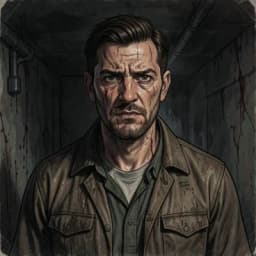
Meet the sample character
The air outside is as lethal as the silence within.
Try a scene · No signup
Rust and Respiratory
A short sample of this world. Your own version starts with your character.
The wind rattles the loose corrugated metal of the hospital roof. Inside the isolation ward, your lantern flickers against the peeling paint. Marta lies on the cot, her chest hitching with the rhythmic, wet click of the plague. She holds a rusted oxygen valve like a rosary, her knuckles white and shaking.

“Check the seals on the canister, Hideo. If the pressure drops before dawn, you are better off putting a bullet in me than listening to me choke.”

You touch the valve. It is freezing, slick with condensation. The gauge needle is pinned firmly in the red zone. If you force it open, you might draw the attention of the scavengers prowling the parking lot, but if you leave it shut, she will stop breathing by sunrise.
“I am not wasting a bullet on you yet, Marta. Keep your head down and stay quiet while I find a seal.”
A heavy boot heel crunches on broken glass in the hallway. Someone is inside the ward, and they aren't hiding. You have seconds to decide whether to draw your rusted shiv, attempt to bribe the intruder, or drag Marta into the ventilation shaft—risking a collapse that could bury you both.
The intruder is silhouetted in the doorway. How do you protect your position?
Your character. Your next move.
The air is turning cold. Will you survive?
Your supplies are running low, and the quarantine zone is closing in. Every cough you hear in the distance is a reminder that the world is no longer yours. Choose your path, manage your resources, and decide who gets to see the sunrise tomorrow.
Start Your Survival StoryYour Story, Your Way
Everything is customizable. Pick any genre, setting, or character — the AI builds a world around exactly what you want.
Any Character
Design your appearance, personality, backstory — every detail
Any World
Fantasy kingdoms, sci-fi stations, modern cities — you choose
Branching Paths
No two playthroughs are the same. Your choices reshape everything
Full Immersion
AI images, voice acting, sound effects — a living story
Decide whether to scavenge high-risk hospitals for limited medicine or avoid the contamination entirely.
Manage dwindling supplies of clean water, masks, and filters to avoid a slow, painful infection.
Navigate tense negotiations with paranoid survivor factions who view every outsider as a potential plague-carrier.
The air in the metro tunnel tastes like copper and stale dust. You tighten the strap of your respirator, listening for the wet, rattling breath of the infected hiding in the dark. Six months ago, the city was alive with sirens and shouting; now, it is just the wind whistling through broken skyscrapers. You are not hunting for treasure or glory. You are hunting for clean water and a filter that will not give out in the next ten minutes. Every decision you make—whether to share your last ration with a stranger or leave them to their fate—echoes in this hollowed-out landscape. Your survival depends on your judgment, and in this quiet, lethal world, one wrong move is the last one you make. This is a story where your choices dictate the boundary between life and the abyss.
What is Plague Aftermath in Post-Apocalyptic?
The plague aftermath trope strips away the complexity of modern society until only the raw instinct for survival remains. Unlike war-torn scenarios, the threat here is invisible. It is not a rampaging army; it is a microscopic killer that turned neighbors into vectors and hospitals into tombs. Think of The Last of Us, where the fungal infection is not just an enemy, but a permanent environmental shift that forces humanity into fragmented, paranoid pockets. This trope focuses on the transition from the before to the after. It asks how we maintain our humanity when the very touch of another person could be a death sentence. It is about the scarcity of medicine, the decay of infrastructure, and the psychological toll of outliving everyone you ever cared about. The tension stems from the constant threat of contamination and the realization that the old world’s rules no longer apply. The focus is on the long-term struggle to rebuild or simply endure within the wreckage left by a global contagion.
Why play Plague Aftermath as an interactive story?
Playing through a plague-ridden collapse puts the weight of every medical decision on your shoulders. You are not just reading about a survivor; you are the one deciding whether to quarantine a wounded companion or risk infection to save them. The agency here is brutal. Do you hoard your remaining antibiotics for yourself, or do you trade them for information that might lead to a safe zone? The game tracks your health, your supplies, and your reputation among the few remaining settlements. You will face moments where the moral choice—like bringing a feverish child into your camp—could mean the death of everyone you have built a life with. Every choice forces you to reconcile your empathy with the cold mathematics of survival. Because the threat is biological, your interactions with the environment are high-stakes. A simple decision to scavenge a pharmacy could lead to a massive infection spike, permanently altering your character’s health and the options available to you later.
Famous examples of Plague Aftermath in books, film, and games
The plague aftermath trope endures because it reflects our deepest fears about vulnerability. In Station Eleven by Emily St. John Mandel, the focus shifts to the preservation of art and memory after a flu wipes out most of the population. It highlights that surviving is not just about food; it is about why we choose to go on. Contrast this with the visceral, high-stakes desperation found in the film 28 Days Later. Here, the plague is fast, violent, and relentless, turning the aftermath into a frantic race for sanctuary. These stories work because they force characters to confront the what if of a total collapse. Whether the threat is a slow-moving virus or a rapid, rage-inducing infection, the core remains the same: the world is broken, and you are responsible for whatever is left of it. The enduring appeal lies in the blank slate of the world; when the institutions of the past fail, the individual finally has total control over their own destiny. By examining these works, we see that the trope is less about the disease itself and more about the resilience of the human spirit when faced with impossible odds. It forces us to ask what we would sacrifice to keep the fire of civilization burning in the dark.
FAQ
Can I catch the disease in this story?
Yes, your health status is a core mechanic. Exposure to contaminated zones or close contact with the infected increases your risk, forcing you to prioritize safety over exploration.
How does this differ from a zombie game?
While zombie stories often focus on physical combat and gore, a plague aftermath story focuses on environmental hazards, resource scarcity, and the psychological burden of a world that is slowly rotting away.
Is there a way to restore civilization?
Your actions can lead to different outcomes. You might find a way to help a small community thrive, or you might just struggle to keep yourself alive until the end.
Do I have to play alone?
You will encounter various NPCs. You choose whether to form alliances, trade, or avoid them entirely to keep your group safe from potential infection.
Explore more Post-Apocalyptic stories like Zombie Survival, Nuclear Wasteland, Faction Warfare.
More Post-Apocalyptic Stories
Zombie Survival
The dead walk and every stranger is a threat. Scavenge for weapons, fortify your shelter, and make brutal choices about who lives and who gets left behind in this undead nightmare.
TropeNuclear Wasteland
The bombs fell and civilization crumbled. Now you wander a scorched earth where radiation is as deadly as the desperate survivors who stalk the ruins.
TropeFaction Warfare
Rival factions carve up what remains of the world, each with their own vision for the future. Choose your allegiance carefully because neutrality is not an option.
TropeScavenger Hunt
Every ruined building could hold the supplies that keep you alive another week. Risk raiders, traps, and structural collapse as you pick through the bones of civilization.
TropeBunker Emergence
You have lived underground your entire life. The bunker door is finally opening and the world outside is nothing like the old recordings promised.
TropeLast City Standing
One city remains, ringed by walls and desperation. Inside, humanity clings to civilization while threats press from every direction. You must decide what this last bastion stands for.