
Post-Apocalyptic · Interactive story
The Longest Shadow: A Sniper’s Wasteland
Your rifle is the only law left in a world without borders.
Start as a guest. Choose your character before the story begins.
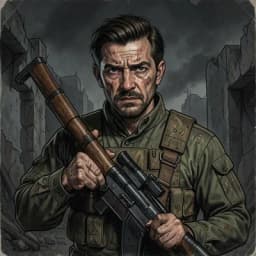
Meet the sample character
One bullet, one life, one final stand.
Try a scene · No signup
The Sightline at Sector Four
A short sample of this world. Your own version starts with your character.
The wind whistles through the jagged rebar of the overpass, carrying the metallic tang of irradiated rain. You adjust the bipod of your rifle, the steel biting into your calloused palm. Below, the rising dust cloud from the black sedan signifies trouble—raiders, clearly marking the trade route for a cull. You hold your breath, letting the heartbeat in your ears slow to a crawl, waiting for the leader to step out.

“Bram, they have enough ordnance to level the camp. If you don't drop the lead, we are all ghosts by sundown.”

The crosshairs hover over the raider's throat as he kicks open the car door. He is laughing, his face smeared with grease and dried mud. You calculate the windage, the drop, and the distance. Every bullet is a resource in this barren stretch, and wasting one on a gamble could leave you defenseless when the next pack arrives. Your trigger finger tightens, but the weight of the decision shifts with every passing second.
“I only have one clean shot before they scatter into the debris. If I miss, the caravan is gone.”
The raider raises a sawed-off shotgun toward the merchant’s daughter. He turns, his gaze sweeping the horizon, and for a fleeting moment, he looks directly toward your vantage point. If you fire now, you reveal your position to the remaining four raiders. If you wait, you gamble with the lives of the survivors you have spent months protecting. The sun glints off your scope, and the enemy freezes.
The raider's finger is white-knuckled on the trigger. Do you pull your trigger first?
Your character. Your next move.
The Wasteland Is Watching. Are You?
A group of raiders is closing in on a settlement you have been watching for weeks. Their leader is exposed, but taking the shot means giving away your position for good. Do you strike now and save the village, or hold your fire to protect your own survival? Your rifle is loaded. Your finger is on the trigger. Make your move.
Take the ShotYour Story, Your Way
Everything is customizable. Pick any genre, setting, or character — the AI builds a world around exactly what you want.
Any Character
Design your appearance, personality, backstory — every detail
Any World
Fantasy kingdoms, sci-fi stations, modern cities — you choose
Branching Paths
No two playthroughs are the same. Your choices reshape everything
Full Immersion
AI images, voice acting, sound effects — a living story
Calculate windage and distance before committing to a high-stakes, long-range engagement.
Scavenge ruined skyscrapers for rare optics and specialized rifle components to survive longer.
Choose whether to remain a ghost or become a local legend by intervening in skirmishes.
Manage your heart rate and stamina to ensure your aim stays true under pressure.
The scope is cold against your eye, a circle of clarity in a dusty, ruined city. Below, a convoy of scavengers creeps through the wreckage, unaware that you are tracking their lead driver. The wind shifts. You adjust your elevation, fingers steady despite the biting chill. This is a story of patience, where every decision—from the ammunition you hoard to the moral weight of who you leave in your crosshairs—shifts the balance of power in the wastes. You determine if you are a protector, a mercenary, or a ghost haunting the ruins. Whether you choose to save the weak or secure your own survival, your choices matter.
What is The Sniper in Post-Apocalyptic?
The Sniper archetype is the silent observer of the end-times. Unlike the brawling warrior or the charismatic faction leader, the sniper operates in the margins. They are defined by distance, detachment, and the immense power contained in a single piece of lead. In fiction, this character often acts as the arbiter of justice or the ultimate survivor. Think of the cold, calculated precision seen in the Fallout series, where a high-perception character uses a long-range rifle to dictate the survival of their companions, or the desperate, lonely vigilance portrayed in books like The Road. The sniper is a tactical puzzle piece; they see the threats before they arrive. They represent the ultimate agency in a lawless landscape—the ability to intervene or ignore, to save or to execute, all without ever leaving the shadows of a rooftop. This character is not just a combatant; they are a scout, a guardian, and a judge, existing entirely on their own terms.
Why play The Sniper as an interactive story?
Playing as a sniper means managing resources that are rarer than gold: clean water, medicine, and specialized ammunition. You will face moments where a clean shot could end a conflict before it starts, but at the cost of exposing your position to enemy scouts. Will you intervene when a caravan is ambushed, knowing it burns through your limited supply of high-caliber rounds? The tension comes from your isolation. You are the invisible variable. If you reveal yourself, the dynamic shifts from predator to prey. Decisions are not just about combat; they are about positioning. Do you take the high-risk shot on a commander, or do you wait for a better tactical advantage? The story responds to your trigger discipline. Every reload, every missed shot, and every life you spare changes the map of the wasteland around you.
The psychology of The Sniper: why readers fall for this character
The Sniper archetype taps into a specific human desire for control in chaotic environments. When the world ends, most people feel powerless. The sniper, however, holds the ultimate trump card. They represent the God-view of the battlefield. We see this in films like American Sniper, where the protagonist's internal struggle is defined by the disconnect between the target and the person pulling the trigger. In games like The Last of Us, characters who wield long-range weapons often carry the heaviest burdens—they see the horror up close while remaining physically removed. This archetype thrives on the patience fantasy. It is the thrill of waiting, the anticipation of the perfect moment, and the realization that you are the architect of a specific outcome. It is an intellectualized form of violence, where the gun is merely a tool and the mind is the true weapon. It appeals to those who prefer strategy over brute force, those who want to be the unseen hand guiding the fate of a broken world. By stripping away the noise of the front lines, the sniper finds a quiet, terrifying clarity that few other characters ever possess.
FAQ
What makes the sniper archetype different from a standard soldier?
Soldiers typically rely on firepower and front-line engagement. A sniper relies on concealment, terrain advantage, and extreme precision to avoid direct confrontation entirely, turning the battlefield into a game of cat and mouse.
Can I play as a pacifist sniper?
Yes. You might use your high-ground position to provide surveillance for others, warning them of traps or ambushes without ever firing a shot, or choosing to disable equipment rather than targets.
Is this game focused on combat or exploration?
It is both. Exploration involves finding the best nests and managing your supplies, while combat is a high-stakes event where every bullet is a precious, limited resource.
How does the game handle the difficulty of long-range shots?
The system tracks environmental factors like wind speed and distance, meaning your success depends on how well you analyze the situation before acting.
Explore more Post-Apocalyptic stories like Zombie Survival, Nuclear Wasteland, Plague Aftermath.
More Post-Apocalyptic Stories
Zombie Survival
The dead walk and every stranger is a threat. Scavenge for weapons, fortify your shelter, and make brutal choices about who lives and who gets left behind in this undead nightmare.
TropeNuclear Wasteland
The bombs fell and civilization crumbled. Now you wander a scorched earth where radiation is as deadly as the desperate survivors who stalk the ruins.
TropePlague Aftermath
A pandemic wiped out most of humanity. You survived, but survival is just the beginning as you navigate a world where disease still lurks and trust is the scarcest resource.
TropeFaction Warfare
Rival factions carve up what remains of the world, each with their own vision for the future. Choose your allegiance carefully because neutrality is not an option.
TropeScavenger Hunt
Every ruined building could hold the supplies that keep you alive another week. Risk raiders, traps, and structural collapse as you pick through the bones of civilization.
TropeBunker Emergence
You have lived underground your entire life. The bunker door is finally opening and the world outside is nothing like the old recordings promised.