
Post-Apocalyptic · Interactive story
The Scarlet Plague: Reclaiming Humanity from the Ashes
The city is silent, the red death was only the beginning. Will you survive?
Start as a guest. Choose your character before the story begins.
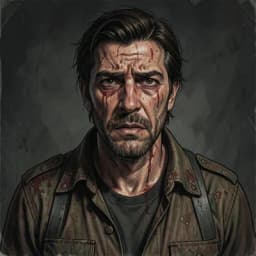
Meet the sample character
Before the world turned silent, it burned.
Try a scene · No signup
The Crimson Rot
A short sample of this world. Your own version starts with your character.
Your boots crunch against glass shards as you pick through the debris of the Presidio. Ahead, a leather medical satchel lies half-buried under a collapsed brick wall. The fabric is stained dark, but the seal is unbroken. You realize the contents could save a village—or incite a war between the tribes of the bay.

“Don't touch that, Silas! The red spots are still fresh on the strap. You want to turn to paste like the others?”

You ignore the boy, your calloused fingers brushing the synthetic fiber. If the serum inside is still viable, it is worth more than all the gold buried under the bay. Yet, you feel the familiar prickle of eyes watching from the rusted girders above. The scouts are closing in, and they do not care for medicine—only for what they can loot.
“Keep your voice down, Kojo. Some things here kill faster than the plague, and the scouts are one of them.”
A sharp, rhythmic whistle echoes from the collapsed overpass—the scouts have spotted your movement. You have seconds to secure the satchel before they descend. Do you vanish into the subterranean drains, prepare for a stand, or attempt to strike a desperate bargain with the approaching raiders?
The scouts are closing the distance. How do you handle the satchel and the incoming threat?
Your character. Your next move.
Will your tribe survive the red death?
The winter is coming, and the stores of dried meat are running low. You hold the map to a forgotten medical cache, but a rival group has spotted your camp. Do you fight to protect the future, or do you abandon your pride to secure another month of life? The decisions are yours to make in this brutal landscape.
Begin the survival journeyYour Story, Your Way
Everything is customizable. Pick any genre, setting, or character — the AI builds a world around exactly what you want.
Any Character
Design your appearance, personality, backstory — every detail
Any World
Fantasy kingdoms, sci-fi stations, modern cities — you choose
Branching Paths
No two playthroughs are the same. Your choices reshape everything
Full Immersion
AI images, voice acting, sound effects — a living story
Trade precious salvaged medicine for the protection of a neighboring tribe’s scouts.
Decide whether to teach the youth to read at the risk of exposing them.
Negotiate passage through the ruins of the Golden Gate Bridge with desperate raiders.
Choose which artifacts of the old world to carry as you migrate seasonal grounds.
The bridge is a rusted skeleton clawing at a gray sky. Somewhere in the tall grass where the Ferry Building once stood, a group of children huddles around a dying fire, listening to the elders recount stories of the before times—of electricity, flight, and medicine. You are the one tasked with teaching them how to skin a deer and when to hide from the marauders who roam the coast. Every decision you make determines if this fragile spark of memory survives another winter or vanishes into the fog. In this interactive story, your choices are the only thing standing between your people and the long, cold dark of total extinction.
What is The Scarlet Plague in Post-Apocalyptic?
Jack London’s 1912 novella The Scarlet Plague is one of the earliest examples of the pandemic-driven apocalypse genre. Set in 2073, sixty years after a swift, horrific contagion wiped out most of the human race, the story follows James Howard Smith, an elderly professor who is one of the few survivors who remembers the world as it was. Unlike modern iterations like The Last of Us or Station Eleven, London’s work focuses on the rapid regression of human society into tribalism. The red death didn't just kill the population; it erased the complex infrastructure that held the world together. The story serves as a cautionary meditation on how quickly the veneer of civilization can crack when the systems we rely on stop functioning. It strips away the comfort of modernity, leaving characters to struggle with the loss of history, language, and social order.
Why play The Scarlet Plague as an interactive story?
Survival isn't just about finding food; it is about managing the psychological weight of a lost legacy. You will face moments where you must decide whether to share your limited resources with a rival tribe or let them perish to ensure your own people thrive. Will you prioritize the preservation of ancient books and tools, or will you focus entirely on immediate physical security? You might encounter a group of scavengers holding a cache of antibiotics from the old world, forcing you to choose between trade or force. The tension comes from knowing that every choice chips away at the humanity you are trying to protect. Your role is not just to survive, but to decide what kind of future, if any, the survivors will inherit.
The literary legacy of The Scarlet Plague
The Scarlet Plague was published a decade before the widespread adoption of the term science fiction, yet it established the tropes that define the genre today. London drew inspiration from his own observations of social inequality and the fragility of human institutions. While the novella was initially serialized in London Magazine, it has since influenced countless works, including the film Children of Men and the survival mechanics in games like Fallout. The core of London's vision is the inevitability of change and the burden of memory. In modern adaptations, the focus often shifts to the technology of the apocalypse, but London remained fixed on the human element—the transition from sophisticated intellectual to primal scavenger. The character of Smith acts as a bridge between two worlds, a trope that continues to resonate because it highlights the vulnerability of our current technological era. By exploring this story, you are interacting with the blueprint of the modern survival genre, seeing firsthand how the fear of a collapsing world has haunted human imagination for over a century.
FAQ
What makes The Scarlet Plague different from other survival stories?
London focuses on the rapid, total collapse of social order rather than just the physical threat of infection. It examines the loss of knowledge and the return to a primal state.
How does the survival mechanic work?
You manage resources like water and shelter while balancing the preservation of knowledge against the immediate need for security. Your inventory and tribe morale dictate your options.
Can I change the course of history in this story?
Your actions dictate the survival of your specific tribe and whether the knowledge of the past is passed on to the next generation or lost forever.
Is this story historically accurate?
It uses Jack London’s original 1912 novella as a foundation, blending his classic vision with original post-apocalyptic survival scenarios grounded in the lore of the book.
Explore more Post-Apocalyptic stories like Zombie Survival, Nuclear Wasteland, Plague Aftermath.
More Post-Apocalyptic Stories
Zombie Survival
The dead walk and every stranger is a threat. Scavenge for weapons, fortify your shelter, and make brutal choices about who lives and who gets left behind in this undead nightmare.
TropeNuclear Wasteland
The bombs fell and civilization crumbled. Now you wander a scorched earth where radiation is as deadly as the desperate survivors who stalk the ruins.
TropePlague Aftermath
A pandemic wiped out most of humanity. You survived, but survival is just the beginning as you navigate a world where disease still lurks and trust is the scarcest resource.
TropeFaction Warfare
Rival factions carve up what remains of the world, each with their own vision for the future. Choose your allegiance carefully because neutrality is not an option.
TropeScavenger Hunt
Every ruined building could hold the supplies that keep you alive another week. Risk raiders, traps, and structural collapse as you pick through the bones of civilization.
TropeBunker Emergence
You have lived underground your entire life. The bunker door is finally opening and the world outside is nothing like the old recordings promised.