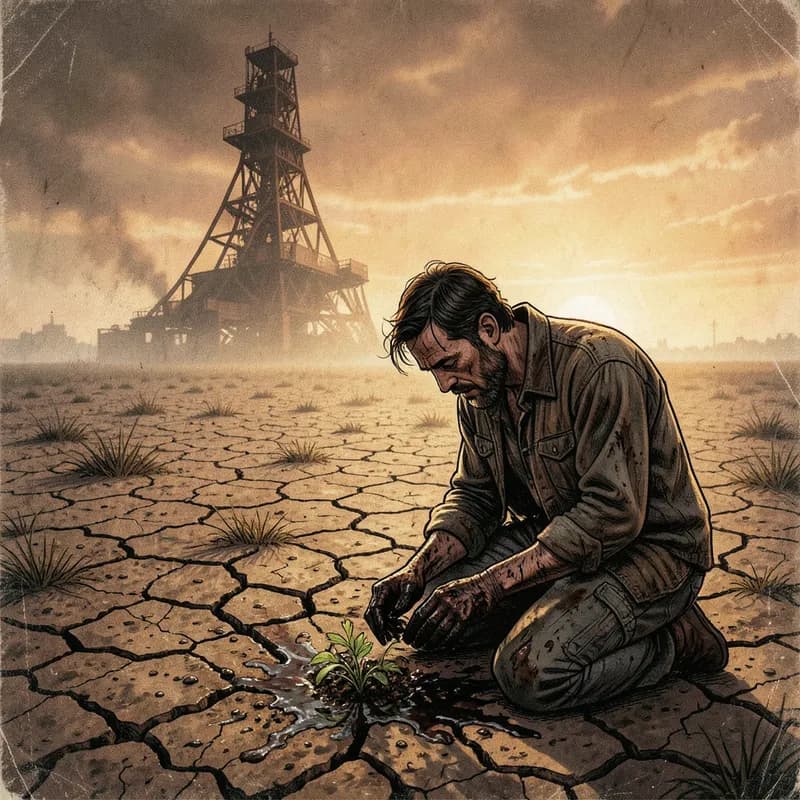
Post-Apocalyptic · Interactive story
Tending the Soil in the Ashes
The sky is grey and the radiation lingers, but the harvest is your only hope.
Start as a guest. Choose your character before the story begins.
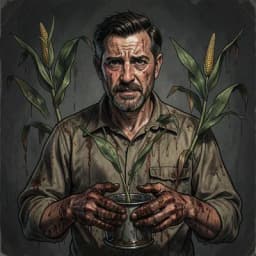
Meet the sample character
The harvest is not for the faint of heart.
Try a scene · No signup
Sowing Dust
A short sample of this world. Your own version starts with your character.
You kneel in the grey, compacted earth, your fingers raw from clawing at the stubborn, dry crust. The radiation sensor clipped to your belt chirps a rhythmic, warning pulse that vibrates against your hip. You ignore it, focusing instead on the fragile, pale green shoot forcing its way through the irradiated grit. This is the only life for miles, and it demands everything you have to stay upright.

“Silas, look at the gauge. The wind is picking up, and it’s carrying acid-dust from the Spire. If you don't pack it in now, your lungs will be liquid by morning.”

You wipe a smear of dark grime across your brow, feeling the heat of the dying sun against your neck. The village relies on these yields, and the thought of them scavenging through scrap metal for moldy rations makes your jaw ache. You stand slowly, your joints popping like gravel in a grinder, and look toward the fence line where the dust clouds are beginning to swirl with unusual, motorized speed.
“They aren't just here for the dust, Bram. Listen to the engine rhythm. That’s a heavy hauler, and they’re aiming straight for the pump house.”
The ground beneath your boots trembles. You have seconds before they reach the perimeter, and your makeshift shotgun is still leaning against the barn door. You can defend the pump and risk a direct confrontation, retreat into the cellar to protect the clean water cache, or attempt to negotiate with the raiders using the last of your harvest as a lure.
The heavy hauler crushes the outer perimeter wire. How do you respond to the incoming threat?
Your character. Your next move.
Will your harvest save humanity or fuel the fire?
The soil is dry, and the neighbors are watching your silos. Every decision you make—from the seeds you plant to the strangers you turn away—will shape the future of your settlement. Step into the boots of the Farmer and see if you have the grit to grow a legacy in the ashes.
Start your farming storyYour Story, Your Way
Everything is customizable. Pick any genre, setting, or character — the AI builds a world around exactly what you want.
Any Character
Design your appearance, personality, backstory — every detail
Any World
Fantasy kingdoms, sci-fi stations, modern cities — you choose
Branching Paths
No two playthroughs are the same. Your choices reshape everything
Full Immersion
AI images, voice acting, sound effects — a living story
Allocate daily water rations between your crops, your livestock, and your thirsty settlers.
Negotiate trade deals with passing caravans to acquire seeds, tools, or defensive munitions.
Choose whether to share your surplus with neighboring camps to build a fragile alliance.
Defend your irrigation system during a midnight raid by desperate, starving intruders.
Silas wipes the dry, grey mud from his brow, his hands stained with iron-rich dust. Beside him, a single stalk of corn pushes through the cracked earth, a defiant splash of green against the monochrome wasteland. The geiger counter on his belt clicks—a slow, rhythmic heartbeat that keeps him on edge. He is not a raider or a wandering mercenary; he is the one who keeps the small settlement alive. Every decision you make here ripples outward, from how you ration the scarce water to whether you turn away the desperate drifters who know your silo is full. This is an interactive story where your choices determine if the garden flourishes or if the desert reclaims everything you have worked to build. You are the barrier between your people and the long, cold winter of extinction.
What is The Farmer in Post-Apocalyptic?
The Farmer is the archetype of continuity. In the aftermath of collapse, where most characters focus on hoarding ammunition or scavenging pre-war ruins, the Farmer focuses on the long game. They represent the transition from survival to rebuilding. This character acknowledges that while bullets might buy you another day, food buys you a future. You see this archetype clearly in figures like Hershel Greene from The Walking Dead, whose farm became a sanctuary for the living, or the agricultural focus in the Jackson settlement in The Last of Us Part II. Unlike the scavenger who lives for the next meal, the Farmer is constantly planning for the next season. They are often defined by their patience, their quiet strength, and their willingness to defend their land against those who would rather steal a harvest than plant one. To play as the Farmer is to accept that you are a target; your productivity makes you the most valuable, and most vulnerable, person in the wasteland.
Why play The Farmer as an interactive story?
Playing as the Farmer adds a layer of tension that combat-focused stories often lack. It is a constant battle against the environment, not just against other people. You will face dilemmas that force you to weigh the morality of your actions against the cold logic of survival. Do you trade your limited corn harvest for medicine to save a sick neighbor, knowing it leaves your own children hungry? Do you install traps to protect your fields, risking the lives of those who wander onto your property by mistake? The agency you hold allows you to define what kind of leader you are: a benevolent provider or a ruthless autocrat who keeps the food for the loyal. Every drought, infestation, or raider raid is a test of your strategy and your resolve. You aren't just reacting to the world; you are actively terraforming it against the odds.
The psychology of The Farmer: why readers fall for this character
The Farmer archetype taps into the primal human desire for stability in the face of chaos. When the world ends, most people fear the loss of the systems that provide for them. The Farmer is the individual who replaces those systems. In Children of Men, the focus on the survival of the next generation mirrors the Farmer's motivation—it is about ensuring life continues past your own expiration date. This archetype provides a fantasy of control. While the rest of the world is burning, the Farmer is pruning, weeding, and nurturing. It is a deeply grounding, almost meditative role that contrasts sharply with the frantic pace of typical post-apocalyptic narratives. Consider the difference between a character like Mad Max, who is defined by his motion and detachment, and the Farmer, who is defined by their connection to a specific plot of land. Max survives by moving; the Farmer survives by staying. This creates a powerful tension: the Farmer is a fixed point in a shifting wasteland. Readers are drawn to this because it explores the idea of 'home' when the concept itself has been rendered obsolete. It raises the question: what are you willing to do to protect your patch of earth? Whether it is the desperate agriculture in A Quiet Place or the homesteading struggles in various survival fiction, the Farmer remains one of the most compelling figures because they represent the only real hope for a return to civilization.
FAQ
What makes the Farmer archetype different from a scavenger?
A scavenger relies on the remnants of the old world, which are finite and inevitably run out. The Farmer creates a renewable resource. While the scavenger survives by taking, the Farmer survives by producing, which creates a completely different set of social and moral dilemmas.
How do resource management choices impact the story?
Your choices regarding water, fertilizer, and labor directly affect the yield of your harvest. A poor harvest can lead to illness, civil unrest, or the collapse of your settlement, directly changing which characters live or die in later chapters.
Can I choose to be a defensive or aggressive farmer?
Yes. You can prioritize diplomacy and sharing to build a community, or you can fortify your farm with deadly traps and turn away any outsiders, becoming a reclusive, feared figure in the wasteland.
Is this story right for me if I prefer combat?
If you enjoy high-stakes tension, you will find it here. Protecting a harvest requires combat, negotiation, and strategic planning. The Farmer is often forced into violent situations to defend their livelihood, making the action feel more personal and high-stakes.
Explore more Post-Apocalyptic stories like Zombie Survival, Nuclear Wasteland, Plague Aftermath.
More Post-Apocalyptic Stories
Zombie Survival
The dead walk and every stranger is a threat. Scavenge for weapons, fortify your shelter, and make brutal choices about who lives and who gets left behind in this undead nightmare.
TropeNuclear Wasteland
The bombs fell and civilization crumbled. Now you wander a scorched earth where radiation is as deadly as the desperate survivors who stalk the ruins.
TropePlague Aftermath
A pandemic wiped out most of humanity. You survived, but survival is just the beginning as you navigate a world where disease still lurks and trust is the scarcest resource.
TropeFaction Warfare
Rival factions carve up what remains of the world, each with their own vision for the future. Choose your allegiance carefully because neutrality is not an option.
TropeScavenger Hunt
Every ruined building could hold the supplies that keep you alive another week. Risk raiders, traps, and structural collapse as you pick through the bones of civilization.
TropeBunker Emergence
You have lived underground your entire life. The bunker door is finally opening and the world outside is nothing like the old recordings promised.