
Post-Apocalyptic · Interactive story
The Last Researcher: A Quest for the Cure
One vial of hope against a world of rot. Can you finish the work?
Start as a guest. Choose your character before the story begins.
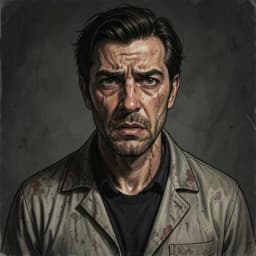
Meet the sample character
The last viable sample lies beneath a landslide of lead and rot.
Try a scene · No signup
Sterile Silence
A short sample of this world. Your own version starts with your character.
The Geiger counter clicks a frantic, uneven rhythm against your hip, keeping time with your ragged breathing. You run your fingers over the keypad, the plastic buttons cracked and yellowed by decades of neglect. Inside this vault, the air is cold enough to crystallize your sweat, and the faint, copper tang of old blood hangs heavy. You are close to the centrifuge, the only machine capable of isolating the viral protein you have spent six years chasing.

“Hideo, the seal is breaking. If you do not step away from that console, the pressure drop is going to liquefy our lungs before we even get a look at the data.”

A low groan of grinding metal echoes through the chamber, vibrating up through your boots. The heavy blast doors are buckling, pushed inward by something massive and frantic on the other side. You glance at your readout—the centrifuge is at seventy percent. You have to decide: do you pull the plug now to seal the room, or do you stay and risk the collapse to finish the extraction?
“I did not walk through three hundred miles of irradiated dust to leave the cure in the machine. Keep that door shut, Vera. I am almost there.”
The screech of tearing steel rings out, and a jagged claw slices through the thick iron plating of the door. The alarm light pulses in a frantic, strobe-like crimson, illuminating the frost gathering on your goggles. The centrifuge emits a high-pitched whine, reaching the final phase of synthesis. You have seconds before the entire wall gives way, and the cure—or your life—is extinguished.
The vault door is buckling under the pressure of the infected horde. How do you secure your work?
Your character. Your next move.
The Cure is Within Reach. Will You Survive?
Your centrifuge is humming, and the final sample is ready for testing. But the perimeter alarm just triggered. A group of scavengers is closing in. Do you abandon your work to defend your ground, or lock yourself in and hope the door holds? Your discovery could save the world, but only if you survive the night.
Begin Your ResearchYour Story, Your Way
Everything is customizable. Pick any genre, setting, or character — the AI builds a world around exactly what you want.
Any Character
Design your appearance, personality, backstory — every detail
Any World
Fantasy kingdoms, sci-fi stations, modern cities — you choose
Branching Paths
No two playthroughs are the same. Your choices reshape everything
Full Immersion
AI images, voice acting, sound effects — a living story
Calibrate delicate lab equipment while defending your perimeter from desperate, starving survivors.
Decide which vital supplies to sacrifice for a chance at a breakthrough.
Navigate complex social dynamics with warlords who want your research for power.
Choose whether to release your findings to the public or keep them guarded.
The radiation burns your skin, but the dry paper of your field notes burns brighter in your mind. You are miles from the nearest settlement, huddled in a rusted-out medical trailer while the wind howls outside, carrying the dust of a billion lost lives. Your hands shake as you calibrate the centrifuge. You aren't just surviving; you are hunting the ghost of a solution to the blight that turned the sky gray. Every choice you make here—whether to trade your last antibiotics for data or risk a trek into the irradiated city center—determines if you become the savior of the next generation or just another skeleton in the wreckage. This is an interactive story where your technical expertise and moral fortitude dictate the survival of the human race.
What is The Scientist Seeking a Cure in Post-Apocalyptic?
The scientist seeking a cure archetype represents the anchor of hope in the ruins. Unlike the hardened raider or the lone mercenary, this character possesses knowledge that the world has forgotten. They are defined by their obsession, their laboratory equipment, and the crushing weight of responsibility. Think of Robert Neville in Richard Matheson’s I Am Legend, who spends his days hunting and his nights dedicated to the microscope, driven by the belief that science can reverse the infection. Another example is Dr. Aris Thorne in various post-apocalyptic tropes, where the character must decide if the cure is worth the sacrifice of the few to save the many. This archetype thrives on the tension between cold logic and human desperation, forcing the player to weigh the preservation of their own life against the slim possibility of a breakthrough that could restart the clock for civilization. It is a role for those who prefer to fight with intellect rather than brute force.
Why play The Scientist Seeking a Cure as an interactive story?
Playing this role requires more than just shooting straight; it requires rationing your curiosity. You will face moments where the logic of your training clashes with the cruelty of the wasteland. Do you use your limited power supply to heat your shelter or to run the blood sequencer? Do you trust a group of armed scavengers who claim to have a lead on a hidden government bunker, or do you assume they want to harvest your organs for their own survival? The agency here lies in how you treat your knowledge. You can hoard your findings to bargain for safety, or risk your neck to share the medicine with a dying village. Every choice ripples through the narrative, forcing you to confront the morality of your research and the cost of being the last person who knows how to fix a broken world.
The psychology of The Scientist Seeking a Cure: why readers fall for this character
The appeal of the scientist seeking a cure lies in the fantasy of control. In a reality where everything has collapsed, the scientist represents the last vestige of the old world’s order. They embody the belief that even in the face of total annihilation, there is a rational explanation and a mechanical fix. This is a powerful psychological anchor. Players gravitate toward this archetype because it replaces the senseless violence of the apocalypse with a goal—a mission. It is the difference between merely existing and having a purpose. Consider the character of Dr. Selvig in The Last of Us games, whose research sparks the central conflict, or the protagonist in Children of Men, where the search for a cause drives the narrative forward through a bleak, dying landscape. These characters are often tragic, as they are haunted by the knowledge of what was lost. They are tasked with playing God with a broken toolset. The tension arises when the character realizes that the cure might not be a vaccine at all, but a societal reset. The fear is not just death; it is the fear that your life’s work might be meaningless. This drives the player to push further into the unknown, making the scientist one of the most compelling roles in the genre.
FAQ
Can I focus on combat instead of science?
You can, but your research will suffer. Every hour spent scavenging for bullets is an hour away from the lab. Balancing combat and science is the core of the challenge.
Does my choice of location affect my research?
Absolutely. Setting up a lab in a fallout zone yields different data than a fortified mountain bunker. Your location dictates what materials are available for your experiments.
Will other characters try to steal my research?
Constant vigilance is required. Knowledge is the most valuable commodity in the wasteland, and you will have to choose who to trust with your notes and samples.
Is it possible to fail the cure quest?
Yes. If you prioritize your own survival too heavily, your resources will dwindle, and the research will stall permanently. You must take risks to succeed.
Explore more Post-Apocalyptic stories like Zombie Survival, Nuclear Wasteland, Plague Aftermath.
More Post-Apocalyptic Stories
Zombie Survival
The dead walk and every stranger is a threat. Scavenge for weapons, fortify your shelter, and make brutal choices about who lives and who gets left behind in this undead nightmare.
TropeNuclear Wasteland
The bombs fell and civilization crumbled. Now you wander a scorched earth where radiation is as deadly as the desperate survivors who stalk the ruins.
TropePlague Aftermath
A pandemic wiped out most of humanity. You survived, but survival is just the beginning as you navigate a world where disease still lurks and trust is the scarcest resource.
TropeFaction Warfare
Rival factions carve up what remains of the world, each with their own vision for the future. Choose your allegiance carefully because neutrality is not an option.
TropeScavenger Hunt
Every ruined building could hold the supplies that keep you alive another week. Risk raiders, traps, and structural collapse as you pick through the bones of civilization.
TropeBunker Emergence
You have lived underground your entire life. The bunker door is finally opening and the world outside is nothing like the old recordings promised.