
Post-Apocalyptic · Interactive story
High Above the Ruin: The Rooftop Garden Colony
Green leaves against a gray sky—the only thing standing between us and hunger.
Start as a guest. Choose your character before the story begins.
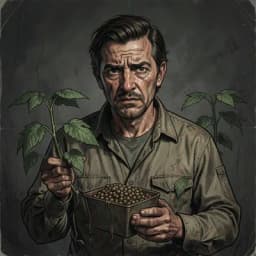
Meet the sample character
The last harvest needs a defender.
Try a scene · No signup
Green Above the Grime
A short sample of this world. Your own version starts with your character.
The sun bleeds orange across the jagged skyline, painting the hydroponic troughs in a sickly, dying light. You brush a layer of toxic soot off the spinach leaves, your hands raw from years of scraping soil from gutters. Above the city’s hollowed-out ribcage, your garden is the only thing keeping the colony from starving, a fragile green lung in a world choked by iron and dust.

“Stop fussing with the kale, Hideo. The scouts in the plaza have spotted our water barrels.”

You step to the edge of the rooftop, peering down the vertical drop into the abyss of rusted steel and shattered concrete. The wind whips through your frayed jacket, carrying the metallic scent of approaching rain and something worse—exhaust fumes from a scavenger truck. Mara’s hand rests on the grip of her rusted pistol, her knuckles white.
“If we lose the water, the crop dies anyway. Do we go down to meet them, or do we let the garden burn to buy us time to flee?”
A sudden, sharp crack rings out from the stairwell door—the locks are failing. The raiders have stopped waiting, and the sound of heavy boots hitting the concrete stairs rhythmically signals that your time for planning has expired. You have mere seconds to decide how to face the metal-clad silhouettes breaking through the door.
The heavy steel door groans, metal shrieking against metal. How do you respond to the incoming threat?
Your character. Your next move.
Can you keep the garden alive?
The sun is setting, and the scavengers below are looking up. You have one crate of seeds left and a perimeter that needs reinforcing. Every decision you make determines if your settlement becomes a legend or a footnote in the ruins. Take control of your colony now.
Start your settlement storyYour Story, Your Way
Everything is customizable. Pick any genre, setting, or character — the AI builds a world around exactly what you want.
Any Character
Design your appearance, personality, backstory — every detail
Any World
Fantasy kingdoms, sci-fi stations, modern cities — you choose
Branching Paths
No two playthroughs are the same. Your choices reshape everything
Full Immersion
AI images, voice acting, sound effects — a living story
Scavenge forgotten greenhouses and hardware stores to expand your vertical agricultural systems.
Negotiate fragile trade treaties with rival rooftop gangs for water and scrap metal.
Defend your fragile green perimeter against desperate scavengers and environmental hazards from below.
The soil smells like compost and yesterday’s rain, a sharp contrast to the metallic tang of the flooded subway tunnels below. You adjust the sun-bleached tarp over the tomato trellises, feeling the weight of the makeshift shiv at your hip. Down there, the city is a graveyard of rusted steel and desperate shadows. Up here, your colony of twenty souls relies on these crates of dirt to keep starvation at bay. Every day, you decide how to distribute the meager yield: do you feed the children, or do you trade the tomatoes with the raiders who control the water pumps? Your choices dictate who survives the coming winter and whether this fragile sanctuary grows or withers into the dust. This is an interactive story where your management, diplomacy, and tactical decisions determine the fate of the last green patch in a gray world.
What is Rooftop Garden Colony in Post-Apocalyptic?
The Rooftop Garden Colony is a specialized story setting that shifts the focus from aimless wandering to static survival. Instead of traversing the wasteland, the narrative centers on the tension of staying put. Think of the lush, vertical hideout in The Last of Us Part II or the desperate, high-altitude agriculture found in the film Snowpiercer, where resources are limited by the physical boundaries of the habitat. This setting demands a different kind of protagonist—someone who is as much a farmer and architect as they are a scavenger. It is about the vulnerability of visibility. When you are the only green thing for miles, you become a beacon for every hungry mouth in the district. The narrative conflict is inherently local: how do you keep plants alive when the air is thick with ash? How do you defend a perimeter that is essentially a glass house in a world of stone-throwers? This setting thrives on the contrast between the fragile, organic hope of your crops and the brutal, mechanical decay of the city below.
Why play Rooftop Garden Colony as an interactive story?
Playing this setting means balancing the long-term goal of sustainability against the immediate necessity of survival. You are not just fighting mutants; you are managing soil pH, negotiating with neighboring rooftop gangs, and deciding which structural supports to dismantle for firewood. Do you expand the garden, risking exposure to snipers in the high-rises across the street, or do you bunker down and ration the seeds? You will face moments where the correct choice is rarely clear. For instance, when a group of refugees arrives at your ladder, do you let them in and double your consumption, or turn them away to protect your current harvest? Every decision ripples through your community, changing the morale of your people and the defenses of your sky-bound home. The agency provided by the AI allows for complex, branching outcomes where your specific approach to leadership—whether through iron-fisted control or communal democracy—defines the colony’s trajectory.
What makes Rooftop Garden Colony work: the worldbuilding
The Rooftop Garden Colony thrives on the tension between the organic and the artificial. The best examples of this tension appear in works like Children of Men, where the fleeting hope of a single life mirrors the fragility of your crops, or the vertical isolation explored in High-Rise by J.G. Ballard. The mechanics of this setting thrive on 'siege psychology.' Unlike a roaming story, the setting here is static, which forces the narrative to focus on depth rather than breadth. The central conflict is the 'Visibility Paradox': the more successful your garden, the more likely you are to be raided. This forces players to choose between expansion and stealth. Character types flourish here: the pragmatic botanist, the paranoid lookout, and the charismatic but ruthless recruiter. Sensory details are vital—the crunch of dry dirt, the hum of makeshift windmills, and the sight of vibrant green vines winding around rusted rebar. By grounding the story in the physical limitations of the rooftop, you create a sense of claustrophobia that makes every successful harvest feel like a monumental victory against the apocalypse. When the environment is your enemy, every drop of water and every seed becomes a plot point, ensuring that your management style dictates the tone and the stakes of the entire narrative arc.
FAQ
What makes the Rooftop Garden Colony different from a desert survival story?
While desert survival focuses on the scarcity of movement and finding the next oasis, the Rooftop Garden Colony focuses on 'siege psychology.' You are anchored in one location, meaning your primary struggle is defense, resource management, and maintaining community morale under the constant threat of being discovered.
How do my choices impact the colony's growth?
Your choices directly affect the colony's infrastructure and population. Choosing to prioritize research into hydroponics might increase food yield but leave you vulnerable to raids, whereas focusing on fortification will keep you safe but may lead to starvation if you cannot produce enough to sustain your people.
Can I lose the colony to outside forces?
Yes. The environment is reactive. If you fail to maintain your perimeter or make poor diplomatic choices with neighboring factions, your garden can be overrun, destroyed, or stolen, leading to a narrative conclusion where your colony fails to persist.
Is this setting suitable for a long-form story?
Absolutely. Because the setting is static, it allows for deep character development and long-term consequences. You will see the results of your early-game decisions regarding water storage and crop rotation play out in the mid-to-late game as your settlement evolves.
Explore more Post-Apocalyptic stories like Zombie Survival, Nuclear Wasteland, Plague Aftermath.
More Post-Apocalyptic Stories
Zombie Survival
The dead walk and every stranger is a threat. Scavenge for weapons, fortify your shelter, and make brutal choices about who lives and who gets left behind in this undead nightmare.
TropeNuclear Wasteland
The bombs fell and civilization crumbled. Now you wander a scorched earth where radiation is as deadly as the desperate survivors who stalk the ruins.
TropePlague Aftermath
A pandemic wiped out most of humanity. You survived, but survival is just the beginning as you navigate a world where disease still lurks and trust is the scarcest resource.
TropeFaction Warfare
Rival factions carve up what remains of the world, each with their own vision for the future. Choose your allegiance carefully because neutrality is not an option.
TropeScavenger Hunt
Every ruined building could hold the supplies that keep you alive another week. Risk raiders, traps, and structural collapse as you pick through the bones of civilization.
TropeBunker Emergence
You have lived underground your entire life. The bunker door is finally opening and the world outside is nothing like the old recordings promised.