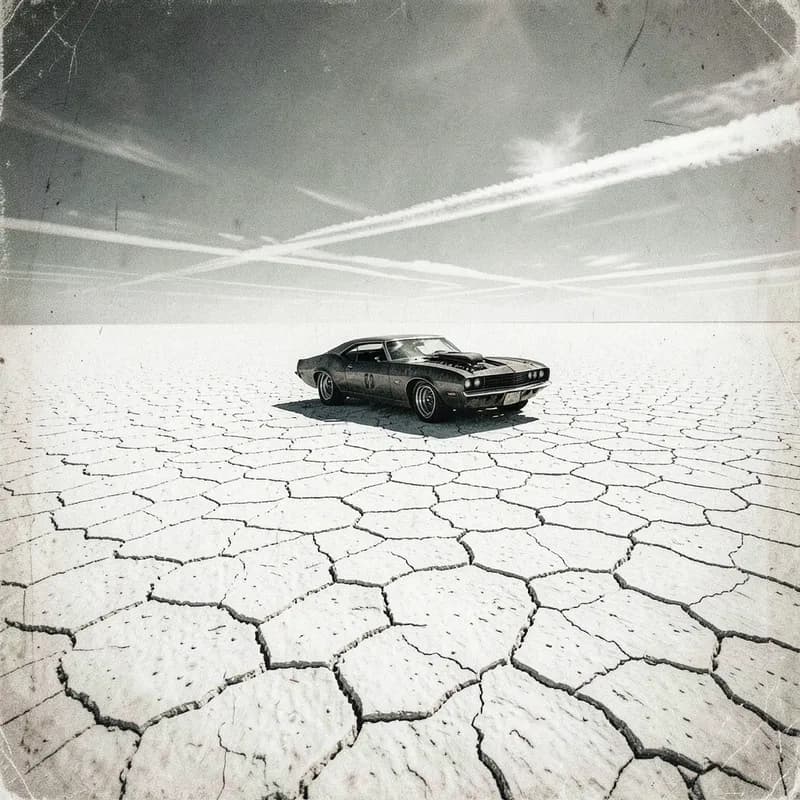
Post-Apocalyptic · Interactive story
Burn Fuel, Survive the Highway
The asphalt is cracked, the tank is nearly empty, and the raiders are coming.
Start as a guest. Choose your character before the story begins.

Meet the sample character
The road doesn't forgive, and the engine never stops screaming.
Try a scene · No signup
Salt and Gasoline
A short sample of this world. Your own version starts with your character.
The interceptor’s engine rattles like a dying man’s lungs. Your gauge is pegged at empty, the needle shaking against the red line as you push the rusted machine across the alkali flats. Behind you, a plume of black smoke marks the pursuit—a pack of scavengers mounted on souped-up dirt bikes, desperate for your fuel cells.
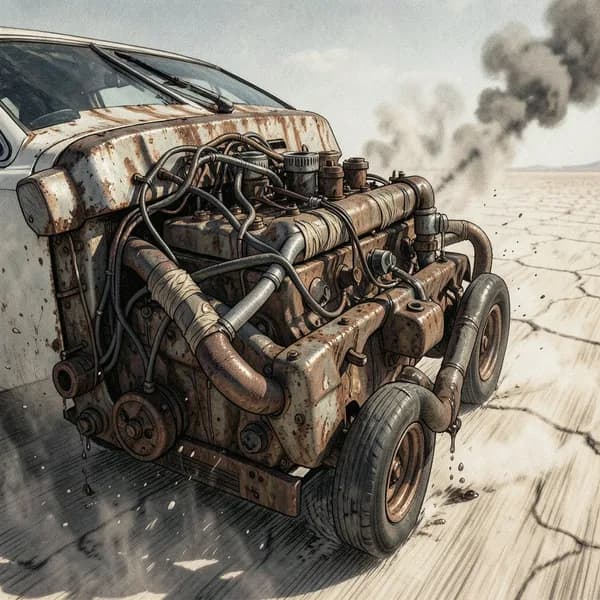
“Stop stalling, Hatcher! If we don't hit the ridge in three minutes, we’re nothing but buzzard food.”
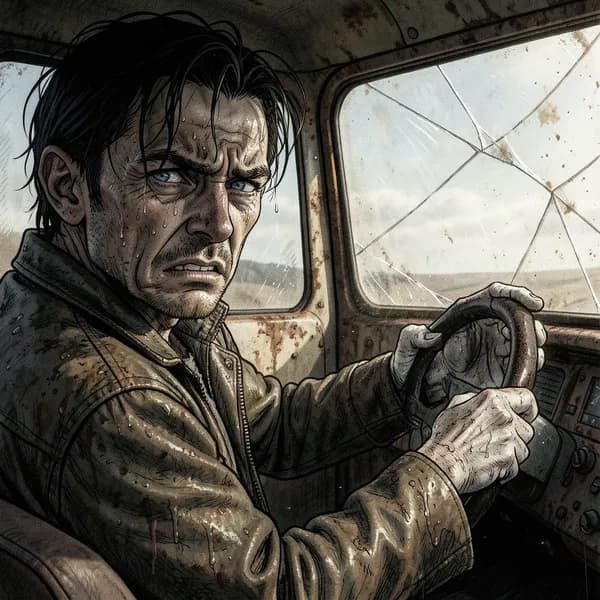
Your knuckles are white against the leather-wrapped wheel. The heat is a physical weight, pressing down on the cracked windshield. You can feel the vibration of the pursuers growing stronger through the chassis, a rhythmic thrum that signals your end if you don't make a break for the canyon entrance hidden in the salt haze.
“Shut up and keep your eyes on the heat trail. If I push the blower any harder, the whole block will turn into a firebomb.”
A metallic screech erupts from the engine as the interceptor lurches. The leading bike is now fifty yards out, their harpoon gun leveled at your rear tire. You have seconds to commit. Do you risk an engine blowout to outrun them, or do you slam the brakes to force a collision that might kill you both?
The harpoon glints in the midday sun. How do you handle the lead pursuer?
Your character. Your next move.
The engine is roaring. Are you ready to drive?
The raiders are closing in, and your fuel gauge is dipping into the red. Every decision you make—from the route you take to the parts you scavenge—determines if you survive the night on the broken highway. Take the wheel and see if you have the grit to outrun the end of the world.
Start Your Road JourneyYour Story, Your Way
Everything is customizable. Pick any genre, setting, or character — the AI builds a world around exactly what you want.
Any Character
Design your appearance, personality, backstory — every detail
Any World
Fantasy kingdoms, sci-fi stations, modern cities — you choose
Branching Paths
No two playthroughs are the same. Your choices reshape everything
Full Immersion
AI images, voice acting, sound effects — a living story
Choose between reinforcing your vehicle’s armor or installing a more efficient fuel intake system.
Decide whether to engage in high-speed combat or use terrain to evade marauder convoys.
Manage limited supplies while choosing which hitchhikers to trust and which to leave behind.
Navigate sudden mechanical failures by scavenging parts from derelict vehicles abandoned on the roadside.
The radiator hisses, spitting steam into the dry, scorched air of the salt flats. You grip the steering wheel, knuckles white, listening for the rhythmic thrum of pursuit vehicles behind you. Ahead, the highway is a jagged scar of broken concrete, littered with the rusted husks of cars that stopped moving decades ago. A flare of red dust on the horizon signals a marauder convoy—they want your fuel, your parts, and your life. You have seconds to decide: do you floor the accelerator and gamble on the engine holding together, or do you veer into the ruins to lose them in the wreckage? In this interactive story, your choices dictate whether you reach the next settlement or become just another pile of scrap metal on the side of the road. Every gallon of gas acts as a countdown, and every encounter forces a calculation between morality and survival. You are the driver, and on these roads, mercy is a luxury the wasteland rarely permits.
What is Road Warrior in Post-Apocalyptic?
The road warrior trope centers on the vehicle as the primary vessel for survival. In a landscape where cities have crumbled, the highway becomes the only lifeline for trade, communication, and violence. These stories focus on the scarcity of resources—specifically gasoline, water, and ammunition—and the constant pressure of nomadic gangs who control the transit routes. Unlike stationary survival stories, this trope emphasizes mobility and the precarious nature of life on the move. The vehicle is more than a machine; it is a mobile fortress, a home, and a weapon. George Miller’s 'Mad Max' series perfectly encapsulates this, establishing the high-octane aesthetic of customized interceptors and leather-clad drifters. The conflict rarely involves long-term societal reconstruction; instead, it focuses on the immediate need to reach a destination or outrun a threat. It is a genre defined by kinetic energy, where the story moves as fast as the tires on the pavement. Whether you are transporting precious cargo or fleeing a warlord, the road provides a stage for high-stakes encounters that test your resourcefulness and your willingness to sacrifice for the sake of the next mile.
Why play Road Warrior as an interactive story?
Agency changes the stakes when your vehicle is your only means of staying alive. In a passive story, you watch the protagonist narrowly escape a crash; here, you decide how to tune the engine, which route to take through the irradiated tunnels, and whether to share your limited fuel with a stranded family. The tension comes from the weight of your decisions. If you run out of fuel, the game doesn't just end—you have to decide if you will abandon your ride and proceed on foot, or gamble on a dangerous raid to siphon a tanker. You encounter moments where you must choose between repairing your armor or upgrading your weapons, knowing that a heavy-duty bumper might save you from a head-on collision, but a mounted turret might be the only thing that keeps you from being boarded. The narrative responds to how you treat your machine and your fellow scavengers, creating a personal history of the road that is unique to your playstyle.
Famous examples of Road Warrior in books, film, and games
The road warrior archetype resonates because it strips life down to basic, brutal mechanics. In the film 'Mad Max: Fury Road', the trope is elevated through visual storytelling, where the road itself becomes a character and the pursuit is a continuous, pulse-pounding narrative device. It demonstrates how a simple objective—getting from A to B—can sustain an entire story through escalating obstacles and environmental hazards. In the video game 'Fallout', the trope appears through the lens of the Highwayman, a classic vehicle that serves as a central hub for the player, representing the freedom to explore a dangerous, lawless frontier. The game uses the vehicle as a mobile base that requires constant maintenance and upgrades, forcing players to prioritize survival over exploration. Another example is the manga 'Desert Punk', which focuses on the harsh, dust-filled reality of desert survival, highlighting the technical ingenuity required to keep old-world tech running in a broken society. These works share a common thread: the road is not a path to safety, but a continuous test of endurance. The trope endures because it reflects the human desire to maintain control in a chaotic, unpredictable environment. Whether you are driving a war rig or a salvaged sedan, the road demands your full attention, making it a perfect setting for a narrative that hinges on split-second decisions and the relentless pursuit of survival.
FAQ
What is the main goal in a Road Warrior story?
The primary goal is usually survival through mobility. You are rarely trying to 'save' the world; instead, you are trying to reach a safe haven, transport essential goods, or simply outrun a pursuing threat. Success is measured by your ability to keep your vehicle running and your supplies stocked.
How does vehicle management affect gameplay?
Vehicle management acts as your primary survival metric. You must balance speed, durability, and fuel consumption. Choosing to drive fast consumes more gas and risks engine failure, while driving slowly makes you an easier target for raiders. Your choices regarding repairs directly affect your survivability in combat.
Is this a combat-heavy genre?
While combat is a frequent element, it is not the only way to play. Many road warrior scenarios focus on evasion, mechanical problem-solving, and resource management. You can often choose to avoid conflict entirely if you are skilled at navigating treacherous terrain or utilizing stealth.
Can I upgrade my vehicle during the story?
Yes. As you scavenge the ruins, you find parts that allow you to modify your vehicle. You can prioritize speed, heavy armor, or specialized weaponry depending on the challenges you face and the playstyle you adopt.
Explore more Post-Apocalyptic stories like Zombie Survival, Nuclear Wasteland, Plague Aftermath.
More Post-Apocalyptic Stories
Zombie Survival
The dead walk and every stranger is a threat. Scavenge for weapons, fortify your shelter, and make brutal choices about who lives and who gets left behind in this undead nightmare.
TropeNuclear Wasteland
The bombs fell and civilization crumbled. Now you wander a scorched earth where radiation is as deadly as the desperate survivors who stalk the ruins.
TropePlague Aftermath
A pandemic wiped out most of humanity. You survived, but survival is just the beginning as you navigate a world where disease still lurks and trust is the scarcest resource.
TropeFaction Warfare
Rival factions carve up what remains of the world, each with their own vision for the future. Choose your allegiance carefully because neutrality is not an option.
TropeScavenger Hunt
Every ruined building could hold the supplies that keep you alive another week. Risk raiders, traps, and structural collapse as you pick through the bones of civilization.
TropeBunker Emergence
You have lived underground your entire life. The bunker door is finally opening and the world outside is nothing like the old recordings promised.