
Post-Apocalyptic · Interactive story
When the Nine Realms Burn: A Ragnarok Interactive Story
The sun fades, the frost bites deep, and the gods prepare for their final war.
Start as a guest. Choose your character before the story begins.
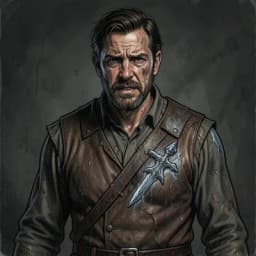
Meet the sample character
The sky burns cold, and the gods have left us to rot.
Try a scene · No signup
Ashes of Yggdrasil
A short sample of this world. Your own version starts with your character.
The wind howls like a wounded beast through the skeletal remains of the overpass. You pull your furs tighter, eyes scanning the slush for anything worth trading—rusted bolts, dry fuel, or anything that doesn't smell like sulfur. Above, the sun is a dead, grey eye, eclipsed by the massive, shifting coils of the serpent winding around the city’s skyline.
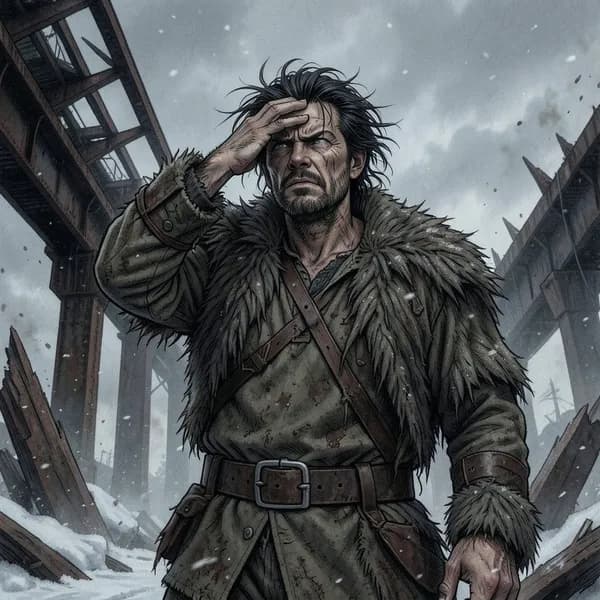
“Stop staring at the sky, Haldor. The serpent doesn't care if you're watching it feed or not.”

A tremor rocks the concrete floor, sending a shower of loose rebar clattering into the darkness below. The ground doesn't just shake; it groans with the weight of giants marching on the horizon. Your pocket burns—the shard of the spear you pulled from the rubble is pulsing, syncing its heartbeat to the rhythm of the dying world.
“It’s not just the serpent, Jarlen. Something is waking up in the foundations of this tower, and it’s hungry.”
As the words leave your mouth, the floor beneath your feet cracks wide open. A blue, rhythmic glow spills out from the fissure, illuminating the rusted machinery that once powered this city. You have seconds before the entire structure collapses, and you must decide whether to save the equipment, defend your position, or try to recruit Jarlen to descend into the pit with you.
The floor is buckling beneath you. How do you secure your future in this ruin?
Your character. Your next move.
Will you survive the final winter?
The giants are at the gates, and the gods have left you to face the cold alone. Every choice you make in these frozen ruins defines the future of Midgard. Do you have the strength to outlast the end of the world? Start your story today and claim your place in the final tally.
Begin the final battleYour Story, Your Way
Everything is customizable. Pick any genre, setting, or character — the AI builds a world around exactly what you want.
Any Character
Design your appearance, personality, backstory — every detail
Any World
Fantasy kingdoms, sci-fi stations, modern cities — you choose
Branching Paths
No two playthroughs are the same. Your choices reshape everything
Full Immersion
AI images, voice acting, sound effects — a living story
Choose whether to scavenge divine artifacts or focus on securing basic survival rations.
Decide which remnants of humanity to protect when the sky-fire begins to fall.
Negotiate with desperate mythological creatures who have lost their masters in the chaos.
Determine the fate of a dying settlement as the world-serpent rises from the sea.
Ash coats the horizon, masking the scent of burning Yggdrasil. You wake in the ruins of a village that once thrived under the protection of the Aesir, now silenced by the march of Jörmungandr. The sky is a bruised violet, bleeding shadows that have no business walking in the light. You have no weapon but a rusted seax and a handful of dried meat, yet every decision you make ripples through the impending collapse. Whether you seek to preserve the flickering embers of civilization or hasten the inevitable descent into the void, your choices dictate the final tally of the dead. In this interactive story, every step through the frozen waste determines if you become a footnote in a dying epic or the architect of a new dawn.
What is Ragnarok in Post-Apocalyptic?
Ragnarok is the terminal point of the Norse mythos—a series of cataclysmic events that see the world devoured by flame and flooded by sea. It is not merely a battle; it is the death of the divine order. In the ancient texts like the Poetic Edda, this event is inevitable, marked by the breaking of chains, the escape of monsters like Fenrir, and the final clash between the Aesir gods and the giants of Jotunheim. Modern reinterpretations, such as Neil Gaiman’s 'Norse Mythology' or the brutal, character-driven narrative in the 'God of War' series, emphasize the tragedy of a world that knows its expiration date. In a post-apocalyptic context, Ragnarok serves as the ultimate scavenger setting. The gods are either dead, dying, or indifferent, leaving the mortal survivors to pick through the wreckage of a reality that has literally come apart at the seams. It is a world stripped of its cosmic safety net, where the survival of humanity depends on the scraps left behind by deities who have abandoned their posts.
Why play Ragnarok as an interactive story?
Playing through the Norse apocalypse forces you to confront the weight of futility against the human instinct to persist. You are not a spectator watching the world burn; you are a participant deciding what is worth saving. Will you trade your last rations to protect a village of refugees from an approaching frost giant, or do you hoard your supplies to ensure your own passage to the next world? The tension stems from the fact that in Ragnarok, the rules of nature are failing. Magic is volatile, the seasons have ceased their cycle, and your allies may turn on you the moment the frost sets in. You will face moments where you must choose between loyalty to a crumbling pantheon or the cold pragmatism required to see another dawn. Every interaction—from negotiating with a desperate valkyrie to scavenging the frozen corpse of a fallen god—is a calculated risk. Your agency turns the myth into a personal struggle for survival where the outcome depends on your moral compass when the light finally goes out.
The literary legacy of Ragnarok
The concept of Ragnarok, or 'Fate of the Gods,' finds its roots in the 13th-century Icelandic Prose Edda and Poetic Edda. These texts were not just religious documents but a complex reflection on the cycle of destruction and renewal. Unlike many Western apocalypses, Ragnarok is cyclical; the world ends only to be born anew. This theme of inevitable destruction has resonated through centuries of literature and art. Richard Wagner’s 'Der Ring des Nibelungen' transformed these myths into a massive operatic cycle, focusing on the corruption of power and the tragic downfall of the gods. In the 20th and 21st centuries, the narrative has shifted toward the human perspective. Marvel’s 'Thor: Ragnarok' film explored the loss of heritage and the necessity of letting go, while video games like 'God of War' (2018) and its sequel 'God of War Ragnarök' focus on the disruption of fate and the agency of the individual against preordained prophecy. What makes this character-driven apocalypse so enduring is the refusal of the protagonists to go quietly. Even when the stars fall and the world is swallowed by the ocean, the struggle to survive provides a grounding human element to the cosmic horror. It is this persistent defiance—the refusal to accept the end without a fight—that makes Ragnarok a compelling framework for modern interactive narratives. It asks the player to find meaning in a landscape where all traditional structures have failed, proving that the human spirit is the only thing that truly survives the death of the gods.
FAQ
What defines the Ragnarok setting in this game?
The setting is the aftermath of the Norse end-times. The gods have fallen or vanished, the Fimbulwinter has frozen the earth, and the remnants of humanity are fighting for scraps in a landscape where mythological monsters roam free.
How do my choices influence the Norse gods?
Your choices determine whether you align with the surviving remnants of the Aesir, defy them, or exploit the power vacuum they left behind. Your actions can either accelerate the destruction of the realms or provide a temporary reprieve for the survivors.
Is this game historically accurate to the myths?
It draws heavily from the themes and figures of the Poetic Edda, but it is a creative interpretation. It treats the myth as a post-apocalyptic reality rather than a religious history, allowing for original character paths and non-linear outcomes.
Can I play as a mortal survivor?
Yes, the primary perspective is that of a mortal scavenger. You are not a god, which makes the stakes significantly higher. You must rely on wit, grit, and limited resources to survive the twilight of the gods.
Explore more Post-Apocalyptic stories like Zombie Survival, Nuclear Wasteland, Plague Aftermath.
More Post-Apocalyptic Stories
Zombie Survival
The dead walk and every stranger is a threat. Scavenge for weapons, fortify your shelter, and make brutal choices about who lives and who gets left behind in this undead nightmare.
TropeNuclear Wasteland
The bombs fell and civilization crumbled. Now you wander a scorched earth where radiation is as deadly as the desperate survivors who stalk the ruins.
TropePlague Aftermath
A pandemic wiped out most of humanity. You survived, but survival is just the beginning as you navigate a world where disease still lurks and trust is the scarcest resource.
TropeFaction Warfare
Rival factions carve up what remains of the world, each with their own vision for the future. Choose your allegiance carefully because neutrality is not an option.
TropeScavenger Hunt
Every ruined building could hold the supplies that keep you alive another week. Risk raiders, traps, and structural collapse as you pick through the bones of civilization.
TropeBunker Emergence
You have lived underground your entire life. The bunker door is finally opening and the world outside is nothing like the old recordings promised.