
Post-Apocalyptic · Interactive story
The Last Outpost at the Edge of Winter
The blizzard is coming, and the furnace is dying. Who gets the last fuel?
Start as a guest. Choose your character before the story begins.
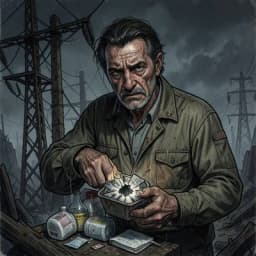
Meet the sample character
Warmth is a memory, and survival is a math problem.
Try a scene · No signup
The Last Hearth
A short sample of this world. Your own version starts with your character.
The wind screams through the gaps in the corrugated iron, a high-pitched whistle that buries itself deep in your marrow. You crouch inside the generator hut, your frost-bitten fingers struggling to solder a connection on the main conduit. Outside, the tundra remains an endless expanse of white, but here, the artificial warmth is fading fast.

“Stop wasting the solder, Vance. Is the core holding or are we sleeping in the ice tonight?”

The weight of the empty fuel drum behind your back feels like a death sentence. You know the truth—the core isn't just failing; it is dead, and the only replacement part is locked in the derelict bunker three miles into the blizzard. You look at Maren, her face pale and rimed with frost, and realize she has no idea how absolute the silence will be once the turbines stop.
“I can patch it, but I need the relay from the North Sector. It is a dangerous run, but it is the only way we keep the lights on.”
A low, rhythmic thud echoes from outside, followed by the screech of grinding metal. The primary wind turbine, the outpost’s last heartbeat, stops dead. Darkness swallows the room as the emergency lights flicker once and vanish, leaving you in the suffocating quiet of the frozen wasteland.
The darkness is absolute and the temperature is plummeting. How do you secure a future for the outpost?
Your character. Your next move.
The furnace is failing. What will you save?
The winds are shifting, and the temperature is dropping faster than expected. You have enough fuel to keep the infirmary warm or the communications array active. The decision rests on your shoulders before the next blizzard hits. Don't wait for the ice to claim the last of your resources.
Start Your Frozen SurvivalYour Story, Your Way
Everything is customizable. Pick any genre, setting, or character — the AI builds a world around exactly what you want.
Any Character
Design your appearance, personality, backstory — every detail
Any World
Fantasy kingdoms, sci-fi stations, modern cities — you choose
Branching Paths
No two playthroughs are the same. Your choices reshape everything
Full Immersion
AI images, voice acting, sound effects — a living story
Decide whether to sacrifice the greenhouse to keep the command center’s furnace running.
Choose which survivor to send into the whiteout for essential medical supplies.
Manage the morale of a starving crew when the last food rations disappear.
Seal off compromised sectors of the base while your team is still inside.
Frost spiders crawl across the reinforced glass of the command deck. Outside, the wind screams, a rhythmic howl that buries the world in white. You check the fuel gauges—they are needles in the red. The others are huddled in the mess hall, their breath forming frantic clouds in the freezing air. Every decision you make here ripples through the station. Will you ration the remaining heat, or do you sacrifice the warmth of the common room to keep the life support systems running for one more day? This is a place where hope is a currency, spent far too quickly on the wrong people. Your choices determine if you freeze in the dark or manage to hold the line until the storm breaks.
What is Frozen Tundra Outpost in Post-Apocalyptic?
The Frozen Tundra Outpost setting thrives on the intersection of extreme isolation and environmental hostility. Unlike desert-based apocalyptic stories where the sun is the enemy, the tundra pits you against the cold itself. It is a setting that mirrors the claustrophobia of John Carpenter’s The Thing or the desperate resource management seen in the game Frostpunk. The architecture is usually industrial—oil rigs, research stations, or military bunkers—that have been repurposed to keep the frost at bay. These locations are inherently fragile, built for short-term duty but now expected to sustain life indefinitely in an environment that wants to kill you. You are not just fighting raiders; you are fighting the physics of heat loss. Every broken seal or rusted bolt is a potential death sentence. The environment dictates the pace of the narrative, forcing you to prioritize repairs and calories over long-term goals.
Why play Frozen Tundra Outpost as an interactive story?
Playing in a frozen tundra setting forces a unique style of triage. You are not just choosing paths; you are choosing what to discard. Do you abandon the infirmary to save the generator? Do you open the airlock for a survivor knowing it compromises the integrity of the insulation? The tension comes from the constant drain on your resources. You will feel the weight of your inventory—every scrap of wood, every liter of kerosene, every bandage. When a supply run goes wrong, you decide who goes out into the whiteout to recover the gear. The consequences are immediate and often brutal. If you prioritize the group, you might lose your own standing; if you prioritize yourself, you might find the doors locked when you return from the snow.
What makes Frozen Tundra Outpost work: the worldbuilding
The effectiveness of a frozen outpost setting lies in its inherent scarcity. The cold is a persistent, non-human antagonist that makes every action carry a cost. In Dan Simmons' The Terror, the ice is a character itself, indifferent to the suffering of the crew. In the film Snowpiercer, the setting is a train, but the principle is the same: the environment is a ticking clock. The best tundra stories lean into the psychological toll of cabin fever. When you are confined to a steel box while an infinite white void rages outside, paranoia becomes the default state. Characters do not just fear the cold; they fear the person sitting across from them. Who is hiding an extra ration? Who is failing to maintain their equipment? Sensory details drive this: the smell of ozone and burnt oil, the sound of metal groaning under the pressure of ice, the visual of a frost-covered window slowly obscuring the view of the world you lost. To make this work, the narrative must emphasize the fragility of the base. If the base is too secure, the stakes vanish. The environment must constantly remind the player that the walls are thin, the heater is failing, and the snow is already piling up against the door.
FAQ
Is this setting purely about survival?
Survival is the foundation, but the story pivots on how you lead. You manage alliances and moral dilemmas that arise when resources hit zero.
How does the cold affect the gameplay mechanics?
The cold acts as a persistent drain on resources, forcing you to prioritize what—and who—you can afford to keep warm.
Can I play as a lone wolf in the tundra?
Yes, though the challenges shift from managing a group to navigating the environment entirely on your own terms.
Does the environment change based on my choices?
Your choices dictate the state of the base, from the structural integrity of the walls to the health of your crew.
Explore more Post-Apocalyptic stories like Zombie Survival, Nuclear Wasteland, Plague Aftermath.
More Post-Apocalyptic Stories
Zombie Survival
The dead walk and every stranger is a threat. Scavenge for weapons, fortify your shelter, and make brutal choices about who lives and who gets left behind in this undead nightmare.
TropeNuclear Wasteland
The bombs fell and civilization crumbled. Now you wander a scorched earth where radiation is as deadly as the desperate survivors who stalk the ruins.
TropePlague Aftermath
A pandemic wiped out most of humanity. You survived, but survival is just the beginning as you navigate a world where disease still lurks and trust is the scarcest resource.
TropeFaction Warfare
Rival factions carve up what remains of the world, each with their own vision for the future. Choose your allegiance carefully because neutrality is not an option.
TropeScavenger Hunt
Every ruined building could hold the supplies that keep you alive another week. Risk raiders, traps, and structural collapse as you pick through the bones of civilization.
TropeBunker Emergence
You have lived underground your entire life. The bunker door is finally opening and the world outside is nothing like the old recordings promised.