
Post-Apocalyptic · Interactive story
The City That Drowned
The tide doesn't care about your past. Only what you can salvage from the depths.
Start as a guest. Choose your character before the story begins.
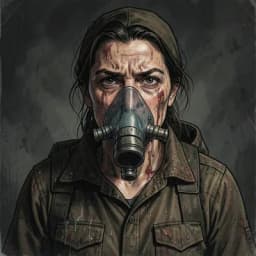
Meet the sample character
The city does not sleep; it drowns.
Try a scene · No signup
Rust and Riptide
A short sample of this world. Your own version starts with your character.
The sun hits the oily surface of the water, turning the black sludge into a prismatic hellscape. You steer your makeshift skiff, the hull groaning against the jagged rebar of a submerged parking garage. Your hands are cracked, caked in salt, and the air smells like wet rot and old copper.

“Keep your eyes on the dark spots, Maren. Something just nudged the hull, and I do not think it was driftwood.”

You glance down. The water is thick, opaque, and entirely too still. Your heart hammers against your ribs, a frantic rhythm against the silence of the drowned skyline. You clutch your rusted harpoon, knuckles white, weighing the risk of stopping to loot this floor against the certainty of being hunted.
“If we do not grab that medical kit from the third-floor ledge, the fever is going to take everyone by dawn. We keep moving.”
As you bank the boat toward the half-submerged skyscraper, a massive shape ripples beneath your feet. The skiff tilts violently, throwing you against the cold concrete. Something metallic clatters into the depths, and the boat starts taking on water. You have seconds before the hull gives out entirely.
The hull is cracking and you are losing buoyancy. How do you respond to the immediate threat?
Your character. Your next move.
The tide is rising. What will you save?
Your boat is leaking, and the last ferry station is about to submerge. Do you spend your final fuel to reach the high ground, or do you descend into the dark lobby below for the antibiotics your crew desperately needs? Every decision you make locks in your fate. Don't wait for the water to claim your story.
Scavenge the Ruins NowYour Story, Your Way
Everything is customizable. Pick any genre, setting, or character — the AI builds a world around exactly what you want.
Any Character
Design your appearance, personality, backstory — every detail
Any World
Fantasy kingdoms, sci-fi stations, modern cities — you choose
Branching Paths
No two playthroughs are the same. Your choices reshape everything
Full Immersion
AI images, voice acting, sound effects — a living story
Decide whether to risk hull damage to scavenge high-value tech from submerged office vaults.
Manage limited fuel supplies while navigating shifting currents and debris-heavy shipping lanes.
Choose how to interact with rival scavenger crews claiming territory on the rooftop islands.
Determine if you salvage medicine for yourself or trade it for safe passage downstream.
Salt crusts the windows of the skyscrapers, and the rhythmic lapping of water against rusted rebar is the only clock you have left. You push your skiff through the narrow gap between two leaning office towers, careful not to scrape the hull against the jagged remnants of a submerged subway sign. Below, the shadows are long and hungry. You are looking for medicine, fuel, or anything that hasn’t turned to pulp in the briny rot. Every decision you make—where to dock, who to trust among the other drifters, and when to fight for a cache—alters the course of your survival. In this interactive story, the environment is as dangerous as the people you encounter. The water is cold, the buildings are failing, and your choices determine whether you find a future or drift into the abyss.
What is Flooded City in Post-Apocalyptic?
The flooded city trope turns urban centers into labyrinthine waterways. It is a vertical graveyard where the ground floor is a death trap and the rooftops are prime real estate. Think of the maritime desolation in the film Waterworld or the moss-choked, submerged streets of Seattle in The Last of Us Part II. In this setting, the ocean is a character. It dictates movement, hides predators, and slowly digests the history of civilization. Unlike a desert wasteland where thirst is the primary enemy, the flooded city forces players to contend with damp rot, limited structural integrity, and the constant threat of whatever the currents push into your path. It is a slow, methodical struggle against an environment that refuses to stop rising. Players must master the art of the boat, managing fuel and hull integrity while reading the currents to avoid whirlpools or jagged debris that could leave them stranded in the middle of a drowned metropolis.
Why play Flooded City as an interactive story?
Agency changes everything when the ground beneath you is unstable. You are not just observing a scavenger; you are deciding whether to risk your boat’s hull to loot a high-rise pharmacy or keep moving to avoid the rising tide. You must balance the weight of your cargo against the fuel left in your engine. Do you share your limited rations with a survivor clinging to a chimney, knowing they might be a liability? Every choice carries the weight of the water. You will track your oxygen, your morale, and the structural integrity of your makeshift base. The tension of the setting comes from the constant need for movement—if you stay in one place, the tide eventually claims it. You choose which buildings to investigate, which factions to trade with, and when to abandon your gear to save your life.
What makes Flooded City work: the worldbuilding
The flooded city thrives on the tension between height and depth. It is a setting that weaponizes architecture. In the game BioShock, the underwater city of Rapture explores the psychological pressure of isolation, while the film Waterworld demonstrates how the scarcity of dry land creates a brutal social hierarchy. To make this setting work, one must emphasize the decay—the smell of salt and stagnant water, the groaning of metal as the tide shifts, and the terrifying silence of an empty lobby. Conflicts arise from the verticality; survivors in the penthouse towers look down on the boat-bound foragers with suspicion. The characters that inhabit these ruins are usually defined by their relationship to the water: the divers who risk the deep for relics, the dry-landers who cling to the highest points, and the drifters who treat the water as their home. Sensory details like the bioluminescence of new, mutated flora in the dark stairwells or the sound of a hull hitting a submerged bus create a persistent sense of dread. It is not just about survival; it is about adapting to a world that has fundamentally changed its relationship with gravity and geography. Every floor you climb is a victory against the sea, but the higher you go, the harder it is to escape when the structure begins to fail.
FAQ
Is a flooded city different from a desert wasteland?
Yes. A desert wasteland focuses on heat and scarcity, while a flooded city focuses on structural decay, buoyancy, and the hidden dangers beneath the surface.
Can I build a base in this setting?
You must maintain a base, usually on rooftops or a moored barge, to manage your health, inventory, and long-term survival prospects.
Are there threats other than the water?
Yes, rival scavenger factions, the unpredictable nature of the ruins, and limited resources pose constant risks to your survival.
How do I navigate the map?
You use various watercraft, ranging from scavenged rafts to motorboats, to travel between the rooftops of former skyscrapers.
Explore more Post-Apocalyptic stories like Zombie Survival, Nuclear Wasteland, Plague Aftermath.
More Post-Apocalyptic Stories
Zombie Survival
The dead walk and every stranger is a threat. Scavenge for weapons, fortify your shelter, and make brutal choices about who lives and who gets left behind in this undead nightmare.
TropeNuclear Wasteland
The bombs fell and civilization crumbled. Now you wander a scorched earth where radiation is as deadly as the desperate survivors who stalk the ruins.
TropePlague Aftermath
A pandemic wiped out most of humanity. You survived, but survival is just the beginning as you navigate a world where disease still lurks and trust is the scarcest resource.
TropeFaction Warfare
Rival factions carve up what remains of the world, each with their own vision for the future. Choose your allegiance carefully because neutrality is not an option.
TropeScavenger Hunt
Every ruined building could hold the supplies that keep you alive another week. Risk raiders, traps, and structural collapse as you pick through the bones of civilization.
TropeBunker Emergence
You have lived underground your entire life. The bunker door is finally opening and the world outside is nothing like the old recordings promised.