
Post-Apocalyptic · Interactive story
The World Burned, Then It Froze
Hope is a rare commodity when the wind screams louder than the survivors.
Start as a guest. Choose your character before the story begins.
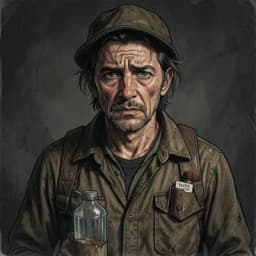
Meet the sample character
The tide waits for no survivor.
Try a scene · No signup
Salt-Crusted Foundations
A short sample of this world. Your own version starts with your character.
The tide isn't just rising; it is predatory. You watch brackish water lap against the rusted rebar of your shelter, thick with oily sludge and jagged shards of glass. The midday sun beats down, blistering the metal walls until the air inside tastes like scorched copper. Every breath is a struggle against the humidity and the encroaching brine that threatens to dissolve what little remains of your sanctuary.

“The pumps are dead, Hollis. If we don't push the raft off now, the rising tide will pin us against the ceiling.”

You look at the stack of salvaged solar cells, your only ticket to clean water for the coming month. They are heavy, awkward, and currently blocking the path to the exit. A muffled, desperate cry echoes from the neighboring unit—someone is trapped behind a wall of fallen concrete, their lungs wheezing against the rapidly rising water level.
“I cannot leave the cells, Mina. Without them, we do not have a future. We have to find a way to shift the rubble first.”
A massive slab of rusted rebar shifts above the neighbor’s head, groaning under the weight of the water surging into the basement. You have seconds before the structural collapse seals their fate forever. The salt spray stings your eyes as the roar of the ocean outside intensifies, warning you that the storm surge will not wait for your indecision.
The structure is failing and the water is at your knees. How do you move?
Your character. Your next move.
The storm is coming. Will you be ready?
The wind is picking up, and the temperature gauge is dropping. Your next decision could mean the difference between finding a warm fire or freezing in the dark. Don't wait for the collapse to catch you off guard. Step into the wasteland and see if you have the grit to survive.
Start Your Survival StoryYour Story, Your Way
Everything is customizable. Pick any genre, setting, or character — the AI builds a world around exactly what you want.
Any Character
Design your appearance, personality, backstory — every detail
Any World
Fantasy kingdoms, sci-fi stations, modern cities — you choose
Branching Paths
No two playthroughs are the same. Your choices reshape everything
Full Immersion
AI images, voice acting, sound effects — a living story
Manage dwindling water supplies while navigating extreme heatwaves that threaten your physical stamina.
Choose whether to repair critical shelter infrastructure or scavenge for food at great personal risk.
Negotiate with desperate factions where the wrong word could lead to your immediate exile.
Decide if you will risk exposure to save a companion or cut ties to survive.
The horizon is a jagged line of rusted steel and salt-crusted concrete. For weeks, the dust storms have scoured the valley, stripping the paint from the derelict cars and burying the remnants of the old world under a blanket of choking silt. You crouch behind a shattered storefront, your throat raw from the dry air, clutching a half-empty canteen that represents your only chance of reaching the northern ridge by nightfall. The sky is an unnatural shade of bruised violet, a sign that the atmospheric pressure is dropping again. Out here, there is no one left to call for help, and the silence is only broken by the groan of collapsing infrastructure. Your next move is yours alone; do you risk the open salt flats to save time, or do you hunker down and hope the walls hold against the coming gale? Every resource you gather and every alliance you form shifts the odds of your survival in this rapidly changing landscape. The temperature is falling, and the choices you make during these final hours of daylight determine whether you find shelter or become another ghost in the wasteland.
What is Climate Catastrophe in Post-Apocalyptic?
Climate catastrophe as a narrative trope centers on the planet turning against humanity due to extreme ecological shifts. Unlike war-torn scenarios where the enemy is another faction, this trope positions nature—superstorms, rising tides, or runaway heat—as the primary antagonist. It forces characters to abandon the comfort of static civilizations and embrace a nomadic or bunker-bound existence. In Bong Joon-ho’s film 'Snowpiercer,' the entire remaining human population is trapped on a train circling a frozen, lifeless globe, turning the climate itself into a literal cage. The trope highlights the fragility of modern systems when faced with an environment that no longer supports traditional life. It is not about the politics of how the world ended, but the brutal, scavenger-practical reality of living through the aftermath. Whether it is the eternal winter of 'Snowpiercer' or the endless, parched wandering in Cormac McCarthy’s 'The Road,' the focus remains on the scarcity of resources like clean water, stable heat, and unpolluted air. This trope strips away the excess of the modern era, leaving only the raw requirement to adapt or perish.
Why play Climate Catastrophe as an interactive story?
Interactivity brings a sharp edge to survival stories. In a static book or film, you watch the protagonist struggle; here, you calculate the risk of their next breath. The agency provided allows you to decide how much of your humanity to sacrifice for a few more days of safety. You face choices that force you to prioritize: do you share your meager rations with a stranger who might know where to find a working solar array, or do you hoard what you have and risk isolation? You might encounter a flooded city where you must decide whether to dive into toxic waters to recover a medicine cache, or move on and lose your only lead on a cure. The tension comes from the limited information you possess. You are not an omniscient observer; you are a survivor making decisions based on faulty equipment, rumors, and the shifting weather. You decide whether to trust the local community leaders in the mountain enclave or strike out on your own through the radioactive fog. Every decision creates a ripple, impacting your reputation among other survivors and your ability to reach the next safe zone.
Famous examples of Climate Catastrophe in books, film, and games
The climate catastrophe trope has long served as a mirror for our collective anxieties regarding the environment. By examining how different media handle this, we see the various ways life persists after the collapse. Cormac McCarthy’s 'The Road' is a definitive example of the 'scorched earth' variant. The world is grey, dead, and dying; the climate has essentially ceased to function as a life-giver. The focus is entirely on the bond between a father and son, with the environment acting as a relentless, oppressive force that actively kills anything it touches. It shows how the trope emphasizes internal morality when the external world provides nothing. In contrast, 'Waterworld' presents a flooded Earth where the catastrophe is a static state of existence. The setting is oceanic, and the struggle is for land and fresh water, turning the environment into a vertical, fluid battlefield. The adaptation here is technological and cultural; society has formed into floating city-states, and the climate is a constant, humid reality of life. Another example is the 'Frostpunk' video game, which shifts the perspective to city management during an unending volcanic winter. It uses the trope to explore the ethics of survival, where players must pass laws that balance the warmth of the citizens against their moral conscience. These works endure because they force characters to ask the same question: what is the price of continuing to live when the world has decided you should not?
FAQ
How do my choices impact the environment in these stories?
Your choices determine how you interact with the environment. If you choose to hoard resources, you might survive longer but lose the chance to build alliances that could help you mitigate environmental hazards like flash floods or sandstorms.
Is this a horror or a survival game?
It is a survival-focused experience. While it can be harrowing, the primary goal is maintaining your health, resources, and sanity in a world where the weather is the ultimate threat.
What happens if I make a mistake?
Mistakes have consequences. You might lose precious supplies, sustain injuries, or find yourself locked out of safe zones. However, failure is often part of the story, leading to new, more difficult paths.
Can I play as different types of survivors?
Yes. You can define your character's background, such as a former engineer who can fix gear, or a nomad who knows how to read the weather patterns. These skills change how you approach each crisis.
Explore more Post-Apocalyptic stories like Zombie Survival, Nuclear Wasteland, Plague Aftermath.
More Post-Apocalyptic Stories
Zombie Survival
The dead walk and every stranger is a threat. Scavenge for weapons, fortify your shelter, and make brutal choices about who lives and who gets left behind in this undead nightmare.
TropeNuclear Wasteland
The bombs fell and civilization crumbled. Now you wander a scorched earth where radiation is as deadly as the desperate survivors who stalk the ruins.
TropePlague Aftermath
A pandemic wiped out most of humanity. You survived, but survival is just the beginning as you navigate a world where disease still lurks and trust is the scarcest resource.
TropeFaction Warfare
Rival factions carve up what remains of the world, each with their own vision for the future. Choose your allegiance carefully because neutrality is not an option.
TropeScavenger Hunt
Every ruined building could hold the supplies that keep you alive another week. Risk raiders, traps, and structural collapse as you pick through the bones of civilization.
TropeBunker Emergence
You have lived underground your entire life. The bunker door is finally opening and the world outside is nothing like the old recordings promised.