
Mythology · Interactive story
The King of Uruk Awaits Your Command
Will you conquer death, or leave only dust in the sands of time?
Start as a guest. Choose your character before the story begins.
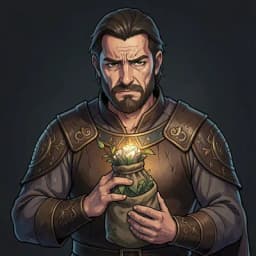
Meet the sample character
The king mourns, and the gods grow hungry.
Try a scene · No signup
Dust and Bronze
A short sample of this world. Your own version starts with your character.
You stand in the shadow of the great ziggurat, the smell of bitumen and dry rot thick in the air. Uruk is silent, its king locked away in the inner sanctum since the funeral fires burned out. You clutch the satchel containing the medicinal roots, your knuckles white against the rough leather. The silence of the city is heavier than the oppressive heat of the sun.

“Why do you bring the scent of herbs into a house of ghosts, envoy?”

The air ripples with the heat radiating from his massive shoulders. He has not shaved, his beard tangled with dried blood and ash. The god-king of Uruk stares toward the horizon, where the mountains of Lebanon loom like jagged teeth. You feel the weight of his gaze, a pressure that threatens to crush your resolve to speak.
“I bring only what is needed to clear the fog from your eyes, my King. The city requires a ruler, not a mourner.”
He turns, a mountain of bronze and raw muscle, and reaches for his heavy bronze mace. His eyes are not those of a ruler, but of a starving wolf. He demands to know if you believe yourself a healer of gods, or simply another worm come to feast on his misery before he departs for the Cedar Forest to seek what no man should possess.
How do you answer the king before his rage collapses the chamber walls?
Your character. Your next move.
Claim your throne in Uruk
The cedar forest awaits, and the gods are waiting to see if you have the strength to defy them. Will you find the secret to life, or will you accept the burden of your mortality? Your reign begins the moment you decide how to confront your first trial.
Begin your epicYour Story, Your Way
Everything is customizable. Pick any genre, setting, or character — the AI builds a world around exactly what you want.
Any Character
Design your appearance, personality, backstory — every detail
Any World
Fantasy kingdoms, sci-fi stations, modern cities — you choose
Branching Paths
No two playthroughs are the same. Your choices reshape everything
Full Immersion
AI images, voice acting, sound effects — a living story
Decide whether to challenge the goddess Ishtar or seek her favor for your city.
Manage your exhaustion while trekking through the forbidden cedar forests to hunt Humbaba.
Choose how to handle the grief of Enkidu’s passing to determine your path to wisdom.
Negotiate with the ferryman Urshanabi to cross the Waters of Death.
The dust of Uruk stings your eyes. Beside you, the silence where Enkidu’s laughter once echoed is deafening. You are the King, two-thirds divine, yet the mortality of your closest companion has shattered your world. Every decision you make—from how you address the gods to how you face the terror of the wilderness—shifts the path of this ancient legend. You hold the pen that writes the final lines of this forgotten epic. In this interactive experience, your choices dictate whether you return to your city as a ruler of men or a seeker who found only the bitter truth of existence. The gods are watching, and they are notoriously fickle.
What is Gilgamesh in Mythology?
The Epic of Gilgamesh remains the oldest surviving work of great literature, originating from ancient Mesopotamia. It tells the story of a tyrannical king of Uruk who undergoes a profound transformation after the death of his wild-born brother, Enkidu. Driven by the fear of his own eventual demise, he travels to the ends of the earth to find Utnapishtim, the survivor of a great flood, in hopes of discovering the secret to eternal life. This story has influenced countless modern works, appearing as a central plot point in the 'Darmok' episode of Star Trek: The Next Generation and serving as a major inspiration for characters in the Fate/stay night anime series. It is a foundational text that explores the tension between civilization and nature, the inevitability of loss, and the limits of human power. Unlike later heroic tales that focus on clear-cut victory, Gilgamesh is a raw, emotional exploration of a man struggling to accept his own humanity.
Why play Gilgamesh as an interactive story?
Playing through the epic allows you to treat the ancient tablets not as static history, but as a series of high-stakes dilemmas. When you stand before the gates of the Cedar Forest, you decide whether to rely on your brute strength or your diplomatic wit to bypass Humbaba. When Ishtar, the goddess of love and war, offers her hand, you choose whether to accept her favor or insult her pride—a decision that triggers a chain of events leading to the death of your friend. The agency provided here allows you to experiment with the king's temperament. Will you rule Uruk with the iron fist of a tyrant, or will you grow into the wise monarch the city requires? The tension lies in the fact that every action carries divine consequences. You are not simply replaying a poem; you are balancing the pride of a king against the inescapable reality of a mortal grave.
Why Gilgamesh still hits
The enduring appeal of Gilgamesh lies in its brutal honesty. Most myths emphasize the glory of the hero, but this epic focuses on the failure of the hero to escape the one thing everyone fears: death. Even when Gilgamesh reaches the edge of the world, he discovers that immortality is not meant for him. This theme resonates as strongly today as it did on clay tablets four thousand years ago. In games like Civilization VI, Gilgamesh is depicted as a protector, yet the source text paints a far more complicated picture of a man who grows through suffering. By engaging with this narrative, you participate in a tradition that predates the Iliad and the Odyssey. It is a story about the fragility of legacy. Whether you are a fan of historical fiction or someone looking for a narrative that challenges the concept of heroism, this epic provides a mirror to the human condition. It does not offer easy answers; it forces you to confront the reality that to be human is to be finite.
FAQ
Does this game follow the original text accurately?
The narrative honors the key plot points and themes found in the standard translations of the tablets. While you are given agency to change the king's reactions and specific outcomes, the cultural setting and mythological stakes remain grounded in the ancient Mesopotamian source material.
Can I prevent Enkidu from dying?
Your choices influence your relationship with the gods and the outcome of your battles. While the tragedy of the epic is a core component, your decisions determine how the kingdom reacts to his absence and how you personally process the weight of his death.
Is this suitable for someone who hasn't read the epic?
Absolutely. The story is designed to introduce the world and its inhabitants naturally. You will learn about the gods, the city of Uruk, and the rivalry of the heroes through the experience itself, without needing prior academic knowledge.
How do my choices change the story?
Choices impact your character's stats—such as his wisdom, pride, and favor with the gods. These traits determine which dialogue options are available and how others in the world, including divine entities, perceive your rule.
Explore more Mythology stories like Godly Intervention, Mortal Champion, Underworld Journey.
More Mythology Stories
Godly Intervention
The gods take a personal interest in your fate, meddling with your life for their own amusement or agenda. Navigate divine politics where a single prayer can bring salvation or catastrophe depending on which god is listening.
TropeMortal Champion
A god chooses you as their champion in a conflict they cannot fight directly. Wield divine blessings and carry the weight of a god's expectations as you battle on behalf of forces far greater than yourself.
TropeUnderworld Journey
Descend into the realm of the dead to rescue a lost soul, seek forbidden knowledge, or bargain with death itself. The underworld tests your resolve with shades of the past and guardians who do not easily release the living.
TropeDivine Punishment
You dared to defy the gods, and now their wrath reshapes your existence. Endure a punishment designed to last eternity and search for the loophole, the redemption, or the defiance that could set you free.
TropeProphecy Fulfillment
An oracle speaks your fate, and every attempt to avoid the prophecy brings you closer to fulfilling it. Choose your path carefully in a story where destiny is a trap and free will may be the greatest illusion of all.
TropeGodly Love Affair
A deity descends from the heavens to pursue a mortal lover, bringing gifts, transformations, and the jealousy of divine spouses. Love a god and face the consequences that come when immortal desire collides with mortal fragility.