
Gothic · Interactive story
The Canvas of Corrupted Youth
A beautiful face hides a rotting soul. How far will your vanity lead you?
Start as a guest. Choose your character before the story begins.
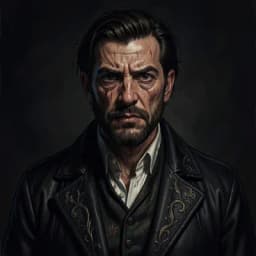
Meet the sample character
Some secrets are meant to decay in the dark.
Try a scene · No signup
The Canvas of Corruption
A short sample of this world. Your own version starts with your character.
The smell of turpentine clings to the air, thick enough to coat your tongue. You stand before a draped object that looms like a tombstone in the center of the room. Dorian watches you, his face a mask of porcelain perfection that defies the dim flickering of the gaslight. He is younger than his years, yet his eyes hold the hollow weight of a centuries-old grave.

“You were hired to restore the frame, Arthur, not to interrogate the subject. Keep your eyes on the gold leaf, or you might find yourself as discarded as the paint.”

His words prick your skin, a warning wrapped in silk. You look away, but your gaze drags back to the heavy velvet shroud. You know the rumors—the whispered stories of beauty that never fades and a secret kept in the dark. Your fingers ache to pull the fabric, to see if the rumors have teeth, or if the madness is merely a byproduct of this suffocating house.
“The frame is secondary, Dorian. It is the work itself that demands attention, and I suspect it has grown far heavier than the wood that holds it.”
The silence stretches, taut as a bowstring. Dorian’s composure cracks, just for a heartbeat, and the drape shifts of its own accord. A sliver of the canvas is revealed—not a face, but a pulsing, necrotic smear of color that defies the laws of art. You reach for the cloth, heart hammering against your ribs, knowing that to look is to forfeit your own innocence.
The velvet cloth slips beneath your trembling grip. Do you pull it away?
Your character. Your next move.
Will your canvas remain pristine or ruinous?
The attic door is locked, but the secrets are already bleeding through the frame. Every choice you make in the parlors of London brings you closer to either salvation or total, irreversible corruption. Will you maintain the facade of beauty, or will you let the world see the monster you have become? The portrait is waiting for your next sin.
Begin your corruptionYour Story, Your Way
Everything is customizable. Pick any genre, setting, or character — the AI builds a world around exactly what you want.
Any Character
Design your appearance, personality, backstory — every detail
Any World
Fantasy kingdoms, sci-fi stations, modern cities — you choose
Branching Paths
No two playthroughs are the same. Your choices reshape everything
Full Immersion
AI images, voice acting, sound effects — a living story
Choose which social circles to influence and which reputations to dismantle for your amusement.
Decide whether to hide the portrait from prying eyes or display your depravity to others.
Manage the escalating panic as the painting reflects your most heinous, hidden actions.
Navigate the manipulative influence of Lord Henry Wotton to define your own path of excess.
The scent of lilies hangs heavy in the studio, masking the metallic tang of something foul. Basil Hallward’s brush strokes are precise, capturing a youth that should be eternal. You stand before the mirror, feeling the weight of the years you refuse to claim. Outside the window, the London fog curls around the gaslights like a shroud. In this interactive story, your decisions determine whether the portrait remains a masterpiece or becomes a grotesque record of your moral decay. Every whispered promise and every cruel act leaves a mark, not on your skin, but on the oil and pigment hidden in the attic. The consequences of your vanity are waiting, and the paint is still wet.
What is Dorian Gray in Gothic?
Dorian Gray is the central figure of Oscar Wilde’s 1890 novel, The Picture of Dorian Gray. He remains the ultimate cautionary tale of vanity and moral hedonism. After wishing for his portrait to age in his stead, Dorian remains physically unchanged while his life descends into debauchery, manipulation, and violence. The painting functions as a living mirror of his conscience, shifting from a handsome likeness to a hideous, withered manifestation of his sins. This archetype appears across various media, from the 1945 film adaptation starring George Sanders to modern reinterpretations like the Showtime series Penny Dreadful, where Dorian exists as a centuries-old immortal struggling with the burden of his own permanence. He is the beautiful monster, a character who trades his humanity for the preservation of an aesthetic ideal. In gothic literature, he represents the fear that our external beauty is merely a mask for the rot we accumulate through our choices.
Why play Dorian Gray as an interactive story?
Playing as Dorian requires navigating the high-society parlors of Victorian London while managing the darkness festering in your private chambers. You are not merely reading a script; you are deciding which secrets to bury and which scandals to embrace. Will you protect your reputation at the cost of an innocent life, or will you openly revel in your corruption, watching the canvas transform with every calculated move? You face moral quandaries that force you to weigh the fleeting pleasure of the moment against the inevitable rot of your reflection. The tension lies in the disconnect between your public perfection and the private horror growing in the attic. You control the pace of your descent into excess, ensuring that every interaction carries the weight of your moral choices.
The literary legacy of Dorian Gray
Oscar Wilde’s only novel, The Picture of Dorian Gray, remains a pillar of Gothic literature. Originally serialized in Lippincott’s Monthly Magazine, it shocked Victorian society with its exploration of aestheticism, narcissism, and the hypocrisy of the upper class. The character has evolved into a cultural shorthand for the price of eternal youth. In cinema, the 2009 film starring Ben Barnes leaned into the supernatural horror elements, while the 2014 series Penny Dreadful recontextualized Dorian as a lonely, tragic figure trapped by his own endless duration. The character endures because the fear of aging and the desire for unpunished indulgence are universal human anxieties. Whether through the lens of psychological thriller or supernatural tragedy, the story forces an audience to confront the reality that true corruption cannot be masked by a pretty face. It is a study in the inevitable collapse of the soul when it is no longer tethered to the consequences of its actions. By placing the player in his position, the narrative highlights the fragility of identity and the weight of a conscience that can no longer be ignored.
FAQ
What is a Dorian Gray interactive story?
It is a narrative experience where you step into the role of the protagonist, making choices that dictate your moral trajectory and the eventual state of your hidden portrait.
Can I change the ending of the story?
Your choices influence the narrative's path, allowing you to explore different facets of Dorian’s corruption and the ultimate fate of his soul.
Is this story similar to the original book?
It captures the atmosphere and themes of Wilde’s original text while providing the agency to deviate from the established plot and explore new, darker consequences.
How does the portrait reflect my choices?
As your character commits immoral acts or yields to temptation, the hidden portrait updates in real-time, visualizing the internal decay caused by your decisions.
Explore more Gothic stories like Ancestral Curse, Dark Family Secret, Doppelganger.
More Gothic Stories
Ancestral Curse
Your bloodline carries a curse that has destroyed every generation before you. Now it is your turn to either break the cycle or succumb to the same dark fate that consumed your ancestors.
TropeDark Family Secret
Something terrible happened in this family and everyone is determined to keep it buried. You unravel layers of deception that reveal a truth more horrifying than the silence that hid it.
TropeDoppelganger
Someone who looks exactly like you has appeared, and they are living a life that mirrors yours in disturbing ways. The closer you get to the truth, the less certain you are which one of you is real.
TropeMadwoman in the Attic
Strange sounds drift from the upper floors and the servants will not meet your eyes. Someone is locked away above you, and the secret of who they are threatens to destroy everything.
TropeDecaying Estate
The manor crumbles around you, its walls rotting like the family that built it. Every sagging beam and peeling wall reflects the moral decay of those who dwell within.
TropeSupernatural Portrait
A painting watches you from the wall with eyes that seem to follow. The portrait holds a supernatural connection to its subject, and its changes reveal truths that should remain hidden.