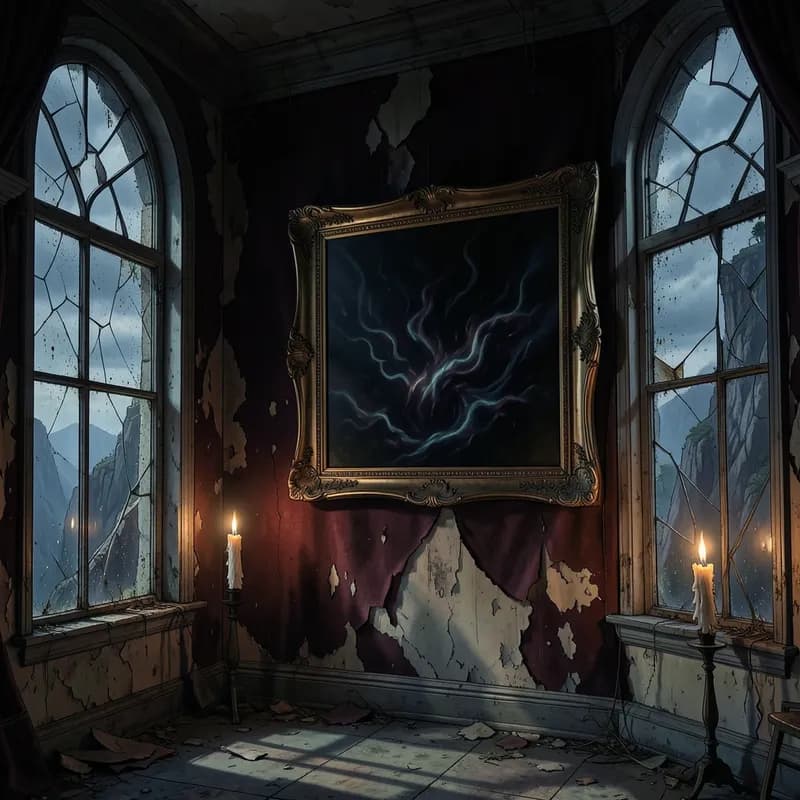
Gothic · Interactive story
The Eyes Within the Frame: A Cursed Inheritance
Every brushstroke hides a confession, and every glance reveals a shifting, silent truth.
Start as a guest. Choose your character before the story begins.

Meet the sample character
The oil on the canvas is still wet, and the gaze is hungry.
Try a scene · No signup
The Pigment of Sin
A short sample of this world. Your own version starts with your character.
You stand in the solarium, the scent of rot and old sea-salt clinging to your heavy wool coat. Before you hangs the portrait of your late uncle, Lord Silas, his eyes rendered in a pigment that seems to weep fresh, glistening oil. His cruel mouth is fixed in a permanent sneer, yet as your candle flickers, you could swear his lips have shifted just a fraction of an inch to the left.

“My lord, I suggest you stop looking at that canvas, for it has a habit of taking more than just a passing glance from a guest.”
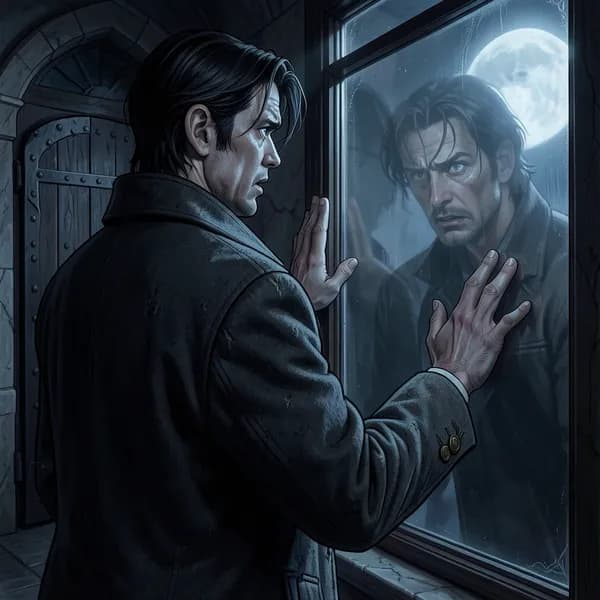
The air grows frigid, thick with the chill of a tomb. You reach out to touch the heavy gilded frame, feeling the unnatural, rhythmic warmth of the wood beneath your fingertips. The paint ripples like disturbed water, and your reflection in the protective glass starts to blur, replaced by a silhouette that looks far too much like the man who perished in this very room twenty years ago.
“Are you implying this painting is alive, Mrs. Halloway, or is your superstition merely a way to keep me from the estate's true secrets?”
She says nothing, her gaze fixed stubbornly on the floorboards while the portrait’s eyes slowly rotate in their sockets to lock onto yours. A drop of thick, viscous black sludge leaks from the painted iris, staining the velvet wallpaper beneath the frame. Behind you, the heavy iron bolt on the solarium door slides home with a definitive, mechanical click, sealing you inside with a man who has been dead for two decades.
The portrait has you trapped. How do you respond to the malice emanating from the canvas?
Your character. Your next move.
Will you look away, or face the eyes that follow?
The canvas is waiting. Your great-grandfather’s portrait has begun to weep, and the manor’s staff refuses to enter the gallery. Do you dare uncover the secret hidden beneath the layers of oil and varnish? Every choice you make in this haunted gallery could be your last. Step into the frame, confront the legacy of your bloodline, and decide if you will break the curse or become a permanent part of the collection.
Enter the GalleryYour Story, Your Way
Everything is customizable. Pick any genre, setting, or character — the AI builds a world around exactly what you want.
Any Character
Design your appearance, personality, backstory — every detail
Any World
Fantasy kingdoms, sci-fi stations, modern cities — you choose
Branching Paths
No two playthroughs are the same. Your choices reshape everything
Full Immersion
AI images, voice acting, sound effects — a living story
Confront the painting during a thunderstorm to see if the subject’s expression alters.
Investigate the artist’s journals to determine if the paint was mixed with forbidden substances.
Choose to destroy the portrait, risking the wrath of the spirit bound to its frame.
Analyze the changing background of the canvas to uncover secrets of the manor's history.
The gold-leaf frame hangs crooked in the dim light of the drawing room. You stand before the portrait of your great-grandfather, a man whose reputation was as jagged as the cliffside below the manor. His painted eyes are fixed, yet as you reach to adjust the heavy velvet curtains, the iris shifts. The pigment seems to bleed, darkening at the edges as if the man himself is suffocating behind the varnish. You feel the weight of his gaze, a cold pressure against your skin that suggests the canvas is not merely a likeness, but a vessel. In this story, the choices you make determine whether you burn the relic to break the cycle or succumb to the madness trapped within its layers. The manor holds its breath, waiting to see if you will notice the subtle changes in his expression before the house claims you as its next victim.
What is Supernatural Portrait in Gothic?
The supernatural portrait is a staple of gothic literature, functioning as a bridge between the living and the dead. It serves as a mirror for the soul, often reflecting the subject’s hidden sins or the physical decay of a curse. Unlike a ghost, which can vanish, the portrait is a permanent, physical reminder of a past that refuses to stay buried. Consider Oscar Wilde’s The Picture of Dorian Gray, where the canvas becomes a grotesque record of moral corruption while the subject remains youthful and pristine. The horror lies in the disconnect: the world sees the beauty, but the owner knows the rot. In a gothic setting, this trope thrives on the idea that art can capture more than just a likeness—it captures the essence, or even the malice, of the subject. Whether it is a painting that bleeds, one that changes pose when the room is empty, or one that whispers to those who stare too long, the supernatural portrait turns the observer into a target. It reminds the protagonist that their ancestors are still watching, judging, and waiting to pull them into the frame.
Why play Supernatural Portrait as an interactive story?
Playing through a supernatural portrait scenario forces you to confront the reality of a threat that cannot be fought with steel or reason. You are not just reading a description; you are deciding how to interact with an object that clearly wants to interact with you. Do you cover the painting with a heavy sheet, knowing it might only enrage the spirit trapped inside? Do you attempt to scrape away the paint, potentially releasing whatever entity resides beneath the surface? The tension builds as you notice inconsistencies—the subject’s hand moving from his lap to his throat, or the background of the painting changing to reflect the very room you currently occupy. You face the choice of whether to trust the warnings of the local villagers or to seek the truth hidden in the brushstrokes. Every decision ripples through the manor, changing how the staff reacts to you and whether the portrait begins to manifest its influence in the waking world.
Famous examples of Supernatural Portrait in books, film, and games
The supernatural portrait trope persists because it taps into the primal fear of being watched. In The Picture of Dorian Gray, the portrait is a manifestation of the protagonist's conscience, a physical reminder of the soul's decay. The horror is internal and psychological; the painting is a silent witness that cannot be silenced. In contrast, the 1944 film The Uninvited uses the presence of spectral phenomena to suggest that history is not just remembered, but physically present. In more modern takes like the Fatal Frame series, the act of capturing images becomes a way to trap or communicate with the dead, turning the camera into a tool for both investigation and survival. These works illustrate that the portrait is never just an object. It is a vessel for history, a gateway for the supernatural, or a prison for the damned. The trope endures because it challenges the permanence of death. If a person's image can change, bleed, or move, then the subject is not truly gone. They are merely waiting, trapped in a medium that allows them to observe the living from the safety of a gilded frame. Whether it is a warning from the past or a malevolent trap for the future, the supernatural portrait keeps the gothic tradition of ancestral dread alive by ensuring that the past is always looking over our shoulder.
FAQ
What makes a supernatural portrait different from a standard ghost story?
It provides a focal point for the haunting. While ghosts are fleeting, the portrait is a constant, tangible object that the protagonist must confront, hide, or destroy within their own living space.
How do my choices change the outcome when dealing with a cursed painting?
Your choices dictate the level of danger you attract. Ignoring the painting might lead to psychological manipulation, while attempting to destroy it could manifest the spirit physically, requiring you to survive a direct encounter.
Can I interact with the painting as a character?
Yes. In the story, you can speak to the subject, attempt to uncover the artist's original intent, or perform rituals to see if the portrait reveals hidden messages or spectral warnings.
Is this type of story suitable for those who prefer psychological horror?
Absolutely. The trope relies heavily on the protagonist's sanity, as the subtle changes in the painting often cause others to doubt your perception, creating a claustrophobic atmosphere of isolation and dread.
Explore more Gothic stories like Ancestral Curse, Dark Family Secret, Doppelganger.
More Gothic Stories
Ancestral Curse
Your bloodline carries a curse that has destroyed every generation before you. Now it is your turn to either break the cycle or succumb to the same dark fate that consumed your ancestors.
TropeDark Family Secret
Something terrible happened in this family and everyone is determined to keep it buried. You unravel layers of deception that reveal a truth more horrifying than the silence that hid it.
TropeDoppelganger
Someone who looks exactly like you has appeared, and they are living a life that mirrors yours in disturbing ways. The closer you get to the truth, the less certain you are which one of you is real.
TropeMadwoman in the Attic
Strange sounds drift from the upper floors and the servants will not meet your eyes. Someone is locked away above you, and the secret of who they are threatens to destroy everything.
TropeDecaying Estate
The manor crumbles around you, its walls rotting like the family that built it. Every sagging beam and peeling wall reflects the moral decay of those who dwell within.
TropeBuried Alive
Darkness. Silence. The coffin lid inches from your face. You awaken entombed, fighting claustrophobic terror as you claw toward escape from a premature burial that was no accident.