
Horror / Thriller · Interactive story
The Portrait Rots: A Dorian Gray Thriller
How much of your soul are you willing to trade for eternal beauty?
Start as a guest. Choose your character before the story begins.
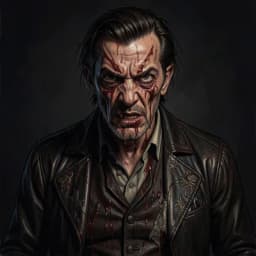
Meet the sample character
Some secrets have a heartbeat.
Try a scene · No signup
The Portrait's Hunger
A short sample of this world. Your own version starts with your character.
You stand in the dim light of the attic, the air thick with the scent of turpentine and something sharp, like old copper. Dust motes swirl around the heavy velvet shroud covering the easel. The floorboards groan under your boots, a protest against your intrusion. The silence here is heavy, vibrating with a low, rhythmic hum that seems to emanate from the portrait itself.

“Do not touch the frame, Arthur. Curiosity is a dull blade, and it cuts the hand that holds it.”

Dorian’s shadow stretches long and jagged across the peeling wallpaper, his silhouette unnaturally still. You feel his gaze boring into the back of your skull, a cold weight that makes your skin crawl. You reach out, your fingers trembling as they brush the edge of the heavy, moth-eaten fabric. The texture is coarse, damp, and unnervingly warm to the touch.
“I have seen the way your eyes wander when you look at this wall, Dorian. It is not vanity. It is terror.”
The shroud slips an inch, revealing a sliver of oiled canvas. A wet, tearing sound echoes through the room, like leather dragging across rotted wood. You realize the painting isn't just observing you; it is actively feeding. Something pulses from within the frame—a heartbeat that isn't yours. The door behind you has clicked shut, and the temperature in the room is plummeting toward freezing.
The fabric pulls taut under your grip. Do you keep tearing it away or pull back before the canvas sees your own soul?
Your character. Your next move.
The canvas is waiting for your next sin.
You are running out of time to hide the evidence. Every social engagement risks exposing the truth hidden in your attic. Will you continue to indulge in your darkest impulses, or will the weight of the portrait finally break you? Step into the frame and see if you can escape the judgment of your own reflection.
Begin your descent nowYour Story, Your Way
Everything is customizable. Pick any genre, setting, or character — the AI builds a world around exactly what you want.
Any Character
Design your appearance, personality, backstory — every detail
Any World
Fantasy kingdoms, sci-fi stations, modern cities — you choose
Branching Paths
No two playthroughs are the same. Your choices reshape everything
Full Immersion
AI images, voice acting, sound effects — a living story
Decide whether to conceal your crimes or flaunt your corruption before high society.
Choose which secrets to bury behind the locked door of the attic gallery.
Manipulate your companions to protect your image while the portrait withers away.
Confront the physical manifestation of your sins in high-stakes psychological encounters.
The gold-leaf frame hangs heavy in your attic, draped in a rotting velvet shroud. You catch a glimpse of the canvas—the paint is weeping, the eyes are hollow, and the skin is puckered with the scars of crimes you have yet to commit. Downstairs, your reflection in the mirror remains smooth, unblemished, and terrifyingly young. You are the architect of your own ruin. In this interactive story, the choices you make ripple through the canvas, turning every act of cruelty into a permanent, festering stroke of oil and pigment. Will you hide the painting, or will you burn it to silence the screams? Every decision dictates the final state of your soul.
What is Dorian Gray in Horror / Thriller?
Dorian Gray is the central figure of Oscar Wilde’s 1890 masterpiece, The Picture of Dorian Gray. He is a man who trades his conscience for everlasting youth, leaving his portrait to bear the physical burden of his moral decay. While Wilde presented this as a philosophical novel, the horror lies in the disconnect between the man in the mirror and the monster on the canvas. It is the ultimate psychological thriller, where the protagonist’s narcissism becomes a weapon of mass destruction. We see this archetype echoed in modern media—from the supernatural tension in the television series Penny Dreadful to the dark, aesthetic obsession seen in the 2009 Dorian film adaptation. It is a cautionary tale about the high cost of vanity, where the antagonist is not a ghost in the hallway, but the reflection of your own hidden depravity. By shifting the focus to interactive horror, the character becomes a vessel for the player to explore the consequences of a life without moral accountability.
Why play Dorian Gray as an interactive story?
Playing as Dorian Gray is not about avoiding the inevitable; it is about choosing how you descend into madness. You face moments that test your resolve: do you manipulate your closest allies for social gain, or do you attempt to repent before the canvas becomes unrecognizable? Each choice forces you to reconcile your external perfection with the mounting evidence of your corruption. Will you ignore the whispers of your conscience, or will you confront the painting during a moment of weakness? Tension mounts as you realize the portrait is more than just a painting; it is a living, breathing record of every secret. Your agency dictates the speed of the decay—will you die as a hollow shell of a man, or will you find a way to shatter the curse before the final stroke?
The literary legacy of Dorian Gray
Oscar Wilde’s The Picture of Dorian Gray remains a pillar of Gothic literature, exploring the duality of human nature through the lens of aestheticism. Published in Lippincott's Monthly Magazine, the novel shocked Victorian audiences with its blatant disregard for morality and its preoccupation with hedonism. The character of Dorian Gray has evolved far beyond his original pages, appearing in reinterpretations like The League of Extraordinary Gentlemen and various stage productions that emphasize the terrifying slow-burn horror of his transformation. Modern interpretations often lean harder into the thriller aspect, focusing on the paranoia that comes with living a double life. The enduring power of the story lies in the question it poses: if your sins were visible to everyone, would you still be the same person? It works today because the obsession with status and appearance is amplified by our own digital age, where everyone curates a version of themselves for the world to see, often hiding the reality behind a digital veil. By engaging with this narrative, you aren't just reading a story—you are stepping into a centuries-old debate about vanity and the price of a life lived for pleasure alone.
FAQ
Can I change the outcome of the story?
Yes, every decision influences your moral trajectory, your social standing, and the final state of the portrait hidden in your attic.
Is this story based on the original book?
It draws directly from the themes, atmosphere, and characters of Oscar Wilde’s novel, reimagined as an interactive horror experience.
What makes this a thriller?
The constant threat of being exposed and the psychological pressure of watching your own soul rot in real-time creates a relentless sense of dread.
Do I need to know the book to play?
No, the narrative is built to stand on its own while providing a deep, satisfying experience for those familiar with the source material.
Explore more Horror / Thriller stories like Haunted House, Survival Horror, Psychological Thriller.
More Horror / Thriller Stories
Haunted House
The house has been waiting for you. Explore rooms that should not exist, hear voices that should not speak, and decide whether to flee or uncover the truth.
TropeSurvival Horror
Resources are scarce and something is hunting you. Every bullet, every hiding spot, every ally could mean the difference between survival and a gruesome end.
TropePsychological Thriller
Trust no one, not even yourself. Reality bends and paranoia mounts as you navigate a story where the greatest threat might be inside your own mind.
TropeFinal Girl
Friends are dropping one by one and you might be next. Outsmart the killer, make impossible choices, and fight to be the last one standing.
TropeEldritch Horror
Some knowledge was never meant for mortal minds. Encounter cosmic horrors beyond comprehension and decide how much sanity you are willing to sacrifice for the truth.
TropeDemonic Possession
Something ancient and malevolent has taken hold of someone you care about. You must decide whether to fight the demon, bargain with it, or risk losing everything to save a soul.