
Zombie · Interactive story
The Zombie Whisperer: Command the Dead or Face the Horde
The dead obey your command, but the living want you dead for it.
Start as a guest. Choose your character before the story begins.
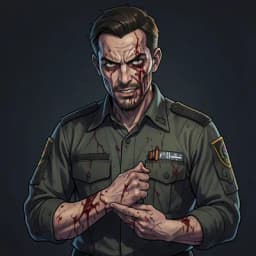
Meet the sample character
They don't hunt you. They listen.
Try a scene · No signup
The Pulse in the Rot
A short sample of this world. Your own version starts with your character.
You stand in the shadow of the cooling towers, the grit of decayed concrete grinding under your boots. A dozen corpses drift toward the perimeter fence, their moans rhythmic and hollow. You raise a hand, palm open, and the frantic clawing at the chain-link fence dies into a shuddering silence.

“Stop it, Silas. Put your hand down before the rest of the group sees you singing to them.”

Mara’s knuckles are white where she grips her rifle. She thinks you are controlling them like puppets, but it feels more like tuning a radio. You sense the static in their hunger—a vibrating frequency that makes your own teeth ache and the bite mark on your arm pulse with warmth.
“They aren't hunting right now, Mara. They are waiting for the vibration at the front gate to stop.”
A heavy, metallic thud echoes from the main supply entrance. The swarm snaps their heads toward the sound, a synchronized movement that sends a cold shiver down your spine. They begin to turn away from you, drawn by the sound of the trapped survivors screaming on the other side of the razor wire. The herd is moving, and you are the only one who can steer them.
The herd is beginning to surge toward the screaming survivors. How do you intervene?
Your character. Your next move.
The gates are failing. Will you command the horde?
The fence is buckling under the weight of a thousand rotting bodies. Your group is terrified, their ammunition running low. You stand at the edge of the perimeter, the only one who can stop the slaughter—but to do it, they have to see what you really are. Make the choice that defines your survival.
Start Your Survival StoryYour Story, Your Way
Everything is customizable. Pick any genre, setting, or character — the AI builds a world around exactly what you want.
Any Character
Design your appearance, personality, backstory — every detail
Any World
Fantasy kingdoms, sci-fi stations, modern cities — you choose
Branching Paths
No two playthroughs are the same. Your choices reshape everything
Full Immersion
AI images, voice acting, sound effects — a living story
Use subtle body language to divert a massive horde away from a defenseless camp.
Choose whether to reveal your unique connection to the dead to skeptical, armed survivors.
Manipulate individual zombies to act as silent scouts for your scavenging missions.
Decide if you will lead the undead to eliminate threats or keep them dormant.
The scent of ozone and rotting meat clings to your clothes. Around you, the restless dead shuffle through the debris of a collapsed highway, their slack jaws clicking in a rhythm only you seem to understand. You don't run. You don't hide. When a gray-skinned creature lunges, you don't raise your rifle; you tilt your head, shifting your weight in a way that makes the monster pause, its milky eyes blinking as it retreats into the shadows. Others in your survivor camp watch from the treeline, their fingers white-knuckled on their triggers. They don't know if you are a savior or a ticking time bomb waiting to bring the horde to their doorstep. In this interactive story, your choices dictate whether you remain a solitary pariah or the architect of a new, blood-soaked order. Every decision forces a trade-off between human morality and the cold, unyielding logic of the dead.
What is The Zombie Whisperer in Zombie?
The Zombie Whisperer is a character archetype that subverts the traditional terror of the undead. While most survivors view zombies as mindless obstacles, the Whisperer treats them as a language, a pattern, or a tool. This archetype appears in various forms across horror media, most notably with the 'Whisperers' in The Walking Dead, who wear the skins of the dead to walk among them, or Big Daddy from George A. Romero’s Land of the Dead, who exhibits the first flickers of organized intelligence. Unlike the typical protagonist who relies solely on ammunition and barricades, the Whisperer utilizes a psychological or supernatural connection to the undead. This power often alienates the Whisperer from other survivors. It creates a tension where the protagonist is caught between two worlds: the warmth of humanity, which is fragile and prone to panic, and the cold, predictable void of the undead, which offers a strange, terrifying security. To play as this archetype is to constantly manage the suspicion of your peers while testing the limits of your influence over the walking corpses that haunt the ruins of civilization.
Why play The Zombie Whisperer as an interactive story?
Playing as the Whisperer shifts the genre from a frantic run-and-gun survival game to a calculated game of influence and deception. You aren't just fighting for calories and clean water; you are fighting to maintain your humanity while possessing a talent that feels inherently monstrous to everyone else. The narrative forces you to balance your loyalty to the remaining human settlements against the temptation of using the horde to clear your path. Will you risk revealing your ability to save a group of refugees, knowing they might exile you the moment they realize what you are? Every encounter is a puzzle: do you distract a swarm to protect your supplies, or do you guide them toward a rival faction's camp? The agency you hold allows you to decide if your gift is a weapon to be used for the greater good, or a dark secret that will eventually consume you.
The psychology of The Zombie Whisperer: why readers fall for this character
The appeal of the Zombie Whisperer lies in the ultimate fantasy of control in a chaotic, uncaring environment. In a typical apocalypse, the protagonist is subject to the whims of a decaying world—starvation, disease, and the unpredictable violence of other humans. The Whisperer, however, gains agency by understanding the very thing that destroyed society. This resonates because it transforms the source of fear into a source of power. Characters like R from the film Warm Bodies showcase the empathic side of this archetype, where the connection to the dead is a path toward healing and reclaiming lost humanity. Conversely, figures like Alpha from The Walking Dead represent the darker, cultish manipulation of the undead to enforce a brutal, new social order. The Whisperer embodies the fear of the 'other.' Because they can communicate with or influence the monsters, they are never fully trusted by the living. This isolation provides a rich narrative ground for exploring themes of sacrifice and identity. Readers are drawn to this archetype because it challenges the binary of 'good survivor' versus 'evil monster.' When you step into the role of the Whisperer, you are forced to ask: if you can control the monsters, does that make you a protector, or do you become the biggest monster of all?
FAQ
Can I control every zombie I encounter?
Not necessarily. Your influence depends on your character's current energy, the surrounding environment, and the state of the undead. Some hordes are too feral to be swayed, and pushing too hard can attract unwanted attention from both the living and the dead.
Will other survivors turn on me?
Trust is a scarce resource in the apocalypse. If you use your abilities openly, you risk being branded a traitor or a freak. You must decide whether to hide your nature to build alliances or show your power to gain leverage, even at the cost of being feared.
Does this story focus more on combat or strategy?
The experience emphasizes tactical decision-making. While combat happens, your primary survival tool is your ability to manipulate the environment and the undead. Success often comes from avoiding direct fights entirely by redirecting the threat.
What happens if I lose control of the horde?
Loss of control usually leads to catastrophic consequences. If a lure fails or a horde turns on you, you'll have to rely on your wits and whatever supplies you've managed to scavenge to escape the chaos you inadvertently created.
Explore more Zombie stories like Zombie Outbreak Day Zero, Safe Zone Search, Zombie Horde Siege.
More Zombie Stories
Zombie Outbreak Day Zero
The first reports are hitting the news and nobody believes them yet. You witness the initial chaos firsthand and must decide whether to warn others, stockpile supplies, or run before the city falls.
TropeSafe Zone Search
Rumor has it there is a safe zone still standing, but the road there is crawling with the undead. You must navigate hostile territory, decide who to trust, and find sanctuary before your supplies run out.
TropeZombie Horde Siege
They are pressing against every barricade and your defenses are crumbling. You must rally your group, ration ammunition, and make brutal sacrifices to survive the night.
TropeCure Quest
A scientist claims there is a cure hidden in a facility overrun with the undead. You must brave impossible odds, gather the components, and decide whether the cost of saving humanity is worth paying.
TropeZombie Evolution
These are not the shambling corpses you expected. The undead are evolving, learning, and adapting to your defenses. You must stay one step ahead of a threat that grows smarter with every passing day.
TropeFast vs Slow Zombies
Some shuffle and some sprint. You are caught between two terrifying variants of the undead, each demanding a different survival strategy. One wrong assumption about what is chasing you could be your last.