
Zombie · Interactive story
Command in the Aftermath: The Burden of the Living
When the world ends, someone has to hold the line. Will it be you?
Start as a guest. Choose your character before the story begins.
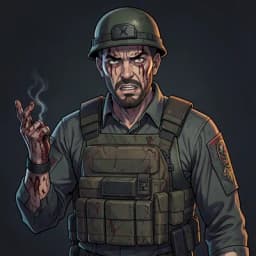
Meet the sample character
Leadership is a death sentence you sign every morning.
Try a scene · No signup
The Perimeter's Cost
A short sample of this world. Your own version starts with your character.
Your boots crunch on broken glass as you pace the perimeter. The sun is sinking, turning the sky the color of a fresh bruise. Your group is huddled inside the main building, their faces gaunt, waiting for you to tell them if they'll see another sunrise. You count the bullets in your magazine—four left. Not enough to fend off a swarm, but enough to finish a problem if one arises.

“Arthur, the kids haven't had a full meal in two days. If we don't hit that supply truck stalled on the overpass, we aren't going to have the energy to hold the gate tomorrow.”

You look toward the overpass. The truck is exposed, a death trap sitting in the middle of the open road. The shadows are lengthening, and you can hear the shuffle of rotting feet against the pavement coming from the woods. Every choice you make here decides who sleeps safely and who becomes a casualty. The weight of their expectant eyes burns into your back.
“We aren't scavengers, Sarah. We're a defensive unit. If we move now, we lose our cover. Stay inside and keep the lights dark.”
Before Sarah can argue, a sharp metallic clang echoes from the back gate—someone triggered a snare. You spin around, heart hammering against your ribs. Through the gaps in the corrugated steel, you see a massive shape pressing against the fence, buckling the metal. The perimeter is failing, and you have seconds to decide how to respond to the breach.
The fence is buckling under the weight of the encroaching horde. How do you hold the line?
Your character. Your next move.
The group is waiting for your orders.
Your supplies are low, the perimeter is failing, and someone needs to decide if you stay or run. The fate of your survivors rests on your shoulders. Step into the role of the commander and see if you have the resolve to survive the night.
Assume Command NowYour Story, Your Way
Everything is customizable. Pick any genre, setting, or character — the AI builds a world around exactly what you want.
Any Character
Design your appearance, personality, backstory — every detail
Any World
Fantasy kingdoms, sci-fi stations, modern cities — you choose
Branching Paths
No two playthroughs are the same. Your choices reshape everything
Full Immersion
AI images, voice acting, sound effects — a living story
Assign daily tasks to survivors to balance scavenging, fortification, and medical care duties.
Judge internal conflicts and decide the fate of members who threaten the group safety.
Manage dwindling resource stockpiles and decide who receives priority for limited life-saving supplies.
Command tactical maneuvers during zombie breaches, deciding which exits to hold and which to abandon.
The radio static finally died, replaced by the guttural moans echoing from the street. Behind the barricaded doors of the community center, fourteen survivors watch your hands, waiting for a signal. Your supplies are down to three cans of beans and a half-empty water jug. A decision hangs in the air: push toward the coast tonight or fortify this deathtrap for another week. Every choice you make ripples outward, deciding who eats, who guards the perimeter, and who might not see the sun rise tomorrow. You are the only thing standing between your group and total collapse.
What is The Natural Leader in Zombie?
The Natural Leader archetype appears when social structures shatter. In the context of a zombie apocalypse, this character is the person who stops the panic and starts the planning. They are not necessarily the strongest fighter or the best shot; they are the individual who accepts the crushing responsibility of keeping others breathing. Think of Rick Grimes in The Walking Dead or Lee Everett in Telltale's The Walking Dead game. These characters are defined by their ability to maintain order when everything else is chaos. They prioritize the survival of the group over their own comfort, often at a heavy personal cost. They are the ones who decide which road to take, who gets the last of the antibiotics, and who has to be left behind when the barricades break. This archetype is about the psychology of command under extreme pressure, where one wrong word can fracture a team and lead to disaster.
Why play The Natural Leader as an interactive story?
Playing as a leader adds a layer of tactical tension that changes how you approach every scenario. You are not just managing your own survival; you are managing the lives of everyone under your authority. If you fail to delegate tasks or miscalculate your rations, you will see the physical consequences in the morale and health of your companions. You will face moments where you must choose between staying moral or staying alive. Will you execute a traitor to keep the peace, or gamble on redemption and risk the safety of the entire group? These decisions are not binary; they are complex calculations where any outcome leaves a scar. Agency matters here because you feel the weight of every casualty. When a survivor dies because you ordered a risky supply run, it is your leadership that is put on trial.
The psychology of The Natural Leader: why readers fall for this character
The Natural Leader archetype taps into the human desire for order during catastrophe. We look to these characters because they offer a fantasy of competence. In a world where the laws of society have evaporated, the leader provides a new framework for existence. Readers are drawn to this role because it forces them to confront the conflict between duty and morality. Consider characters like Sarah Connor or Joel Miller from The Last of Us. They do not lead through charisma alone; they lead through a grim, unwavering commitment to a singular goal. Their appeal lies in their transformation from ordinary people into hardened protectors. The fantasy is not about power; it is about the burden of choice. When you inhabit this role, you are forced to ask yourself: what is the price of keeping your humanity in a world that has lost its own? The thrill comes from the realization that you are the only one capable of making the hard calls. You are the shield, the strategist, and the final arbiter of life and death. The archetype thrives because it puts the reader in the driver’s seat of a morality play where the consequences of failure are final.
FAQ
How does the leadership mechanic influence the story?
Leadership mechanics track your group's morale and trust. High trust allows for easier decision-making, but low morale can lead to mutiny, desertion, or internal sabotage. Your choices dictate the loyalty of your survivors.
Can I choose to be a ruthless leader?
Yes. You can prioritize pure survival, sacrificing individuals for the greater good. However, being ruthless may make you more efficient but can isolate you from your group, potentially leading to a solitary or tragic end.
What happens if a survivor I am leading dies?
Each death impacts the group’s capability and your own narrative trajectory. Losing a medic makes future wounds harder to treat, while losing a guard makes your base more vulnerable to future zombie swarms.
Is this story focused on combat or strategy?
It is a blend of both. While you will face combat encounters, the strategy of resource management and interpersonal relationships is what determines your long-term success in the apocalypse.
Explore more Zombie stories like Zombie Outbreak Day Zero, Safe Zone Search, Zombie Horde Siege.
More Zombie Stories
Zombie Outbreak Day Zero
The first reports are hitting the news and nobody believes them yet. You witness the initial chaos firsthand and must decide whether to warn others, stockpile supplies, or run before the city falls.
TropeSafe Zone Search
Rumor has it there is a safe zone still standing, but the road there is crawling with the undead. You must navigate hostile territory, decide who to trust, and find sanctuary before your supplies run out.
TropeZombie Horde Siege
They are pressing against every barricade and your defenses are crumbling. You must rally your group, ration ammunition, and make brutal sacrifices to survive the night.
TropeCure Quest
A scientist claims there is a cure hidden in a facility overrun with the undead. You must brave impossible odds, gather the components, and decide whether the cost of saving humanity is worth paying.
TropeZombie Evolution
These are not the shambling corpses you expected. The undead are evolving, learning, and adapting to your defenses. You must stay one step ahead of a threat that grows smarter with every passing day.
TropeFast vs Slow Zombies
Some shuffle and some sprint. You are caught between two terrifying variants of the undead, each demanding a different survival strategy. One wrong assumption about what is chasing you could be your last.