
Zombie · Interactive story
Lessons in Survival: The School as a Last Stand
The final bell rang hours ago. Now, you hold the barricade against the starving horde.
Start as a guest. Choose your character before the story begins.
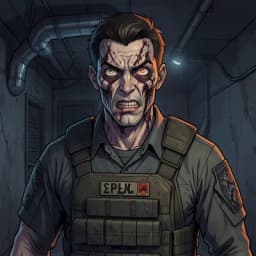
Meet the sample character
The gymnasium walls are thinner than they look.
Try a scene · No signup
Final Bell at Lincoln High
A short sample of this world. Your own version starts with your character.
You wedge a rusted metal desk against the gymnasium double doors, your palms raw and bloodied from the effort. The smell of stale gym socks and copper blood hangs heavy in the stagnant air. Outside, the rhythmic thud of rotting fists against the reinforced glass shatters the fragile quiet of the hallways.

“Marcus, stop moving! You're just drawing them closer to the hinges; we need to be silent.”

You ignore her, feeling the cold steel of the door frame vibrate against your spine. The chain-link fence separating the basketball court from the bleachers is already straining under the weight of the refugees huddled inside. You haven't slept in thirty-two hours, and the tremor in your hands is becoming impossible to hide.
“If we stay quiet, they'll just keep banging until the glass gives way. We need to clear the stairwell or this roof becomes a tomb for everyone in here.”
A crack echoes through the gym, sharp as a gunshot. A spiderweb fracture blooms across the tempered glass of the exit door, and the first gray, bloated finger pushes through the gap. You have seconds before the seal fails completely, and the families behind you are already starting to wail.
The glass is failing. How do you handle the immediate breach?
Your character. Your next move.
The horde is at the doors. Will you survive?
The bell has stopped, but the screaming has just begun. You have a handful of survivors, a few desks, and a growing hoard outside the gymnasium. Every choice you make—from who guards the perimeter to what supplies you prioritize—will determine if you make it to morning. Start your story now and see if you have the tactical edge to turn this school into a sanctuary.
Begin Your Survival StoryYour Story, Your Way
Everything is customizable. Pick any genre, setting, or character — the AI builds a world around exactly what you want.
Any Character
Design your appearance, personality, backstory — every detail
Any World
Fantasy kingdoms, sci-fi stations, modern cities — you choose
Branching Paths
No two playthroughs are the same. Your choices reshape everything
Full Immersion
AI images, voice acting, sound effects — a living story
Allocate limited rations between the injured and the able-bodied to maintain group stability.
Choose which wings of the school to fortify and which to abandon to the horde.
Manage interpersonal conflicts between survivors who disagree on your leadership and tactical direction.
Scavenge for specialized equipment in dangerous areas like the chemistry lab or boiler room.
The smell of floor wax and stale air hangs heavy in the hallway, now tainted by the metallic tang of blood. Outside the reinforced double doors, hundreds of fingers scrape against the glass, a rhythmic, maddening sound that never stops. You are huddled in the library with thirty terrified students, a few panicked teachers, and a dwindling supply of vending machine snacks. The windows are boarded up with heavy wooden desks, and the silence inside is broken only by the whimpering of a child in the corner. You have to decide: do you send a team to the cafeteria for more supplies, or do you conserve your energy and hope for a rescue that may never come? This is an interactive story where every resource you claim and every person you protect depends entirely on your judgment. The hallways are narrow, the exits are few, and the dead are patient. If you make the wrong call, the school that was meant to be your fortress will quickly become your tomb.
What is School Turned Shelter in Zombie?
The school-as-shelter trope utilizes the juxtaposition of a place meant for learning and growth, now transformed into a claustrophobic cage. Schools are inherently defensible but structurally flawed; they possess heavy doors, long corridors that create natural kill zones, and massive cafeterias that offer food but require dangerous supply runs. In stories like the graphic novel series *Highschool of the Dead* or the intense sequences in *Dead Rising*, the setting forces characters to adapt to a tactical nightmare. You are not a soldier; you are a survivor managing a chaotic environment. A gymnasium becomes a refugee camp where interpersonal friction is as deadly as the infection outside. You must deal with the realities of sanitation, the psychological toll of confinement, and the physical degradation of your barricades. Unlike a remote cabin or a fortified bunker, a school is a public space. It carries the history of the people who were there before the collapse, making every ransacked classroom a reminder of what was lost. Understanding this setting requires recognizing that the building itself is a character—one that is slowly failing under the pressure of the siege.
Why play School Turned Shelter as an interactive story?
Agency changes everything when you are trapped. In a standard narrative, you watch characters make foolish mistakes; here, you bear the weight of those decisions. You will face dilemmas that test your morality against your survival instincts. If the science lab catches fire during a breach, do you prioritize saving the medical supplies or rescuing the students trapped in the biology wing? You must manage the group’s morale, which fluctuates based on your leadership and the scarcity of resources. Every choice regarding whether to reinforce the main entrance or clear the basement affects your long-term survival probability. The tension comes from the limited space; there is nowhere to run once a hallway is breached. You will feel the pressure of ticking clocks as you scramble to secure a perimeter before nightfall, knowing that the undead are attracted to the sounds of your frantic repairs. Your ability to delegate tasks among the survivors—assigning someone to watch the perimeter while others organize the pantry—is the difference between a functional camp and total collapse.
What makes School Turned Shelter work: the worldbuilding
The effectiveness of a school-based survival setting lies in the specific, tactile nature of the environment. Schools are built for controlled movement, which becomes a liability when the occupants are panicked and the threat is relentless. Authors and creators like those behind *All of Us Are Dead* understand that the horror comes from the familiarity of the setting being violated. The gymnasium, once a place of celebration, becomes a site of mass trauma. The lockers, designed for books, become potential traps or hiding spots. Sensory details are vital here: the screech of metal on linoleum, the smell of damp gym uniforms, and the flickering of outdated fluorescent lights. Conflict in this setting is naturally multi-layered. You have the external threat of the undead, but you also face internal friction caused by overcrowding and the loss of social hierarchy. The school setting strips away the pretense of authority; a principal’s title means nothing when the barricades are failing. Characters who would normally be ignored—the quiet student, the janitor with the keys, the athlete with the stamina—become essential assets. When building a narrative here, focus on the 'bottleneck' effect. Because schools are designed with long, straight corridors, they create natural tension points. You can hear the threat coming long before you see it, which adds a layer of dread that open-world survival stories often lack. Whether you are inspired by the gritty realism of *Night of the Living Dead* or the frantic pacing of modern zombie media, the key is to ensure the environment feels like a puzzle. You are not just fighting the undead; you are solving the architectural problems of a building that was never meant to withstand a siege. Success relies on your ability to map the space, identify its weakest points, and accept that you cannot save everyone.
FAQ
How does resource management work in a school setting?
Resource management involves tracking food, water, and medical supplies scavenged from the cafeteria, nurse's office, and vending machines. You must balance the needs of your group against the risk of sending survivors into dangerous, overrun hallways to find more gear.
Can I lose the story if my barricades fail?
Yes. If you fail to manage your fortifications or ignore the structural integrity of your shelter, the horde can breach the perimeter. Your decisions directly impact whether your group remains safe or is overrun by the undead.
What makes this different from other zombie survival games?
This experience focuses on the tactical reality of a single, defined location. Instead of wandering a map, you are tasked with turning a school into a fortress, emphasizing the physical constraints and psychological pressure of being trapped in one building.
Is this story setting appropriate for tactical gameplay?
Absolutely. The school layout provides specific tactical opportunities, such as using classrooms as chokepoints, utilizing the PA system to distract the undead, or creating escape routes through ventilation shafts or second-story windows.
Explore more Zombie stories like Zombie Outbreak Day Zero, Safe Zone Search, Zombie Horde Siege.
More Zombie Stories
Zombie Outbreak Day Zero
The first reports are hitting the news and nobody believes them yet. You witness the initial chaos firsthand and must decide whether to warn others, stockpile supplies, or run before the city falls.
TropeSafe Zone Search
Rumor has it there is a safe zone still standing, but the road there is crawling with the undead. You must navigate hostile territory, decide who to trust, and find sanctuary before your supplies run out.
TropeZombie Horde Siege
They are pressing against every barricade and your defenses are crumbling. You must rally your group, ration ammunition, and make brutal sacrifices to survive the night.
TropeCure Quest
A scientist claims there is a cure hidden in a facility overrun with the undead. You must brave impossible odds, gather the components, and decide whether the cost of saving humanity is worth paying.
TropeZombie Evolution
These are not the shambling corpses you expected. The undead are evolving, learning, and adapting to your defenses. You must stay one step ahead of a threat that grows smarter with every passing day.
TropeFast vs Slow Zombies
Some shuffle and some sprint. You are caught between two terrifying variants of the undead, each demanding a different survival strategy. One wrong assumption about what is chasing you could be your last.