
Zombie · Interactive story
Above the Horde: A Rooftop Survival Tale
The stairs are blocked, the dead are hungry, and your water supply is running dry.
Start as a guest. Choose your character before the story begins.

Meet the sample character
Thirst is a slower killer than the teeth below.
Try a scene · No signup
The Last Filtration
A short sample of this world. Your own version starts with your character.
You check the plastic bottle again. Empty. The wind whips grit into your eyes from the sun-scorched asphalt of the rooftop. Down in the street, the gray masses sway in a slow, rhythmic cycle of decay. Margo leans against the brick chimney, her fingernails caked with black grease, staring across the gap at the neighboring warehouse. The glint of a blue plastic barrel on the opposite roof mocks your thirst.
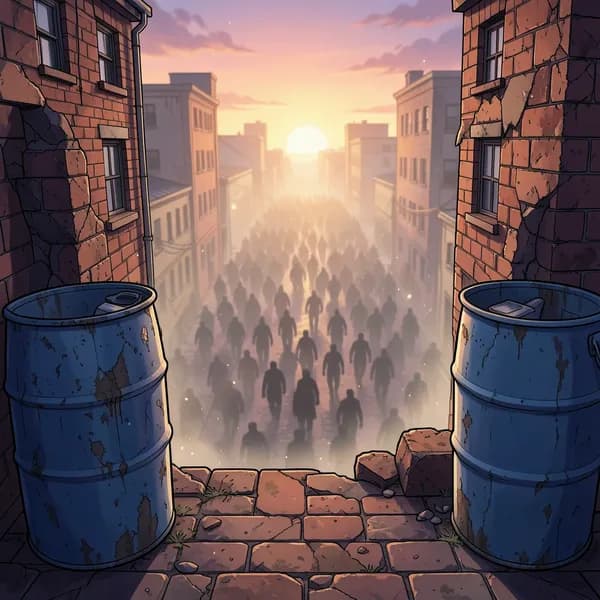
“If we don't grab that tank by sundown, we’re dead by morning. Those scavengers next door aren't just watching the rain.”
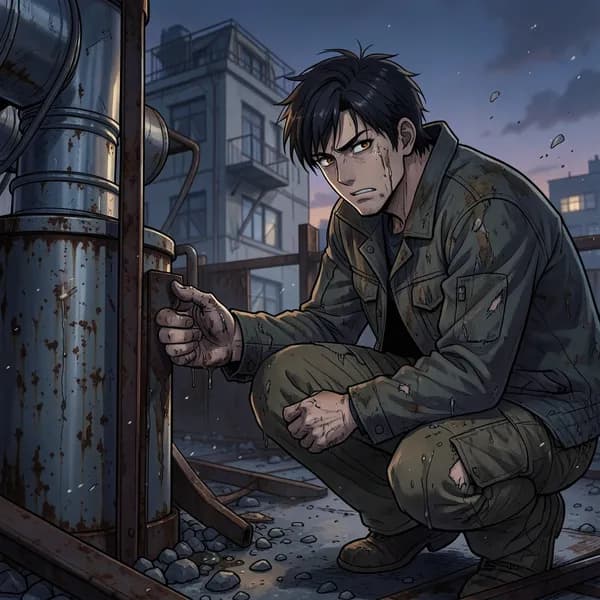
You crouch behind a pile of rusted HVAC ducting, the metal stinging your palms. The gap between your roof and theirs is six feet of lethal open air. Below that gap, the street is a churning sea of gray flesh, waiting for a single misstep. You have a climbing rope, but it is frayed. The sun is dipping behind the skyline, casting long, jagged shadows that turn the rooftops into a maze of potential graves.
“I am not jumping that gap for a barrel that might be tainted. We either bridge it or we wait until they sleep.”
You eye the rusted metal ladder lying near the edge. It is heavy, and dragging it will make enough noise to draw every walker within three blocks to the base of your building. If you do not act, the scavengers will empty the tank, and you will have nothing to trade for your survival. A low, wet rattling sound rises from the alleyway, signaling the horde is beginning their nightly ascent.
The scavengers are moving toward the water tank. How do you force their hand?
Your character. Your next move.
The sun is setting. Will you hold the roof?
Your water is gone, and you hear movement on the fire escape. The choice is yours: barricade the hatch and wait for morning, or take the leap to the next building in the dark. Your survival depends on the path you choose now.
Start Your Rooftop SurvivalYour Story, Your Way
Everything is customizable. Pick any genre, setting, or character — the AI builds a world around exactly what you want.
Any Character
Design your appearance, personality, backstory — every detail
Any World
Fantasy kingdoms, sci-fi stations, modern cities — you choose
Branching Paths
No two playthroughs are the same. Your choices reshape everything
Full Immersion
AI images, voice acting, sound effects — a living story
Decide whether to scavenge the building interior or risk the jump to neighboring roofs.
Manage dwindling supplies of clean water and firewood against the harsh elements.
Choose to signal distant survivors for help or remain silent to avoid unwanted attention.
Construct makeshift barricades to secure the fire escape and roof hatch from intruders.
The smell of rot rises with the midday heat, thick enough to taste. From here, the city is a silent, sprawling graveyard of glass and steel. You press your back against a rusted HVAC unit, clutching a crowbar until your knuckles turn white. Down on the street, the gray-skinned masses shuffle in aimless circles, their moans vibrating through the soles of your boots. You have a tarp, a bag of stale crackers, and a view of every movement in the neighborhood. In this interactive story, the terrain is your greatest asset and your most dangerous trap. Every decision you make—from how you reinforce the fire escape to whether you trust the signal fire burning on the building across the street—will determine if you remain the master of this concrete island or become just another casualty of the climb.
What is Rooftop Camp in Zombie?
A rooftop camp is the ultimate manifestation of vertical survival. It is a setting defined by the brutal trade-off between isolation and visibility. By climbing above the tide of the undead, you gain a clear line of sight and relative safety from the immediate threat of being bitten, but you sacrifice access to ground-level resources and mobility. In stories like the game Dying Light, the rooftop serves as a sanctuary where players master parkour to move between buildings, while in The Walking Dead, characters often find that a rooftop is only as secure as the barricade blocking the stairwell. The setting forces a specific rhythm of life: you are constantly looking down at the threat, calculating how long your supplies will last, and wondering if the neighbors in the adjacent high-rise are friends or scavengers looking to take your spot. It is a static, high-stakes environment where the weather, the lack of water, and the psychological weight of isolation are just as lethal as the creatures waiting below.
Why play Rooftop Camp as an interactive story?
Playing a rooftop camp scenario puts the burden of logistics squarely on your shoulders. You are not just fighting; you are managing a precarious existence. You will face choices that require cold, tactical calculation. Do you risk a dangerous jump to a neighboring roof to find a radio battery, or do you stay put and ration your last tin of peaches? When another survivor appears on the horizon, do you signal them to join your camp, or do you hide your presence to prevent a potential conflict over your limited space? These decisions create a tension that standard linear narratives cannot match. Because the environment is physically constrained, every move you make has immediate, visible consequences. If you fail to reinforce the hatch, you will hear the scratching against the metal as the sun goes down. If you choose to share your water, you will feel the pinch of hunger the next day. You are the architect of your own survival, and every mistake is etched into the skyline.
What makes Rooftop Camp work: the worldbuilding
The effectiveness of the rooftop camp setting lies in its inherent claustrophobia despite the open air. It creates a 'siege' mentality that drives character development. Writers and game designers use this setting to focus on the grit of survival—the dirt under the fingernails, the sound of wind whistling through broken glass, and the constant, dull roar of the undead below. In Max Brooks' World War Z, the verticality of urban survival is a recurring nightmare, emphasizing that height is a temporary reprieve, not a permanent solution. Similarly, in the film 28 Weeks Later, the struggle for control over secure zones highlights how quickly a sanctuary can turn into a prison. The setting thrives on sensory details: the blinding glare of the sun reflecting off city windows, the heat radiating from tar-covered roofs, and the terrifying silence of an empty street. Conflict in this setting is rarely about epic battles; it is about the quiet, agonizing erosion of hope. You are forced to interact with the environment in creative ways—tethering yourself to chimneys, creating water collection systems from salvaged plastic, and watching the horizon for threats. It is a test of patience and resourcefulness. By limiting the player’s geography, the story forces you to care about the small things: a single working flashlight, a handful of nails, or a clear view of the street below. When the world is reduced to the size of a roof, every choice takes on monumental significance.
FAQ
What makes the rooftop setting different from other zombie scenarios?
Most zombie stories focus on travel or large-scale fortifications. The rooftop camp focuses on vertical isolation. You are restricted to a small footprint, making resource management and structural security the primary drivers of your survival. You cannot run away easily; you must hold your ground.
Can I interact with other survivors in this setting?
Yes. Other survivors are a core component of the tension. You will encounter neighbors on adjacent buildings. You must decide if they are allies who can help you scavenge, or rivals who see your roof as a prize worth taking by force.
Does the weather affect my survival on the roof?
Absolutely. Without the protection of a building interior, you are exposed to the elements. Extreme heat, torrential rain, and freezing nights all impact your character's health and the condition of your supplies. You must plan for the weather just as much as the undead.
Is this story setting better for combat or exploration?
It is better for tactical survival. While combat occurs, the focus is on avoiding it through stealth, fortification, and clever resource gathering. Exploration is limited to nearby rooftops, turning every trip outside your camp into a high-risk gamble.
Explore more Zombie stories like Zombie Outbreak Day Zero, Safe Zone Search, Zombie Horde Siege.
More Zombie Stories
Zombie Outbreak Day Zero
The first reports are hitting the news and nobody believes them yet. You witness the initial chaos firsthand and must decide whether to warn others, stockpile supplies, or run before the city falls.
TropeSafe Zone Search
Rumor has it there is a safe zone still standing, but the road there is crawling with the undead. You must navigate hostile territory, decide who to trust, and find sanctuary before your supplies run out.
TropeZombie Horde Siege
They are pressing against every barricade and your defenses are crumbling. You must rally your group, ration ammunition, and make brutal sacrifices to survive the night.
TropeCure Quest
A scientist claims there is a cure hidden in a facility overrun with the undead. You must brave impossible odds, gather the components, and decide whether the cost of saving humanity is worth paying.
TropeZombie Evolution
These are not the shambling corpses you expected. The undead are evolving, learning, and adapting to your defenses. You must stay one step ahead of a threat that grows smarter with every passing day.
TropeFast vs Slow Zombies
Some shuffle and some sprint. You are caught between two terrifying variants of the undead, each demanding a different survival strategy. One wrong assumption about what is chasing you could be your last.